Showing posts with label Bootleg. Show all posts

Friday, 2 October 2026

Bob Dylan "Self Portrait" 1970**** vs. "The Bootleg Series Vol. 10: Another Self Portrait (1969–1971)" 2013(comp)****

“What is this shit?” Probably the most famous opening line for a record review, this was Greil Marcus' reaction to Dylan's Self Portrait LP. Music critics at the time treated it as an abomination, but I see it as a labor of love. We now know of his love for country, old-time folk, and crooner music — he made it evident in his long-running radio show, and even released a whole album of Sinatra covers in 2015. On that album, he opted for a smaller band; here, however, he was considerably more ambitious, covering almost all of the tracks with lush, sometimes even schmaltzy, orchestral arrangements, not unlike those Sinatra used. Back to the beginning of our story: during 1969 and 1970, in what seems like an attempt to decompress and experiment, Dylan entered the studio with a bunch of Nashville session players instead of a rock band. Rather than teaching them new songs, he looked for common ground, playing standards and contemporary hits. Some, like Paul Simon's "The Boxer", don't work at all. Gordon Lightfoot's "Early Mornin' Rain" does. He digs deep into roots music, resurrecting the Appalachian murder ballad "Little Sadie" twice, playing steamboat work songs like "Alberta" (also presented in two versions), and traditional tunes about making moonshine whiskey ("Copper Kettle") and the California gold-digging fever ("Days of '49"). "Belle Isle" is a traditional ballad of Irish origin, and "Gotta Travel On" is another old-time folk tune, initially popularized by one of Dylan's early idols, Pete Seeger. It's the kind of material Dylan tackled in his Village days, some of which he recorded for his 1961 debut. Yet he takes a completely different direction here. He used to play these songs solo, accompanying himself on guitar and harmonica. Now he's backed by some ace musicians — I especially love the piano, pedal steel and violin — and often tops it all off with intricate orchestral arrangements. The liberal use of female chorus vocals (think the Andrews Sisters) is another surprising element. It's a novel, but questionable, approach. Probably the strangest cover choice here is Rodgers and Hart's "Blue Moon". How audacious of him to tackle the Great American Songbook, songs that have been sung by some of the greatest voices in American music history! You know what, though? I like it, certainly better than Elvis' version. His singing is the smoothest we've ever heard him, without straining for notes beyond his range; the arrangement is sympathetic, and the short violin solo at the end is a bold but pleasant addition. Additionally, he treats us to professional-sounding Nashville-style renditions of the classic country songs "Take Me as I Am (Or Let Me Go)" and "I Forgot More Than You'll Ever Know", as well as the Everly Brothers' "Let It Be Me" and "Take a Message to Mary". Then there are a few blues tracks: the '40s standard "It Hurts Me Too", the impromptu jam "Woogie Boogie", and Dylan's original composition "Living the Blues". Until now, nothing sticks out, and nothing offends my sensibilities. And yes, I do know that plenty of people were offended — trust Dylan to do that. But these fans had a very narrow-minded view of American music, refusing to consider country and pre-rock'n'roll crooner music as having any value. Perversely scattered among the string-laden ballads and country tunes, Dylan also inserted some recent live recordings with The Band, made at the Isle of Wight festival in England — a momentous occasion. These include "Like a Rolling Stone", "Quinn the Eskimo (The Mighty Quinn)", "Minstrel Boy", and "She Belongs to Me". I believe this was the first time the fruits of that historic collaboration were officially released, yet people didn't pick on that. It doesn't matter that these performances don't improve on the originals; they're simply great complete reworkings of older material, with Garth Hudson's organ and Robertson's guitar at the fore. Last but not least, we have two heavily overdubbed songs, interesting and wholly un-typical of Dylan. Opener "All the Tired Horses" doesn't feature Dylan at all; it consists of two lines sung by a small female choir, repeated in a loop with lush orchestral backing. "Wigwam" has Dylan doing some wordless vocalizing backed by a mariachi-style band. It shouldn't work, but it's an infectious melody, at once nostalgic and feel-good. It was released as a single, and while it didn't crack the Top 40, it received a much better critical reception than its parent album. To summarize: yes, I get why this album received so many bad reviews at the time. It's not a masterpiece; it's overproduced, overlong, and seemingly incoherent. Importantly, it contains almost no new songs, while the public was accustomed to Dylan releasing a masterpiece of songcraft each year. But it resurrects folk classics ripe for reappraisal, features great performances by Dylan's musicians, and shows him attempting to sing in a different, more melodic manner. Removed from the zeitgeist, it makes for fine listening.

**** for Alberta #1, I Forgot More Than You'll Ever Know, Days of '49, Early Mornin' Rain, Living the Blues, Like a Rolling Stone, Gotta Travel On, Blue Moon, (Quinn the Eskimo) The Mighty Quinn, Take Me as I Am (Or Let Me Go), Take a Message to Mary, She Belongs to Me, Wigwam, Alberta #2

*** for All the Tired Horses, Let It Be Me, Little Sadie, Woogie Boogie, Belle Isle, Copper Kettle, It Hurts Me Too, Minstrel Boy

** for In Search of Little Sadie, The Boxer

Another Self Portrait isn't really an alternate version of Self Portrait so much as a selection of recordings from the broader period in which Self Portrait and New Morning emerged. Some of these recordings ended up on Self Portrait, some on New Morning, while others remained unreleased until they were unearthed for The Bootleg Series. Regarding the Self Portrait material, rather than simply offering alternate performances of songs we already know, the compilers have removed many of the overdubs, allowing us to hear the songs more or less as they emerged from the studios in Nashville (1969) and New York (1970). The effect is revealing. The traditional material now sounds more like folk songs are supposed to sound: the focus shifts from the arrangements to the performance and the words. I'm reminded of the Dylan of his Village days, though with a more relaxed, less reedy vocal and the support of first-rate session musicians. The exception is "In Search of Little Sadie", which is more theatrical, with Dylan almost ironically recounting rather than singing the lyrics. "All the Tired Horses" is reduced to its vocal core, all 70 seconds of it, while "Wigwam"'s winning melody retains its charm - though the latter is one of the occasions where the overdubs actually enhanced the song. The compilation also adds a wealth of outtakes from the sessions, mostly completed songs that were left off the original albums rather than rough demos. They generally sound little different from the material that made the records: the musicianship is exceptional and Dylan's vocals are unusually smooth. Among the highlights are the Appalachian ballad "Pretty Saro", a different version of "Alberta", Tom Paxton's "Annie's Going to Sing Her Song", and a beautiful piano-led version of Charles Badger Clark's "Spanish Is the Loving Tongue". There is also a further group of traditional songs that recalls Dylan's early folk recordings, with his vocal and harmonica once again to the fore but now supported by superior guitar and piano work. "Railroad Bill", "Thirsty Boots", "This Evening So Soon", "House Carpenter", and "Tattle O'Day" all show how naturally Dylan could inhabit this material when the arrangements get out of the way. Some tracks here predate Self Portrait: A ragged version of "Minstrel Boy" comes from the 1967 Basement Tapes sessions with The Band, while demos of "I Threw It All Away" and "Country Pie" from Nashville Skyline remind us that Dylan's flirtation with country musimusic didn't begin with Self Portrait. The latter album was less an isolated stylistic detour than one point in a continuing exploration of country, folk, and traditional American music. We also get two more live recordings from the 1970 Isle of Wight festival with The Band, "I'll Be Your Baby Tonight" and "Highway 61 Revisited". Both differ sufficiently from the original recordings to be of interest. The deluxe version of Another Self Portrait adds a third CD containing the complete concert, which should make for a compelling standalone live album in its own right. The story doesn't end with the outtakes. Dylan went almost immediately from recording these covers to New Morning, using many of the same musicians but turning his attention back to his own compositions. The difference is striking: the grander excesses of Self Portrait are largely gone, there are no sweeping orchestral arrangements, and Dylan returns to his natural voice. Interestingly, some of the alternate versions from New Morning contain overdubs that were ultimately scrapped from the finished album. The horns on the title track push it closer to soul territory, while the orchestral backing on "Sign on the Window" is actually quite sympathetic. It seems that Dylan experimented with this approach before deciding that it wasn't for him after all. An alternate version of "If Not for You", featuring piano and gypsy violin, is particularly interesting, taking this familiar song in an entirely different direction. "Time Passes Slowly" appears in two versions, with the second fuller and better realized. Another song represented by two versions is "I Went to See the Gypsy", the song rumored to be about a meeting with Elvis. The acoustic demo already sounds great, while the second version takes on a more hypnotic, almost lounge-like quality. "If Dogs Run Free" is another oddity, with an unusually long spoken-word section. The finished version has a jazzier feel, driven by piano, whereas this one is considerably simpler. A few other songs were recorded during the New Morning sessions but left off the album altogether, including the bluesy "Working on a Guru" and "Bring Me a Little Water". From 1971 come a couple of demos recorded during the sessions for Greatest Hits Vol. II. "Only a Hobo" is a song Dylan had carried with him from his early folk years; this 1971 re-recording didn't make the cut either. "When I Paint My Masterpiece" is an early version with prominent piano and alternate lyrics, offering another glimpse of a song that would continue to evolve before reaching its familiar form. Having finished the cross-examination of the two albums, I have to conclude that it wasn't quite as good an idea as I originally thought it would be. Yes, stripping the overdubs from some of the Self Portrait songs is genuinely revelatory, allowing us to hear them in a way that changes our perception of the original album. But there simply aren't enough duplicate songs for a meaningful head-to-head comparison. Another Self Portrait is better understood as a snapshot of what was going through Dylan's mind during this period - a collection of experiments, demos, outtakes, and alternate versions that offer glimpses of the directions he was considering, rather than an alternate Self Portrait. Nevertheless, as The Bootleg Series has taught us to expect, the music is of such a high caliber that it makes for a worthy standalone collection rather than merely a deep archival dive for obsessive Dylanologists.

**** for Went to See the Gypsy, Pretty Saro, Alberta #3, Spanish Is the Loving Tongue, I Threw It All Away, Working on a Guru, House Carpenter, Thirsty Boots, This Evening So Soon, These Hands, If Not for You, Wallflower, I'll Be Your Baby Tonight, Highway 61 Revisited, Sign on the Window, Tattle O'Day, New Morning, Went to See the Gypsy, Time Passes Slowly #2

*** for Annie's Going to Sing Her Song, Time Passes Slowly #1, Only a Hobo, Railroad Bill, Country Pie, If Dogs Run Free, When I Paint My Masterpiece

** for Minstrel Boy

Monday, 26 January 2026

The Rolling Stones "Reggae 'N' Roll" (rec.1975, release 1978?)****

Back to the subject of rare recordings that I have and are being made more readily available, I have this RS bootleg, subtitled "The Stones in Studio with Jeff Beck". Now, I know that the new Black And Blue reissue contains outtakes featuring Jeff Beck, so does that include what I have here? Apart from "Sexy Night", which is retitled "I Love Ladies", there are also three jams featuring Jeff Beck on the Deluxe edition of the new reissue, but the titles are different ("Blues Jam", "Rotterdam Jam" and "Freeway Jam") so who knows? Back to the sessions for Black And Blue, Mick Taylor had just quit The Stones feeling creatively stifled, as well as unable to follow the others' frantic pace of non-stop gigging and partying. So the band reconvened in Rotterdam and Munich to try out new material and audition guitarists. Among those considered: Peter Frampton, Steve Marriott, Harvey Mandel, Wayne Perkins, Robert A. Johnson, Ronnie Wood, Rory Gallagher, and Jeff Beck. Clapton was apparently also there, but doesn't seem to have recorded anything or to have been seriously considered. Perkins, Mandel, and of course Wood, can be heard on the final album. Marriott also being a singer, was vetoed by Jagger. Gallagher impressed everyone and was leading the race, but had to go off on a Japanese tour; when he came back, the seat was filled. Later he recognized a riff he played during his audition as the main riff on "Start Me Up", released a few years later on Tattoo You (1981). It's not surprising, as The Stones hadn't written any new songs for that album, raiding their archives for any useable half-finished stuff instead. Two more outtakes from the Black and Blue sessions appearing on Tattoo You were "Worried About You" (here under the title "Sometimes I Wonder Why") and "Slave" (here in an instrumental version under the title "Black 'N' Blue Jam"). The former is a nice ballad with a falsetto vocal by Jagger, a bit too similar to "Fool To Cry", which explains why it wasn't included on Black And Blue. According to Wikipedia, the solos are played by Wayne Perkins, not Beck - but then, they may have tried it with different guitarists during their Rotterdam residency. The latter is a funky jam with lots of organ, quite good, and showing a different direction for the band. As is relaxed instrumental "Reggae 'N' Roll", apparently also known from other bootlegs as "Munich Reggae". "Back To The Country" aka "Cellophane Trousers" is another, more rock'n'roll, instrumental and "Memory Motel" a shorter instrumental version of the track that ended on the finished album. "Sexy Nite" is a slow funky piece with a falsetto vocal - the version on the 2025 Black and Blue deluxe reissue is obviously heavily overdubbed, with better sound. But that's not to say that this bootleg suffers in the sound quality department. After all, it's not an amateur concert recording: it was recorded on the RS' own mobile studio. The last song "Come On Sugar" (aka "Let's Do It Right") may probably be the best unreleased RS song (well, after "Cocksucker's Blues" of course). It is a very danceable funk jam with Jagger on top form, as is everyone really. Does Jeff Beck play guitar here, too? I wouldn't know; I think that the title is misleading; probably he plays on some, but not all, of the tracks here. Truth is, he found The Stones' rock'n'roll playing style rather limited (he was in his virtuoso jazz phase at the time) and elected to continue his solo career. In the end, The Stones chose to go with Beck's former bandmate (he played bass in The Jeff Beck Group) Ronnie Wood, mostly because he was an English lad, and a member of a similarly hard-partying band, The Faces. Now, this bootleg is (probably) a Dutch release, but I've never seen it in all the years I've been living here. Instead, I found it in Tokyo. I'm not a big fan of bootlegs, given their questionable sound quality, but the price (I think slightly over ¥1000, so less than €10) and my curiosity as to what a combination of The Stones and Jeff Beck would sound like, convinced me to get it. Which was a good choice, because I love the masterful playing and relaxed vibe of it - you can really tell that the lads are enjoying themselves. I might even like this bootleg better than certain official RS albums.
**** for Sometimes I Wonder Why, Memory Motel, Sexy Nite, Black 'N' Blue Jam, Come On Sugar 
*** for Reggae 'N' Roll, Back To The Country

Wednesday, 8 November 2023

Bob Dylan "The Real Royal Albert Hall 1966 Concert" (2016)**** vs."The Bootleg Series Vol. 4: Bob Dylan Live 1966, The "Royal Albert Hall" Concert" (1998)*****

Today (I'm writing on a Tuesday) I was free from work and had nothing planned for the day, so I started getting random records out to play. My eye fell on this double Bob Dylan LP entitled The Real Royal Albert Hall 1966 Concert. Of course I had listened to it a few times when I bought it, then put it aside; it sounded pretty good to me, but I was overly familiar with the songs, both from the studio versions and from the other live album recorded during the same tour: The Bootleg Series Vol. 4: Bob Dylan Live 1966, The "Royal Albert Hall" Concert (note the quotation marks). The story of the latter one is a huge part of Dylan's mythology, and so well-known it feels unnecessary to recount it again - yet, just like with well-worn jokes, there's always a first time one hears something, and this may be yours. Here's the story in a nutshell: a few short years into his career, Dylan had become the unwilling poster boy of protest folk. Resenting this, he strove for artistic freedom by abandoning political lyrics and going electric. The live unveiling of this new direction happened in July 1965 at the high profile Newport Folk Festival; after a short acoustic introduction, Dylan brought onstage The Paul Butterfield Blues Band for an electric set that shocked the conservative audience to their core. According to legend, veteran folkie Pete Seeger cut the electrical wires with an axe to stop Dylan from corrupting the audience's sensitive ears with his musical onslaught. This detail, which had been reported in press and endlessly repeated throughout the years, is untrue; yet it does convey the reaction of the folk establishment: Seeger has admitted to feeling offended by the sheer volume of the music, at the time the loudest anyone had experienced at a festival, and frustrated that the lyrics were impossible to hear. The latter has of course become a permanent fixture of Bob Dylan concerts; the few times I saw him perform I only got to recognize which tune was playing when he was already halfway through the song. Anyway, the controversy followed Dylan throughout his 1965-1966 tour. During this tour Dylan would play two sets, an acoustic one reminiscent of the "old" folkie, and a loud electric one, backed by rockers The Hawks, soon to be renamed The Band. Audiences politely applauded during the acoustic set, but had diverse reactions to the electric one: as word had gotten out, some fans came to the concerts not only to hear their old favorites but also to boo him for abandoning traditional folk and protest music. A few of the concerts were recorded, and the electric part of one of them came out in bootleg form around 1970. According to many, myself included, this is the ultimate Bob Dylan live album, yet it wasn't officially released until 1998 in the cader of the Bob Dylan Bootleg Series project. It was recorded at Manchester Trade Hall on May 17, but the bootleg was erroneously entitled Royal Albert Hall. Since it was already known thusly, the company also used "Royal Albert Hall" -albeit in quotes- for the official release title. Aside from the band's spirited playing (Robertson's electrifying guitar fills in particular) and the fact one gets carried away by the youthful enthusiasm and conviction (Dylan had just turned 25, Robertson was 23) the album is famous for an exchange between Dylan and an audience member: between songs, a punter shouts at Dylan "Judas!" This is greeted by the audience with laughter and applause - to which the singer replies "I don't believe you... You are a liar." and then turns to his guitarist with the following instruction "Play fucking loud!" as the band launches into a tremendous performance of "Like A Rolling Stone". This here is a piece of rock history captured on tape - it alone would be worth the price of admission, but of course what we have here is much more: an amazing document of Dylan live in his prime. And don't let the whole back story about him going electric distract you from listening to the acoustic disc, either: containing solo performances of hits ("She Belongs To Me", "It's all over now, Baby Blue", "Mr. Tambourine Man") and marathon song-poems ("Visions of Johanna", "Desolation row") this is the quintessential folk troubadour experience - just voice, acoustic guitar and harmonica.  

As for The Real Royal Albert Hall 1966 Concert, this came out on the semi-centennial anniversary of the concerts. As I said, I just listened to both albums back to back, track for track. It's extraordinary, how similar they sound: recorded with the same musicians within a few days from each other, they follow the same arrangements and identical setlist - deriving mostly from the three landmark albums Dylan had recently recorded, all in a space of 18 months (Bringing It All Back Home, Highway 61 Revisited and Blonde On Blonde). Which isn't to say that the performances are identical; seeing as Dylan wasn't a conventionally qualified vocalist, he probably couldn't sing a tune the same way twice if he tried. They're just very similar and -IMO- equivalent with each other. Don't expect me to get into details like in-between song banter, or which concert has a better guitar or harmonica solo here or there. I do have a slight preference for the London acoustic set and Manchester electric one, but in truth they are both fantastic in terms of performance and sound quality. I guess that, for everyone but the biggest fans, The "Royal Albert Hall" Concert (in quotes) is essential because of the history it caries, while The Real Royal Albert Hall 1966 Concert is, however good, similar enough to be superfluous. I for one am very happy to have the former on CD (it is ridiculously rare on vinyl) and the latter on double vinyl; in this way I can choose which one to play depending on whether I feel like getting up to change sides or not. I just can't believe it took me this long to sit down for a combined listen.
P.S. Away from home, I re-listened to some tracks from the Manchester concert on Spotify to check something before posting, and guess what I discovered? The notorious Judas incident has been edited out of the Spotify version of the album. Could they have been so offended by Dylan using the F_ word? Hard to believe, when other singers (not to mention rappers) on the platform use much coarser language. This is another reason why streaming sucks, people! Vinyl or CD, that's the way to go!

The "Royal Albert Hall" Concert:

***** for It's all over now, Baby Blue, Desolation row, Just like a woman, Tell me Momma, I don't believe you (She acts like we never have met), Baby let me follow you down, Leopard-skin pill-box hat, Ballad of a thin man, Like a rolling stone

**** for She belongs to me, 4th time around, Visions of Johanna, Mr. Tambourine Man, Just like Tom Thumb's blues, One too many mornings

The Real Royal Albert Hall 1966 Concert:

***** for 4th time around, It's all over now Baby Blue, Desolation row, Just like a woman, Mr. Tambourine Man, Baby let me follow you down, Leopard-skin pill-box hat, Ballad of a thin man, Like a rolling stone

**** for She belongs to me, Visions of Johanna, Tell me Momma, I don't believe you (She acts like we never have met), One too many mornings

*** for Just like Tom Thumb's blues

Tuesday, 4 January 2022

Warsaw "An Ideal for Killing" 2002?(comp) 1977-1979(rec)***

On June 4, 1976 The Sex Pistols played in Manchester for the first time. It was probably the single most influential gig in rock. Supposedly only 42 people were present (though hundreds, if not thousands, have claimed to have been there), but many of those went on to form bands that dominated the future UK indie scene: Pete Shelley (Buzzcocks), Howard Devoto (Buzzcocks/Magazine), Mark E. Smith (The Fall), Mick Hucknall (Simply Red), Morrissey (The Smiths). The members of a local band with the provisional name Stiff Kittens were also present. Following this concert they would change their sound and name: first to Warsaw, then Joy Division, and finally -following the tragic death of their lead singer- to New Order. In case you are a New Order/Joy Division fan and wonder what the hell The Sex Pistols have to do with an early incarnation of your favorite band, prepare to be shocked the moment you drop the needle on this bootleg of early Warsaw demos: on the first couple of tracks ("Inside the Line", "Gutz") they sound like a bunch of raw, enthusiastic Sex Pistols imitators. Especially Ian Curtis' vocals are unrecognizable, aggressive shouts and sneers rather than his famous baritone croon. Tracks 3 ("At a Later Date") and 4 ("The Kill") show more promise and musical similarities to their later work as Joy Division. Together with track 5 (the Pistols-mangle-sixties-Nuggets "You're Not Good for Me") they all make up Warsaw's first demo from July 1977. They're followed by a live version of "At a Later Date" recorded in October '77 and later included in the Short Circuit: Live at the Electric Circus comp. Incidently, this song, which tries to explore the state of mind of captive nazi Rudolf Hess, is the band's first ambiguous approach of nazism. Renaming themselves Joy Division after the horrid nazi forced prostitution camps was a more serious one, but, as time has proved, the band were inspired by the bleakness and hopelessness created by the nazis, not their execrable ideology. "Novelty" apparently comes from the much-bootlegged May 1978 sessions. These recordings were intended to be the band's debut LP for RCA records but were abandoned at the time only to resurface in 1994 on CD under the name Warsaw. The version here sounds rawer than the one on Warsaw - it may be that the bootleg version is an alternate take, or that it retains the original edge which was somewhat smoothed over when it got a wider release. Two more tracks from the same sessions are here: "Walked In Line", and "Ice Age". Both compositions are excellent, showing the band's progression from generic punk to proto-goth. Ian Curtis' vocals are not yet what they would become, but he is also transitioning from emulating Johnny Rotten to broodily crooning, Jim Morrison-style. Side 2 opens with the An Ideal For Living EP. Recorded in December 1977 but released in June '78 under the new name and featuring a drummer in a Hitlerjugend uniform on the cover, it added to the controversy about the band and was wisely pulled out and later re-released with a different cover in 12-inch format. The music inside was great, especially the two tracks ("Warsaw", "Leaders of Men") later included in the classic Substance compilation - my first JD vinyl, played to death before I unceremoniously replaced it with a CD during the great vinyl purge. Once again, I have the feeling that the versions in this bootleg sound rawer than the official (re)release. The only way to know if they are identical to the original "Hitlerjugend" 7-inch would be to procure a copy and compare them note for note. Good luck finding one, discogs currently has only two on sale, going for upwards of €4500. "No Love Lost" and "Failures" from the same EP have an endearing (to me) garage-rock style, but are objectively not playing to the bands' strengths. This compilation closes with a song called "The Kill". Different to the same-named track on side 1 (though still somewhat punky), it was recorded after the name change: this rough take comes from the sessions that produced Joy Division's debut Unknown Pleasures (1979) and was later reworked for inclusion in the posthumous compilation Still. So, is this Spanish bootleg comp worth buying? First things first: the music is good. Warsaw were a good punk band to begin with, and this album chronicles their evolution to a great post-punk/dark wave one. As such, it is essential to Joy Division fans and certainly of interest to punk rockers. Regarding the sound quality now... as I mentioned, the Warsaw CD sounds noticeably better, and includes all but two of these (plus the rest of the RCA sessions, not included here). I say go for that one, except if you're a JD completist, or if -like me- you come across this LP in a shop, and hear it calling your name. I can't say I regret bringing it home.

**** for At a Later Date, Novelty, Warsaw, Leaders of Men, Failures, Ice Age, Walked in Line, The Kill (2)

*** for The Kill(1), You're Not Good for Me, At a Later Date (Live), No Love Lost

** for Inside the Line, Gutz

Friday, 17 April 2020

The Rising Sons "Rising Sons" 1965-66(rec)****

One might consider the Rising Sons as the first blues rock supergroup... except that they were formed the opposite way than how supergroups usually do: None of the members was famous before or during their time with the group, but they went on to become famous later: Taj Mahal & Ry Cooder as solo artists (they've released around 40 albums - each!), initial drummer Ed Cassidy played in psych rockers Spirit (along with his stepson, Randy California) and his replacement Kevin Kelley in The Byrds. According to the liner notes Cassidy can be heard in some of these tracks, but that's probably false as he left early in 1965. The band also included the (lesser known) Jesse Lee Kincaid (rhythm guitar & vocals) and Gary Marker (bass). They came together in 1964 when Cooder was only 17 years old and Mahal (née Fredericks) 22, fresh out of agricultural college. Both were students of traditional folk blues at a time when that genre was almost forgotten: black audiences were listening to R&B soul, white ones were about to discover the electric blues via the British invasion bands or "purists" like Eric Clapton and Paul Butterfield, but the downhome sound of the Delta was something that belonged in the Library of Congress. Cooder and Mahal, though, took those old Skip James and Sleepy John Estes songs and gave them life, playing constantly around L.A. They only released one 7' single (Candyman/The Devil's Got My Woman, 1965) but seem to have had a pretty big influence in what was later called the San Francisco sound (Grateful Dead, Quicksilver M.S., Charlatans etc) with their mix of electric and acoustic instruments, folk, blues and rock. Another aspect that was before of its time was the integrated nature of the band. Arthur Lee's Love and the Butterfield Blues Band would follow soon, but mixed race bands remained contentious till the late 60's. They recorded a bunch of songs that remained unreleased until 1992 - or almost: there were already some bootlegs around for a time. The source for this (by a label called Israphon, probably Israeli) CD must have been this vinyl bootleg, seeing as the the titles coincide (the songs were given different titles later). It found its way into my collection before the official release, also at a time before file sharing, so I can brag I've heard these songs before 99% of the rest of the world. 
Label logo for this (bootleg) reissue
Also, apparently the official release contains some contemporary overdubs by Taj Mahal, so the original raw recordings are still difficult to find. Now when I say raw, that doesn't mean that the performance of sound quality is sub par; these are not demos, it's a finished album produced in a real studio by the producer of The Byrds, Terry Melcher. It just stayed on the shelf for almost 3 decades. Rev. Gary Davis' "Candy Man" is a jaunty sped-up country rock tune, and Skip James' "Devil's Got My Woman" is notable for Cooder's superb slide guitar. Both songs are included  in two (quite similar) versions, apparently one of them is from the 7' single while the other comes from the aborted LP. Jesse Lee Kincaid has written a few tracks here, all quite good: "32-20" is a blues rocker with cool harmonica and electric guitar, "She Don't Love Me No More" sounds like a pop-fied Elmore James. The folky "Spanish Lace Blues" is reminiscent of Dylan, "Sunny Street" of Donovan, and "Sorry To Tell You" of The Beatles. Another pop song is The Monkeys' "Step Outside Your Mind" (AKA "Take A Giant Step") played here as garage blues. Taj Mahal would later record a slow acoustic blues version - similar to what he does here with "Corrina" and "2:10 Train". "Walking Down The Line" and "Down To Mexico" are jangly folk rock ala Byrds, "By And By" is a slow blues dominated by Cooder's slide guitar, while Estes' "Diving Duck Blues" and Howling Wolf's ''Got My .44" is the closer they get to electric Chicago Blues. Had the album been released in its time it might not have been a hit but it'd be considered a classic seeing as it moves slightly ahead of the times. Still very much worth discovering, a veritable "Buried Treasure" album in any time.
***** for Candyman, The Devil's Got My Woman, Step Outside Your Mind (AKA "Take A Giant Step")
**** for Diving Duck Blues, Untitled 1 (AKA Spanish Lace Blues), Got My .44, Sorry To Tell You (AKA Flying High), Down To Mexico (AKA Tulsa County), Untitled 2 (AKA 2:10 Train), She Don't Love Me No More, 32-20 (AKA I Got A Little), By And By, Sunny Street, Walking Down The Line, Candyman v.02, The Devils Got My Woman v.02, Corrina
*** for Sorry To Tell You (Reprise)

Tuesday, 5 November 2019

The Sisters Of Mercy ‎"Enter The Sisters" 1982-83(rec) 1987(comp)*****

I was recently at Utrecht's Tivoli concert hall to see one of my favorite 80's bands, The Sisters Of Mercy. I refer to them as an 80's band although they've been active for nearly 40 years, because they released their last LP way back in 1990. They've been touring the world playing their Goth Rock classics ever since, without bothering recording another album. Sometimes I wonder if anybody would object to, say, The Rolling Stones doing the same. To be honest, the concert didn't live up to my expectations: Singer Andrew Eldritch still caries that characteristic bass voice, but the live sound didn't do him any favors so he came over as suffering from a throat infection. The electronic beat and light show made it look like being in a techno festival, which I didn't mind at all, but the two guitarists didn't add that necessary something: The one (I learned later that his name is Ben Christo, with SoM since '06) played a few good melodic parts. The other (Dylan Smith, new member) basically just posed and played riffs. The SoM riffs can be simple yet effective, but in the concert they lacked volume - by which I don't mean loudness but fullness. These songs that sounded huge played on the speakers of the rock clubs of my youth should kick ass live. Certainly the venue's sound betrayed them, but I think the guitarists are also not up to the task - not only was their playing pretty basic, they failed to harmonize correctly as backing vocalists. I unfortunately didn't get the sense that this tour was something more than a hastily thrown together moneymaking routine for Eldritch. That said, I did have a good time, and so did thousands of other spectators greeting every song with an enthusiasm I rarely see nowadays. Truth be told, The Sisters' songbook does constitue the Goth Rock Bible. Bands from Rammstein to Paradise Lost to Fields Of The Nephilim owe them a lot.
I don't know if the enthusiasm of those 40-something fans was fueled by the songs or by the throwback to the good-old-days of the 80's and 90's. Because those were certainly good times, even if they aren't often refered to as such. At least in Athens where I grew up there was a vibrant (rock) club scene, live concerts, and lots of great new music coming out. My first acquaintance with the SoM was around 1987-'88, and back then this was the album to get. As far as I knew, it was their most famous LP. Little did I know it was a bootleg release, and much less that it was limited to Greece. These early recordings were initially scattered between various singles and EP's, to get them on import would cost a fortune. So a nice Greek bootlegger with the mysterious name Black Swan Records included the best of them in one LP and put it out on the market. Someone had to do it. The Sisters only came round to it circa 1992, when they released their early output as the Some Girls Wander By Mistake CD. But until then, this was the indispensable companion of every Greek Goth. Here the band doesn't deal in metallic riffs like they would towards the end of the 80's, but Ben Gunn and Gary Marx play some sharp post punk guitar and a few nice melodic solos. Craig Adams' propulsive bass adds buzz, but it's the synthetic part of the rhythm section that dominates the beat department: SoM's drum machine Doktor Avalanche may well be the most famous non-human rock musician. Despite seeing various incarnations through the years, the doctor is the only "consistent" member of the band - save for its programmer and singer Andrew Eldritch. Eldritch's deep bass-baritone voice is one of the most recognizable in rock: imagine that of Leonard Cohen stripped of its particular elegance and warmth and wrapped in the icy atmosphere of Joy Division with a hint of Christopher Lee gravitas. The band were certainly Cohen fans: the borrowed their name from one of his songs, while the title of their album Some girls wander by mistake ("...into the mess that scalpels make") is a line from another Cohen song from the same record.
The earliest tracks here (the "Body Electric/Adenochrome" and "Anaconda" singles) are pretty much in the post punk vein: The bass and atmosphere are reminiscent of Joy Division, guitars of The Sound, and the vocals are very deep and theatrical. Their first EP contained the rousing rocker "Alice" with its spidery guitar, and the mutant disco of "Floorshow", both featuring more animated vocals betraying an Iggy & The Stooges influence. "Burn" and "Lights" from 2nd EP The Reptile House are quite different: slow and dark, they justify the Gothic label that followed the band. Eldritch sounds here like Nosferatu singing from the inside of his coffin. The (chronologically) last tracks come from the Temple Of Love EP. The eponymous song became their biggest hit when they revisited it ten years later, but the infectious guitar intro and operatic chorus was already present in this original version. "Heartland" is mid-tempo song with a catchy chorus, and "Gimme Shelter" an imposing cover of The Stones' masterpiece. Quite different really, the original was more soulful when this is slower, starker, and more sombre. Subsequent SoM albums would favor a richer sound with female backing vocals and harder guitars, while the music here is relatively underproduced, bleaker and more electronic. The sound quality of the vinyl is not bad, given that the bootlegger's source was most certainly his own vinyls rather than the original master tapes. More importantly, it really has the feel of a bona fide complete LP: the duration is right, there is a uniform production style which is rare for compilations, there is a good balance between fast and slow songs, and between side one and side two. Sure, the official Some Girls...CD is better sounding and longer with a more complete tracklisting, but it doesn't gel as well. To me, Enter The Sisters will always be The Sister Of Mercy's first, and best, album.
***** for Temple Of Love, Floorshow, Alice
**** for Anaconda, Adrenochrome, Body Electric, Heartland, Gimme Shelter
*** for Burn, Lights

Tuesday, 16 April 2019

Sex Pistols "Never Mind The Bollocks & Spunk/This Is Crap" 1976-1977(rec) 1996(reissue)*****

I recently presented my vinyl copy of "Never Mind The Bollocks", along with an entertaining (I hope) account of the Nottingham Bollocks Trial. I need to present the CD version separately, though, as this '96 reissue features a whole disc of bonus tracks. First and foremost, here you get almost all of Spunk, one of the most famous rock bootlegs as well as the Pistols' de facto debut. This album, you see, hit the stores shortly before "Never Mind...". While Virgin had invested good money in what was considered to be the world's most toxic rock band and even more to advertise their upcoming debut as the most revolutionary rock album yet, here slipped out this little bootleg of the whole album in demo form, ruining the great unveiling of punk's Rosetta Stone by giving a preview of the goods inside. It most certainly had Richard Branson running around in panic trying to suppress it. The band's manager Malcolm McLaren was suspected to be behind the leak, a logical conclusion seeing as he's always been a prankster, and greedy enough to swindle Branson trying to make some money on the side after securing a fat check for the rights to the band's debut. Reportedly he's said he considers these demos to be superior to the finished album. While that's a bit of an exaggeration, there's no denying the virility of these recordings. They may lack the power and punch of "Never Mind...", but they gain in spontaneity and are closer to the band's actual live sound. On the official record, producer Chris Thomas (who had previously worked on such landmarks like The Beatles' White Album and Pink Floyd's Dark Side Of The Moon) overdubbed layers of guitar to give it volume and sped the songs up a bit, giving them more of a hard rock punch. The Spunk versions on the other hand, which were recorded by the band's live sound engineer Dave Goodman, sound closer to garage rock with traces of The Stooges and New York Dolls. The slower tempo sometimes works out, especially in the definitive version of "Submission" with its psychedelic guitar effects and almost Morrison-esque(?) vocal delivery. The vocals here generally display a slightly less aggressive, more sarcastic, tone. "Nookie (Anarchy In the U.K.)" is an inferior take, but usually the songs are well-played and clearly recorded. One may even argue that these demos feature the band's best playing, thanks to the presence of original bassist Glen Matlock. Bass parts on "Never Mind..." were played (semi-competently) by guitarist Steve Jones because Sid Vicious was a pretty incompetent bassist, taken in for what he added to the band visually and for being Rotten's mate. The original Spunk recordings are augmented with 3 demos recorded with Chris Spedding in May '76. "Problems" sounds pretty good at this early stage and even has some nice solos. "No Feelings" sports a rough vocal, but nimble bass lines by Matlock and some surprisingly cool rockabilly guitar. Either Spedding was jamming with the band on this or Jones outdid himself trying to impress him as a fellow guitarist. 4 more bonus tracks are alternate takes from the "Never Mind..." sessions, produced by Chris Thomas. These are not radically different from the ones that finally made it to the record. A bit more hard rock than the "Spunk" versions, with a relatively clear sound but still rough around the edges compared to the finished product. Listened back to back, both the demo and LP versions have their strong points. Getting them both in one package makes sense, if you can find this specific version of the album. If not, Spunk (also available as No Future U.K?) is by far the best-sounding of the countless Sex Pistols bootlegs and would make a worthy addition to any punk record collection.
****/***** for the original "NEVER MIND THE BOLLOCKS" tracks
BONUS DISC: 
***** for Seventeen (D.G. demo), Satellite (D.G. demo), Submission (D.G. demo) , No Future (God Save the Queen)(D.G. demo), Pretty Vacant(D.G. demo), Problems (C.S. demo), No Feelings (C.S. demo)
**** for Just Me (I Wanna Be Me)(D.G. demo), Liar(D.G. demo), Who Was It (EMI)(D.G. demo), New York (Looking For A Kiss)(D.G. demo), Problems(D.G. demo), Submission (C.T. alt. take), No Feelings (C.T. alt. take), EMI (C.T. alt. take), Anarchy in the UK" (Denmark St. demo)
*** for Feelings(D.G. demo), Nookie (Anarchy In the U.K.)(D.G. demo), Lots of Fun (Pretty Vacant)(C.S. demo), Satellite (C.T. alt. take), Seventeen (C.T. alt. take)

Tuesday, 15 January 2019

Bob Dylan "Daddy Rolling Stone" rec.1961-1969 (bootleg 1970)****

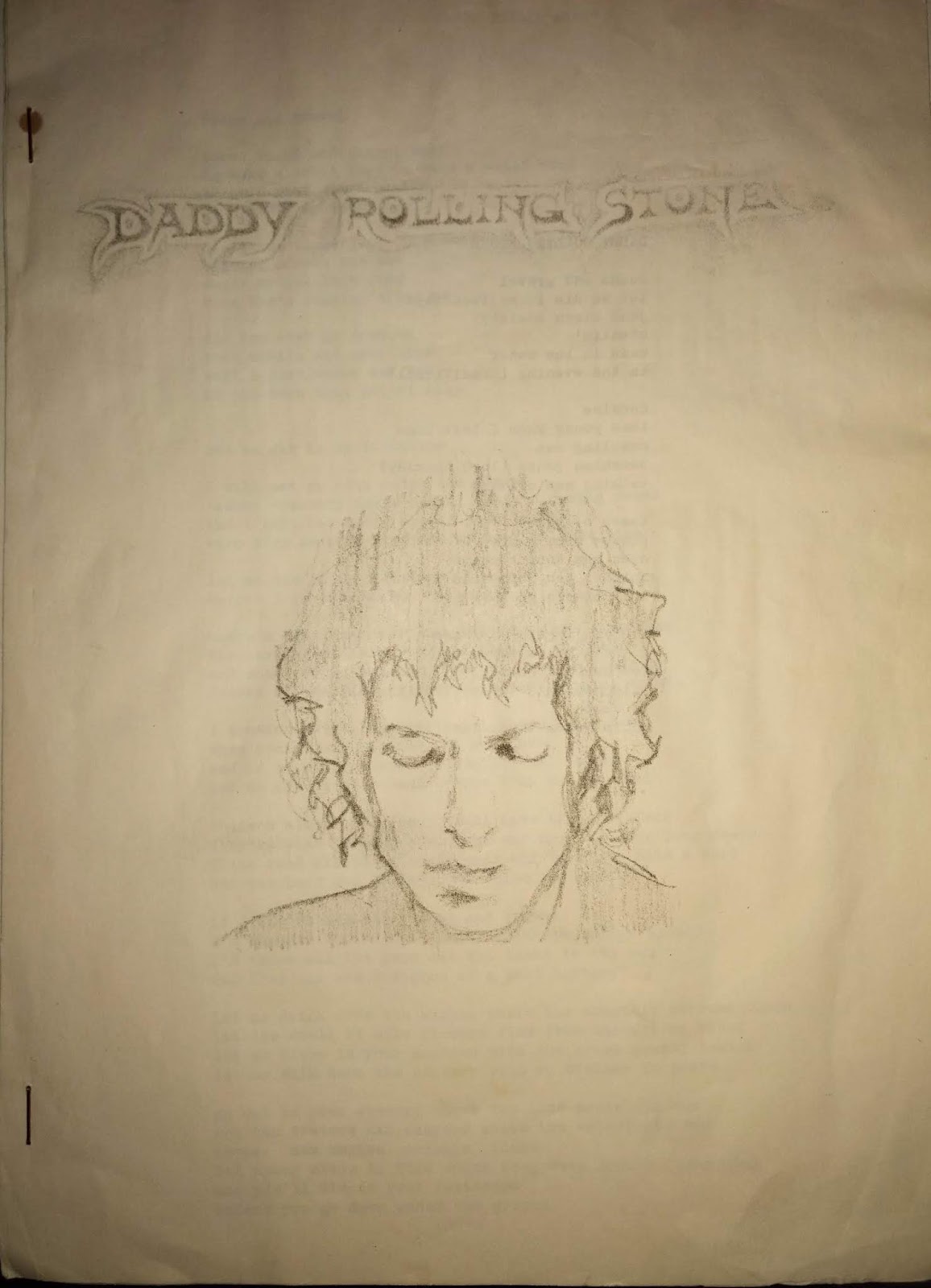
I got this 1969 or 1970 Bob Dylan bootleg from a record shop in Leiden. It's a great copy with very few hairline marks, and includes the original artwork by Dutch cartoonist and illustrator Peter Pontiac and original lyric booklet. All housed in an unmarked white sleeve, as can be expected for an illegally marketed product (even now, it's banned from sale in discogs). It's a collector's item, even though the contents are not the valuable rarities they once were: Dylan has recently been making his legendary archive of unreleased recordings available at an incredible rate: his official Bootleg Series is reaching now number 14, not mentioning unnumbered releases like Live At The Gaslight 1962 and various other copyright-free demos and live recordings from 1961-1962, all now available in superior quality. No, I bought it thinking about what it represented at the time of its release. Remember, Dylan retired from the public eye after his motorcycle accident in 1966. Up to then, people were looking forward to his next record as if he was a prophet pointing the way. When the psychedelic revolution came, instead of leading, he disappeared into a cabin with The Hawks (later renamed The Band) to make a bunch of recordings he initially left on the shelf, while the two albums he released in 1967 (John Wesley Harding) and 1969 (Nashville Skyline) were acoustic folk and country in stark contrast to what he had been doing before his accident and what his fans expected (and wanted) to hear. Which is when, in July 1969, rock's very first bootleg album appeared. It became known as the Great White Wonder because it was released in an unmarked white sleeve. Later editions came stamped with the title but still no artist name on. About half of it consisted of acoustic demos and solo recordings made in a Minnesota hotel room in December 1961. But what really blew people's minds were the new songs he had recorded with The Band at the Woodstock cabin in '67, and which were arguably superior to his recent LP's. Immediately other artists fell on this songwriting treasure trove: The Byrds, Jullie Driscoll, Joan Baez, Manfred Mann, and -of course- his co-conspirators The Band recorded their own hit versions many years before Dylan's own emerged (as The Basement Tapes, in 1975). GWW was quickly followed by other Dylan bootlegs, including Stealin', John Birch Society Blues and Isle of Wight Live. Drawing from all of these sources and released almost simultaneously, albeit in The Netherlands only, Daddy Rolling Stone must have been Europe's first introduction not only to these songs, but to music bootlegs in general.
LP1 contains Dylan solo acoustic demos and live recordings, while LP2 features The Band. No information is given other than the titles, but by comparing with what has been released elsewhere one can make an educated guess about the origin of these recordings. For example "Rocks & Gravel" (heavily borrowed from bluesman Mance Lipscomb) and "Let Me Die in My Footsteps" are known to have been recorded during the Freewheelin' sessions (1962) but left out of the album at the last moment. The former has officialy resurfaced in the True Detective series soundtrack, and the latter in Dylan's Bootleg Series Volumes 1 - 3, as has the talking blues "John Birch Society Blues", recorded live at Carnegie Hall at 1963 - provided of course it's the same version. A lot of the other acoustic tunes on LP1 come from the heavily bootlegged Minneapolis Party Tape, recorded in 1961 at the apartment of his activist/actress friend, Bonnie Beecher. These include the traditional "Wade in the Water" and "Stealin'", Brownie Mc Ghee's "In The Evening", Woody Guthrie's "Ramblin' 'Round", and the wonderful "I Was Young When I Left Home" (later included in The Bootleg Series Vol. 7: No Direction Home: The Soundtrack). Revd. Gary Davies' "Cocaine", Lord Buckley's "Black Cross" and the talking blues "Hezekiah Jones" were probably recorded at The Gaslight café in 1962 (the whole concert was officially released in 2005, initially only available to buy at... Starbucks). Two songs ("Cocaine","New Orleans Rag") are cut short, signifying that they have been lifted off another bootleg, Stealin', where they were also edited. Unlike the stark solo performances on disc 1, the songs on disc 2 are very familiar: recorded with the help of The Band at that Woodstock cabin, they include some of Dylan's best known songs, then appearing for the first time. 
The lyric booklet
The poetry is as excellent as ever, while the music draws from all kinds of American tradition: folk, blues, soul, country and rock. The performances here may not be as fleshed out as the ones appearing in the official release but they still sound full, with The Band all playing with gusto and singing together with Dylan. His great song of hope and redemption "I Shall Be Released", sung from a prisoner's perspective, has a gospel feel. "Open The Door Homer" is warm folk rock, "Tears Of Rage" a soulful ballad, and "Please Mrs. Henry" a drunken bawdy tune. "Nothing Was Delivered" sports some bluesy piano and guitar, while the mystical "This Wheel's on Fire" is dominated by Garth Hudson's churchy organ. All of the songs have a singalong campfire quality to them, which is even more evident in the more country-ish "You Ain't Going Nowhere" and "Too Much of Nothing". The sound quality is generally below par, but otherwise the versions here do not depart too much from the ones officially released later. Three songs probably come from Dylan and The Band's live appearence in the Isle Of Wight festival in '69: the traditional ballads "Wild Mountain Thyme" and "Minstrel Boy", and a band version of Dylan's "To Ramona", originally a solo number from his '64 album Another Side Of Bob Dylan. Such was the quality of these unreleased songs that they were immediately snatched by other artists who had hits with them, but the importance of them appearing out of nowhere in an unmarked sleeve to be sold under the counter in '69 is easy to forget now that they've been available in better form for decades. As a testament to that age, bootlegs like this and Great White Wonder remain valuable and worth spending the extra penny to add in one's collection.
***** for I Shall Be Released
**** for Let Me Die in My Footsteps, I Was Young When I Left Home, Tears of Rage, Please Mrs. Henry, Open the Door Homer, Nothing Was Delivered, This Wheel's on Fire, You Ain't Going Nowhere, Wild Mountain Thyme, Minstrel Boy
*** for Rocks & Gravel, John Birch Society Blues, Stealin', Wade in the Water, In the Evening, Cocaine, Ramblin' 'Round, Black Cross, To Ramona
** for Hezekiah Jones, New Orleans Rag

Wednesday, 20 April 2016

Joe Strummer "Nefertiti Rock" 1986-2000(rec.) 2013(comp)****

I've always been a fan of music rather than of musicians, but Joe Strummer is the closest I get to having a rock idol. Today, the notion of the socially conscious rock star is Bono, surrounded by his bodyguards, meeting Obama or IMF boss Christine Lagarde to ask them to forgive third world debts, exchange pleasantries, and get their photos taken together. Strummer was his polar opposite: a simple man of the people, traveling the third world in beat-up buses, making friends and playing music with the locals, passionately supporting his ideology from the street level rather than use his celebrity status. Fittingly, his last concert ever (and only time he shared the stage with Clash alumni Mick Jones since they disbanded) was in a benefit for striking firefighters. This performance (in Acton Hall) as well as live recordings with The Pogues have been released as Record Store Day exclusives (in 2012 and 2014, respectively) but I've missed out on them. Getting this one last week was a small compensation. Although I did buy it on Record Store Day, it's not an official RSD-related release, but a semi-legal Belgian limited release of 500 copies in black vinyl, plus 3x100 in yellow, green and purple. The cover is a simple stencil on brown carton paper, with no details on the origin of the recordings. The back cover just states "Rare and Unreleased Recordings!" but from the tracklisting it's obvious that these are mostly taken from 80's movie soundtracks. Strummer's wilderness period between The Clash and The Mescaleros has not only been musically almost barren but under-curated as well. His only album of the period, 1989's "Earthquake Weather" remains out of print, and was at the time such a disappointing flop that he did not enter a recording studio again for a decade. These tracks were recorded with his backing band Latino Rockabilly War prior to "Earthquake Weather" and show him in search of a new sound, mixing punk with rockabilly and world music. To my ears, they sound better than the album did but, maddeningly, no-one seems to have thought of collecting them before. I'd like to have a properly remastered official release, but for the time being this will do. The sound quality, for once, is great. The LP kicks off with "Ambush At Mystery Rock", a surf/western instrumental form the soundtrack of Alex Cox's punk western Straight to Hell. "Dum Dum Club" comes from the soundtrack of Sid & Nancy, another Cox movie starring Gary Oldman as Sid Vicious. It sounds like a combination of Sandinista-era Clash and Strummer's latter work with The Mescaleros. Three tracks from the 1988 Permanent Record soundtrack close side one: "Baby The Trans" is a mix of rockabilly and worldbeat, "Nefertiti Rock" is a throwback to his pub rock days with The 101ers and "Nothin' Bout Nothin'" a garage rocker with a short hard rock guitar solo - I think it's the first one I've heard in a Strummer-related album. The second side starts off with a great cover of Jimmy Cliff's reggae classic "The Harder They Come". It seems to be the version he recorded with Long Beach Dub Allstars for a 2000 compilation album and thus belongs to a whole different era than the rest of the songs here. "Evil Darling" is a vaguely Moriconne-sque ballad from Straight To Hell and "Love Kills" is a tribute to Sid Vicious from the Sid & Nancy soundtrack. It's a tremendous rocker that wouldn't sound out of place in Clash's Combat Rock album. "Trash City", as performed by Latino Rockabilly War in the Permanent Record soundtrack, is probably Strummer's finest post-Clash moment. The version included here is similar but less powerful. I've read somewhere that this album also includes "home recordings with Joe on all the instruments" and I guess that's the one they meant. The inclusion of the original would warrant the album another star, but collectors who already have the Permanent Record soundtrack may be happier with the demo. I'm not, though it gives me an incentive to buy the official reissue if and when it appears - as if I needed incentive.
***** for Dum Dum Club, Love Kills 
**** for Ambush At Mystery Rock, Baby The Trans, The Harder They Come, Evil Darling, Trash City 
*** for Nefertiti Rock, Nothin' Bout Nothin'

Wednesday, 18 November 2015

Neil Young "Chrome Dreams" 1974-1978(rec), 1992(reissue)****

I jumped at the chance to get this one, as it's probably rock's most famous bootleg (at least since the official release of Bob Dylan's "Royal Albert Hall" tapes and The Beach Boys' "Smile"). It contains studio demos in various stages of completion, mostly featuring his long time associates Crazy Horse. They were intended for inclusion in an aborted album called "Chrome Dreams" for which Young already had a cover (not this one) and whose release was announced for 1976. In the end, the demos were shelved and Young released another album called "American Stars 'n Bars". Few of these songs were included in this album but, just like "Smile",  most of them resurfaced in different form in future LP's "Comes a Time", "Rust Never Sleeps", "Hawks and Doves" and "Freedom". Various bootleg versions of Chrome Dreams have been around since 1977, this particular one surfacing in Italy around 1992. It's not the original bootleg (if that's not a contradiction in terms) as it contains a different track order, adds a few live recordings and replaces "Homegrown" with a '92 live recording of "Homefires". This unreleased song has been part of Young's repertory since the mid-70's, but for some reason (sound quality?) they chose a version that's separated by the rest by at least 15 years. It's often said that, had "Chrome Dreams" been released at its intended time, it would have constituted one of Young's best. This may very well be the case, although many of the songs here are presented in acoustic demo form. Which does not subtract any of the magic from masterpieces like "Powderfinger" and "Pocahontas", eventually included in the Rust Never Sleeps album. There's also a hard rockin' version of "Sedan Delivery" featuring Crazy Horse, as well as a rough live recording of "Ride My Llama".  "Will To Love" is an emotive ballad and "Captain Kennedy" an old-timey folk/country tune. They both resemble the final versions in American Stars 'n Bars and Hawks and Doves, respectively. "River Of Pride" is a typical Neil Young and Crazy Horse tune, with its country heart and sprawling hard rock guitar. "Too Far Gone" is a nice tune featuring Crazy Horse's Frank "Poncho" Sampedro on a vintage mandolin. "Star Of Bethlehem" and "Hold Back the Tears" are country ballads, the former featuring nice harmonica and backing vocals by Emmylou Harris and the latter an unidentified female vocalist. They were eventually re-recorded for American Stars 'n Bars, along with the ultimate Neil Young and Crazy Horse powerhouse "Like A Hurricane", presented here in an extensive live version: 11-and-a-half minutes of electric guitar heaven. "Look Out For My Love" and "Piece Of Mind" are two mid-tempo songs also featuring the Crazy Horse. "Homefires", the odd track out, is a solo acoustic song recorded live in 1992 in front of a quietly respectful audience. "Stringman" is a beautiful piano ballad. Amazingly, it had to wait for an official release until 1993 when it was revived for Young's "Unplugged" album. There's a reason that bootlegged "rare and unreleased" albums are usually not as good as they're supposed to be: If they really were that good, the artists would want us to hear them. But Neil Young is a bit strange that way, so he kept a perfectly good (even great) album on the shelf. Knowing him, he's probably got plans for it at some point but he's taking his time until he feels he can present these songs in the best manner. When he does, it'll really be something!
***** for Captain Kennedy, Pocahontas, Like A Hurricane, Look Out For My Love
**** for Powderfinger, Will To Love, Sedan Delivery, River Of Pride, Too Far Gone, Star Of Bethlehem, Stringman
*** for Hold Back The Tears, Homefires, Ride My Llama, Peace Of Mind