Showing posts with label Live. Show all posts

Sunday, 26 July 2026

The B52s "With the Wild Crowd! Live in Athens, GA" 2011****

I recently saw The B-52's live at TivoliVredenburg in Utrecht. When I heard they were coming, I instantly knew it would be an unmissable occasion. I couldn't remember the band ever performing anywhere near me, and there was good reason for that: this was only their third performance in the Netherlands in the past 45 years. As for Athens, Greece, where I lived until 2009, these Athenians from Georgia never set foot in their Old World namesake—at least not to perform. The show was a resounding success. Any concerns that age might have slowed them down disappeared immediately. From the opening notes of Planet Claire to the raucous closing Rock Lobster, it was an exuberant, high-energy performance full of infectious party spirit and the wonderfully offbeat humour that has always set them apart.
To prepare for the concert, I had put on this DVD I had laying around the house. It is actually a DVD/CD box set - I've certainly listened to the CD a few times in the last decade, but this may well have been the first time I watched the rhe entire concert. Apart from the inclusion of several songs from their then-new Funplex album (2008), it came remarkably close to the show I experienced myself. True, these songs have been dropped from the setlist in the meantime, but they don't weigh down the performance at all. "Pump"'s infectious riff, for once, makes for an excellent concert opener - it's no "Planet Claire" but it comes close. The rest ("Ultraviolet", "Funplex", "Love In The Year 3000", "Hot Corner") are all highly energetic dance-oriented tunes featuring zany lyrics, Fred's manic shouted declarations, and the glorious harmonies of Kate Pierson and Cindy Wilson. At their weakest they may remind you of The Spice Girls, but at their best they're like Martha and the Vandellas fronting Talking Heads. Still, the newer material is really the potatoes here; the meat is the run of classics from the late '70s and early '80s, particularly their self-titled debut (1979) and Wild Planet (1980). Every one of them is performed superbly. The live band trades the angular post-punk edge of the early records for a fuller, warmer, and more organic sound. Purists may find the arrangements a little too polished, and some will inevitably miss Ricky Wilson's singular guitar playing. Yet Keith Strickland, who took over guitar duties following Ricky's tragic AIDS-related death in 1985, proves himself a more conventional but by no means inferior guitarist. He nails the surf-inspired riffs while adding tasteful fills that flesh out the band's sound. "Mesopotamia" (orig. 1982)  is reminiscent of The Talking Heads' funky new wave, while the songs from Cosmic Thing (1989) are best suited to the band's live configuration: warmer and sunnier, with the ladies' soulful vocals gaining the upper hand from Fred's more abrasive half-singing half-talking style. "Roam" is one of the highlights, but the band keep the best for last: perfect party tune "Love Shack" is delivered with irresistible gusto, driven by an irresistibly funky bass groove. For years I couldn't make out what the response was to Fred's immortal question "Your... what??" Now I know, and so does everyone in the audience who shout out in unison "Tin! Roof! Rusted!". The concert climaxes with two of the band's earliest, best, and weirdest, tunes: "Planet Claire" and "Rock Lobster". Can't think of a better ending, really. A 76-minute (90 minutes for the DVD, which includes 3 more tracks) relentless non-stop party; if there's any downside, it's the lack of any significant variation in tempo - basically, the band hits top gear from the get go, and never ease up. The DVD itself is just a professionally shot straightforward document of the performance. It's enjoyable to watch the band playing to an adoring hometown audience, some sporting very eccentric costumes. The surround sound is clean and immersive, although not especially revelatory, while the stereo mix is equally effective at conveying the atmosphere of a live concert.Despite the polished arrangements, enough rough edges remain to preserve the feel of a genuine live performance rather than a studio reconstruction of the event. The result is both an excellent introduction for newcomers and a rewarding live document for longtime fans. More than anything, it captures the B52's in their natural element, proving they remain one of rock's greatest party bands.
***** for Planet Claire, Rock Lobster
**** for Pump, Private Idaho, Mesopotamia, Give Me Back My Man, Roam, 52 Girls, Party Out Of Bounds, Cosmic Thing, Love Shack
*** for Ultraviolet, Funplex, Whammy Kiss, Love In The Year 3000, Hot Corner, Wig

Wednesday, 3 June 2026

Mutantes "Live - Barbican Theatre, London, 2006" 2007****

Another band I never expected to see live, I discovered Os Mutantes around the turn of the millennium, when Luaka Bop released a compilation of their 1960s material. It received rave reviews, and after hearing it myself I couldn’t help but agree: this eclectic, whimsical and experimental yet often poppy mix sounded as exciting and unique as anything from the era. The band disbanded in the early 1970s, having achieved little recognition outside their native Brazil until the Luaka Bop compilation introduced them to a new international audience. A few years later their albums were reissued on CD — and eventually vinyl as well — while a partially reunited lineup celebrated the band’s 40th anniversary with a major London concert, documented on the CD/DVD release reviewed here. The following years brought sporadic new albums and live appearances by a version of the band led by original guitarist Sergio Dias. They rarely venture into Europe, so last year’s Amsterdam performance — their first Dutch show since 2016 — felt unmissable. They no longer wear outlandish costumes onstage, and, at 75, Sergio Dias isn't in great shape physically, singing and playing seated for most of the show, but his guitar work remained superb, with echoes of Hendrix and Santana throughout. The band alternated between proggy psychedelia and pure pop (e.g. "Baby"). The harmonies were as strong as ever, while Esméria Bulgari handled the lead vocals admirably. Rita Lee, of course, who left the band in 1972 and died in 2023 remains irreplaceable. The other great absentee was Sergio’s brother, Arnaldo Baptista: he has often struggled with mental health issues linked to his past excessive LSD use, and took his leave from the band, long ago.

He nevertheless can be heard on this live CD, alongside Dias, original drummer Dinho Leme, and guest singer Zélia Duncan. Esméria Bulgari was also present on this occasion, albeit only as a backing singer. As I mentioned earlier, Os Mutantes have always been a very peculiar band, drawing on everything from Beatlesy pop and bossa nova to ballads and psychedelic rock, all filtered through a lens of whimsy and anarchic humor not unlike that of the Bonzo Dog Band—while sounding nothing like them in practice. Such eclecticism often left them difficult to categorize. For many years they were mentioned—if at all—only as part of the Tropicália movement, which also included more celebrated Brazilian artists like Caetano Veloso, Gilberto Gil, Gal Costa, and Tom Zé. This was too restrictive, since all of those artists were closer to Brazilian musical traditions, whereas Os Mutantes explored a much wider range of styles. This live CD manages to encapsulate most of them, making it one of the best entry points into the band's music. The performances are uniformly strong, while the arrangements benefit from a fuller band and generally sound more polished than the original versions. Some listeners may miss the rough edges of the originals, but I believe very little is lost in the process. Opener "Don Quixote" is an impressive psychedelic mess, incorporating everything from an orchestral fanfare to the band's signature harmonies and Dias' electric-guitar outbursts. This is followed by "Virginia", a charming Beatlesque ballad. The pace then picks up with a pair of upbeat Latin rockers: "Cantor de Mambo"—reminiscent of Santana and featuring some first-rate electric guitar in this live rendition—and "El Justicero". Hilariously, Tony Blair and "Jorge" Bush are portrayed as Old West gunslingers in the song's intro. The mood changes once again with the exotic, chilled-out bossa nova of "Baby" and "I'm Sorry Baby", both sung in English. Later, "Dia 36" and "Ave Lucifer" drift by as stoned psychedelic ballads awash in vocal distortion and spaced-out effects, while "Fuga No. 11" and "Balada do Louco" evoke a dreamlike meeting point between Gilberto Gil and John Lennon. The acoustic "Le premier bonheur du jour" adds a Rennaissence flavor, while "I Feel a Little Spaced Out(original Portuguese title was "Ando Meio Desligado") perfectly embodies the sound of The Summer of Love: Imagine throwing The Zombies, Jefferson Airplane, early Pink Floyd, and the soundtrack to Hair! into a blender and ending up with something surprisingly coherent. As the concert nears its end, Os Mutantes showcase their riotous carnivalesque side on "A Minha Menina" and "Bat Macumba" before bowing out with an ecstatic English-language rendition of "Panis et Circenses" that once again recalls The Beatles circa Sgt. PepperThe above track listing corresponds to my own (UK) version of the album, which combines a single CD and DVD video. There is also a US double-CD edition that adds five songs but omits the visual content. Those tracks are reinstated on my DVD, which also includes a short documentary, video clips from the concert and rehearsals, and a photo gallery. The DVD offers both stereo and surround-sound audio options, as well as subtitles for the lyrics. To be honest, neither the video quality nor the surround mix is particularly impressive, which means I find myself returning to the CD far more often than the DVD. Now, I know that many fans may find Rita Lee's absence difficult to overlook, English translation of the lyrics somewhat incongruous, and the band's live sound a little too down-to-earth for their liking. For myself, I believe that Live In Barbican, 2006 successfully captures the eclecticism, humor, musicianship, and sense of adventure that made Os Mutantes so special in the first place. For newcomers, it serves as an ideal introduction; for existing fans, it's a rewarding celebration of this unique band. Having finally seen the band in concert, I can confirm that, sixty years on, the magic is still there.

***** for Cantor de Mambo, Baby, I Feel a Little Spaced Out

**** for Virginia, El justicieroI'm Sorry Baby,  Dia 36, Fuga Nº II, Ave Lucifer, Balada do Louco, A Minha Menina, Bat Macumba, Panis et Circenses

*** for Don Quixote, Le Premier Bonheur du Jour

Thursday, 2 October 2025

Paul McCartney "Back in the World-Live" 2003***

With the exception of the famous rooftop performance for the Let It Be film in '69, The Beatles stopped playing live pretty early in their career, in '66. Even before that, they struggled to be heard above the legions of screaming fans. Their small live legacy consists of some live-at-the-BBC-studio recordings, plus Live At The Hollywood Bowl and Live At The Star Club Hamburg - all displaying their early pop/rockabilly side. The relevant performances aren't bad, but nothing special either. Since the band broke up, John and Ringo have barely ever played any Beatles songs live, and George has stuck to his own compositions for the band. So it fell to Paul to keep the Lennon/McCartney songbook alive. Only, in this case the billing is reversed: instead of Lennon/McCartney, here the songwriting credit goes to McCartney/Lennon. According to Paul, he only reversed the credit on songs written by him (the songwriting team had agreed to share credit 50/50 regardless of each song's principal songwriter). For this specific live album, mostly culled from his 2002 US tour, two thirds of the setlist is comprised by Beatles songs. Which makes it probably the closest one can get to a true Beatles live album. Is this how they would sound like at the beginning of the 21st century? Who knows, really? Truth is, there are Beatles tribute bands out there which sound more than the original than Paul's band does. I can't tell if that's a good or a bad thing though. Would I prefer hearing Paul play with John, George, and Ringo impersonators? Honestly, probably yes. But that would have been a tribute band rather than Paul McCartney and his band. As it is, he doesn't get overly creative with the arrangements: songs either sound similar to the originals ("Hello, Goodbye", "All My Loving", "Fool On The Hill"), or starker ("We Can Work It Out", the ukulele version of George's "Something"). John's harmonies are notably absent at times. When harmonies are evident, as in "Getting Better" and "Hey Jude", they have a more soul/gospel feel. Then, of course, you have the classic McCartneyesque ballads ("Blackbird", "Yesterday", "Michelle") which were very stark and fragile to begin with. Somehow, these never sound great in a live setting. Orchestral arrangements on "Eleanor Rigby", "She's Leaving Home", and "The Long and Winding Road" are replicated; presumeably the orchestral parts are played on the synthesizer. Songs from Let It Be are among the best, with small differences adding to rather than subtracting from the song: some jazz piano on "The Long and Winding Road", sax on "Lady Madonna", an electric guitar solo on "Let It Be". The upbeat rockabilly-ish songs are loads of fun to listen to even if they don't deviate much from the originals ("Can't Buy Me Love", "Back in the U.S.S.R.", "I Saw Her Standing There"). The inclusion of a forgotten Beatles track ("Mother Nature's Son" from 1968's White Album) is a pleasant surprise. Three tracks taken from his then current solo LP Driving Rain ("Lonely Road", "Driving Rain", "Your Loving Flame") sound relatively weak among such company. Conversely, songs from 1973's Band On The Run ("Jet", "Let Me Roll It", "Band on the Run") still sound great. Other notable performances include the funky "Coming Up" (from McCartney II, 1980), "Maybe I'm Amazed" (from solo debut McCartney, 1970), and James Bond theme "Live and Let Die" (1973). There's also a poignant tribute to John Lennon composed shortly after his death ("Here Today" from Tug of War, 1982) while the CD closes majestically with "Sgt. Pepper's Lonely Hearts Club Band/The End". Back In The World is the international counterpart of 2002's Back In The US : it subtracts "C Moon" and "Freedom", replacing them with four tracks recorded in Mexico and Japan and uses a different performance of "Hey Jude", recorded in Mexico instead of New York. As a souvenir for Beatles fans, it's rather frustrating: on one hand, this is the closest one gets to listening to The Beatles live in the 21st century. On the other, it's disappointingly pedestrian. But who's to say that, had they stayed together and resumed performing, The Beatles would have been a great live band? Unfortunately, nothing except their crazy pre-fame Hamburg days points to that. Maybe it would have been better for McCartney to avoid comparisons altogether and stick to his solo stuff. But these songs deserve to be played live - and who's better equipped to do it than him?

**** for Hello Goodbye, Jet, Coming Up, Let Me Roll It, You Never Give Me Your Money/Carry That Weight, The Fool on the Hill, Eleanor Rigby, Here There and Everywhere, Michelle, Band on the Run, Back in the U.S.S.R., Maybe I'm Amazed, She's Leaving Home, Can't Buy Me Love, Live and Let Die, Let It Be, Hey Jude, The Long and Winding Road, Lady Madonna, Sgt. Pepper's Lonely Hearts Club Band/The End

*** for All My Loving, Getting Better, Lonely Road, Blackbird, Every Night, Mother Nature's Son, Here Today, Calico Skies, Let 'Em In, My Love, I Saw Her Standing There, Yesterday

** for Driving Rain, Your Loving Flame, We Can Work It Out, Something

Thursday, 17 July 2025

The Who with Orchestra "Live At Wembley" 2022 (rec.2019)***

The first time I saw The Who live was in Amsterdam during their Quadrophenia and More Tour (2013). It was a rewarding experience; Pete Townshend and Roger Daltrey were in good form despite their age,  and the rest of the band supporting them ably - especially Pino Palladino on bass and "Ringo's son" Zak Starkey on bass. The visuals were also excellent, but I remember thinking that it took a very proficient and well-rehearsed 10-piece band to produce a result that only came somewhat close to the original 4 members. Later, a DVD, recorded at Wembley Stadium during that tour, came out as Quadrophenia Live in London. I didn't buy it, despite the fact that it could have served as a nice souvenir of the concert. I figured that any time I want to listen to Quadrophenia start to finish, I can play the studio version. And if I want to listen to The Who live, I have the expanded Live At Leeds and The Kids Are Alright. Why, then, did I buy Live At The Wembley recorded at the same location as Quadrophenia Live, and even reprising half of that album, only 6 years later? Well, of course it's the orchestra thing. How much does it add to the original songs? First thing first: Metallica S&M, this isn't. Where, on that album, rock band and orchestra combined to produce intensely heavy music in an epic scale, here the orchestra just plays a supportive role, not unlike the expanded 10-piece band I remember from the Quadrophenia concert in Amsterdam. Townshend and Daltrey are in similarly good form - better than what can be reasonably be expected, given their age. When they are not accompanied by the orchestra, as in "Substitute" and "The Seeker", they sound like an older, slightly blunted, version of themselves. The acoustic version of "Won't Get Fooled Again" is different enough to previous ones to be of interest, but frankly rather weak. It was interesting to hear the orchestra replace the synths on tracks like "Baba O’Riley" and "Eminence Front" resulting in a more organic sound. Often it adds some welcome bombast, as in the fanfares of "Pinball Wizard" or melodrama, as in "Behind Blue Eyes" and "Love Reign O'er Me". Lesser known tracks like "Imagine A Man" (1975) and "Hero Ground Zero" (2019) gain from new orchestrations; new blues track "Ball And Chain" (2019) isn't up to the same level as the classics, but it's good to have a live version of it. An acoustic rendition of "Tea and Theater" from 2006's Endless Wire (recorded during a different concert, too) makes for a puzzling inclusion, and rather anti-climactic closer. This set was also released on triple vinyl, but my own version is the 2CD and Blu-Ray set. The Blu Ray offers Stereo, DTS 5.1, and Dolby Atmos audio, but no video! All you get on your screen are some photos! That was an unwelcome surprise, for sure! Since it's not made specifically clear on the package that this is an audio-only BluRay, I -and almost everybody else who purchased it- naturally assumed we were getting a video recording of the concert with surround sound. I mean, it's not some ancient archive recording. It's a huge production at Wembley stadium in 2019! Many buyers felt cheated. After all, to be honest the PCM 5.1 sound (I can't judge the Dolby Atmos sound channel, since I don't have the appropriate equipment to listen to it on) isn't all that revelatory - slightly bigger and more vivid, especially in the orchestral parts, but I'm guessing that, had they known that there was no visual content in the BluRay, many buyers would have gone for the vinyl version instead. The official response to complaints was that "the Wembley concert wasn’t filmed for DVD or Blu-ray. The only filming was choosing  for the live back screens at the show." So the cameras were transmitting while a director chose which camera feed to project on the back screen. Although the primary material wasn't recorded, apparently we still have the visuals as they were projected on the back screen. Well, some of those visuals are available for free on youtube; they look quite good and complement the sound on those youtube videos perfectly! It's a pity they didn't also make them available to paying customers, to watch on their TV while listening to that nice crisp digital sound on BluRay, instead of watching a stupid slideshow. Anyway, purely music-wise, this is The Who (or, more correctly, Roger Daltrey and Pete Townshend) in respectably good form, playing some of their most famous and beloved songs. True, these "live with orchestra" versions can't compare to the studio ones, or with live recordings by the original band in their prime. It would be unreasonable from us to expect that. But they are just different enough for fans to want to listen to. If you are fans, if you already own their classic studio albums and some essential live Who from their 60's and 70's, and you are still not satiated, you may want to get this one, too. It certainly makes for a fun listen, and the orchestra adds a welcome new dimension. Too bad for the missed opportunity; some nice visual content might have elevated this to a 4* set. 
**** for Eminence Front, Imagine A Man, Pinball Wizard, Hero Ground Zero, Behind Blue Eyes, 5:15, Love Reign O'er Me,  Baba O’Riley
*** for Who Are You, Join Together, Substitute, The Seeker, Won't Get Fooled Again (Acoustic), Ball And Chain, The Real Me, I’m One, Tea & Theatre (Acoustic)
** for The Punk And The Godfather, Drowned, The Rock

Friday, 27 June 2025

Santana "Sentient" 1987-2024(rec) 2025 (comp)***

Photos: Santana Live at Ziggo Dome, Amsterdam. Tuesday 24 June, 2024
We recently went to Ziggo Dome for a Santana concert. It was the second time I saw the band live - the previous one was waaay back in 1991 at Leoforos Alexandras Stadium in Athens. I was mesmerized by Carlos' guitar, and still think of it as the best guitar playing I've ever witnessed live - and I've seen a lot of concerts starring a lot of famous guitarists. At the time I had recorded the concert on my walkman, and -despite the awful sound quality- every listen would reinforce that conviction. That cassette went wherever cassettes go when you're not paying them attention, but there's a better recording of that concert out there on youtube so you can judge for yourself. This time around, Carlos' playing was a little less impressive, but what do you expect? the man is 77 years old - it's difficult to grasp that he was only 43 back then, quite younger than what I am now, but it felt like I was seeing a legendary beast from a bygone age; Woodstock was like the Jurassic period to me, but I was less removed from it then than I now am from that warm Athens night when I first saw Santana live. And if Carlos' fingers are a tad less nimble than they used to be, Tuesday's concert didn't make for an inferior experience. First of all, this time Santana have a lot more hit songs than they did then; especially the ones from multi-Grammy Award winner Supernatural (1999), they played 5 off that one on the Ziggo Dome concert. Secondly, it's a terrific band: David Mathews was impressive on keyboards throughout, bassist Benny Rietveld played a masterful solo, the vocalists, percussionists, and the rest of the band were also great. But my girlfriend and I were most impressed by wife Cindy Blackman Santana on drums. So, at the end of the show, we went to the merchandise stall and got both Santana's latest vinyl and Cindy's new(ish) CD (to be presented next week)

First of all, "Sentient" may be Santana's newest LP, but it mostly contains older, semi-forgotten, recordings and collaborations, going back as many as long as three decades. Which one can guess by taking a look on the collaborators: Miles Davis (R.I.P.)? Michael Jackson (R.I.P.)? Actually, Miles was already dead when "Get On" was included on Paolo Rustichelli's Mystic Man (1996) which means tha Carlos and the Italian keyboardist were playing along to Davis' trumpet samples. Not bad, though. It's a chillout tune with a semi-electronic Latin beat and a small funky vocal sample. So far that sounds like something you might listen at a Balearic beach bar in the 90's - but the superb playing by the musicians elevates it tremendously. The LP contains another track from the same CD, "Vers Le Soleil". No Miles here - just Carlos and Paolo, relaxed vocals and dramatic synthesized strings. Both are "Sentient versions", meaning they've been reworked for inclusion here. I wouldn't know how much, but the new versions are great, especially Carlos' guitar which is just magical. Another reworked version is "Please Don't Take Your Love" featuring Smokey Robinson, originally recorded for the soul legend's comeback LP Time Flies When You're Having Fun (2009). Smokey's ageless vocal combines with Carlos' classy blues licks to create one of the highlights here. Opener "Let the Guitar Play" was released last year as a Record Store Day single, and features veteran rapper Darryl McDaniels (of Run-DMC) on vocal. I don't know why all those old rockers think they're modernizing their sound by adding unrelated rap segments; to be honest, I find it intrusive and would have prefered the track as an instrumental. "Whatever Happens" off Michael Jackson's last album Invincible (2001) features some nice acoustic guitar and intricate production. It wouldn't have sounded out of place on Supernatural. A second MJ composition "Stranger In Moscow" is included here in a, previously unissued, instrumental version recorded live in 2007 at a small club, backed by renowned drummer Narada Michael Walden and his band. Santana's guitar literally sings, as it copies the tone of MJ's vocal on the original ballad. A great gift for the diehard fan who may already own all the other, rare but previously released, pieces. Another previously unreleased track is "Coherence", credited to Santana and wife/drummer Cindy Blackman. It's an adventurous jazz fusion piece featuring great musical interplay between the couple. The vinyl version of Sentient closes with a masterful instrumental called "Blues For Salvador" from the eponymous 1987 album - I guess its inclusion is justified by the fact that it comes from a "solo" Carlos Santana LP, and thus new in the official Santana-the-band discography. As you may have already guessed, this is a hodgepogde of different styles, even more so than Santana's (in)famous string of commercial "collaboration" albums of the early 00's. It's nevertheless nice to bring all those scattered tunes together, and Carlos' playing is inspired throughout irregardless of song style. Not essential for the casual listener, but good for diehard fans who want to collect everything from their favorite artist, as wll as those who, like me, wanted a souvenir of the Oneness tour (although I believe the band didn't play any of these tunes live). The album cover you see here is exclusive to the European market - basically, it swaps the international edition's front and back covers. The CD version of the album contains extra tracks: two more Rustichelli collaborations called "Rastafario" and "Fool Moon", as well as "I'll Be Waiting", a soul ballad from Moonflower.

**** for Please Don't Take Your Love, Get On, Blues For Salvador

*** for Let The Guitar Play, Stranger In MoscowWhatever Happens, Vers Le Soleil, Coherence

Tuesday, 27 May 2025

Deep Purple "Live In Japan" a.k.a. "Made In Japan" 1972*****

I found this LP at a 2nd hand records store in Tokyo; I am quite familiar with the (official, at least) discography of Deep Purple but couldn't recall an LP called Live In Japan. Last Concert In Japan, yes. Τhere it was, also in front of me. I bought that too, because I couldn't resist the serendipity of coming across that LP while travelling in the city where it was recorded. Could this be the classic DP live album Made In Japan, albeit with a different album cover and title? If I could only see the tracklisting I'd know for sure, but that was nowhere to be seen. What the heck, I thought; let's buy it anyway, it's cheap enough. It turns out my suspicion was correct: Indeed, Made In Japan retains this title all around the world with one exception: if it is actually made in Japan, then it's sold under another title. I can imagine the frustration of the Warner Bros Japan executive who had to release this for the Japanese market "Made In Japan? Why, all of our records are made in Japan! No, this is too confusing! Unacceptable, we must call it something else!". So I bought this one again, which is fine; I had it on cassette back in the day, and still have the remastered CD, but a nice gatefold double LP is a thing of beauty - plus, this album has sold more than a million copies in Europe but I'm fairly sure I'm the only person in my neighborhood who owns this particular version. The original international edition, the one everybody except me has, uses the same picture as the remastered CD but the lettering is reversed, black letters on gold background. One of my classmates taped it for me, maybe 40 years ago. "If you listen closely" he told me "you will hear a Japanese fan blowing his own brains out on the balcony". No shit! "Yes shit!" Play-rewind-play-rewind, and yes indeed there it was around 9:45' minutes in during "Child In Time", the unmistakable sound of a gunshot - or is it? There are more plausible theories, such as an amp blowing out, or a spring reverb unit built into Jon Lord's organ suddenly going into action. But the idea of a fan choosing that moment to commit suicide, combined with Gillan's wailing and screaming and lyrics about bullets flying and ricocheting, that is goosebumps-inducing stuff. No wonder this theory was so popular with teenagers in the 80's - though how it proliferated so far and wide in the pre-internet days, I don't know. I myself heard it from a friend who either heard it from a friend, or a pirate radio DJ. Urban myths aside, this live version of "Child In Time" is fantastic - the band were in great form, possibly inspired by the triumphant reception from the Japanese fans: Gillan goes from quiet and emotive to demented-all-hell-breaks-loose screaming, and Blackmore's solos are insane, way faster than the studio version. Opener "Highway Star" is just another amazing performance featuring a brain melting solo with an immense difficulty factor - I remember seeing Blackmore's Rainbow play Monsters Of Rock 2016; he started that concert too with "Highway Star" and we all wondered if he could still play this solo at the age of 70, after a 20-year absence from rock performances; he almost nailed it, which is why his performance from Bietigheim-Bissingen didn't make the cut on the Memories In Rock DVD - they included the performance from Loreley instead. Side B starts with the band introducing "Smoke On The Water" to mild applause; back then, it was just a track from their latest album, which a lot of fans hadn't heard yet. The audience claps along to the intro, which is slightly different to the one we know; instead of repeating the same riff six or seven times, Blackmore plays a variation the second time. Once more, great solos surpassing those of the studio version. Which brings us to the moment everyone dreads during arena rock concerts: the drum solo which takes up most of "The Mule"s 10 minutes. Side C opens with "Strange Kind Of Woman" which I never particularly liked as I considered it too poppy for DP; the live version, though, is pure dynamite. Near the end there's an amusing duel between Gillan and Blackmore, with the singer mimicking the sounds of the electric guitar. "Lazy" takes a long time to warm up; Jon Lord plays an extended jazz intro on the Hammond for a few minutes before the band join him for a great jazz-blues jam; Gillan even blows a mean blues harmonica, which is quite uncharacteristic. All of Side D is taken up by a 20-minute version of "Space Truckin'". People will tell you it's boring and indulgent 70's arena-prog-rock shit. Those people are not your friends. Why would you want to miss the chance to hear what the exhaust pipe of a spaceship would sound like? If sound could travel in space, that is. Now you know: it sounds exactly like Jon Lord's organ, which sounds like nothing else on planet Earth. This is probably the last time that Blackmore and Lord share the spotlight equally as soloists: during the band's early days Lord seemed to have the upper hand; by this time DP had already become Blackmore's band, but the live organ and guitar duels here don't produce a clear winner. It's the incredible virtuosity of these two instrumentalists, along with the undeniable skill of the rhythm section, and -above all- Ian Gillan's unbelievable vocals that have rendered this album the leading candidate for Best Live Hard Rock/Heavy Metal Album, ever! Not only that; it's also probably the only classic live album in this genre that doesn't contain any overdubs. Others (Thin Lizzy's Live And Dangerous, Kiss Alive! and Judas Priest's Unleashed in the East, to name just the worst offenders) were almost completely recreated in the studio, but Live In Japan is the pure unadulterated live sound of a monster rock band at the height of their powers.
P.S. The 25th Anniversary Remaster contains a bonus CD with 3 songs from the Japanese tour encores: "Black Night" (previously released only as a single) and "Speed King" come from the August 17 Tokyo date; the former easily outstrips the rather tame studio version, while the latter is a bit messier but still good fun. The bonus CD closes with a cover of Little Richard's classic rockabilly "Lucille" recorded the previous night in Osaka - it's quite entertaining but a bit lightweight compared to the rest of the album. Indeed the classic 7-song version of Live In Japan is just impossible to beat, and the glorious chaos of "Space Truckin'" makes for a perfect ending.
***** for Highway Star, Child In Time, Smoke On The Water 
**** for Strange Kind Of Woman, Lazy, Space Truckin', Black Night (CD), Speed King (CD)
*** for The Mule, Lucille (CD)

Tuesday, 13 May 2025

"Rolling Tickets - Live Back-" 1964-1969(rec)1982(comp)*****

Wow, it's been a month to the day - probably the longest time I've been away from you. Truth is, I've been quite busy at work, and then travelling - in Japan, for a large chunk of last month. You can bet I visited a lot of record shops there, and I have the receipts to prove it! I bought mostly albums by Japanese bands, although I found great stuff in all kinds. I'll present as many of my purchases as I can in this blog (notice I've given up on the ambition to present all, or even the bulk of, my collection here). Let's start with this one, by the "Rolling Tickets":
Who are the Rolling Tickets? you ask. Fair question, that's what I asked myself when I came across this LP at the Shinjuku Rock branch of Disk Union. My first guess was some kind of Japanese Rolling Stones tribute band, perhaps? No siree, this is a Japan-only official Rolling Stones compilation. What the hell does the title mean, then? Why tickets? Is it a live recording? What does the word back refer to? I guess what we have here is a typical case of Engrish, otherwise known as Japanglish. You'll see it everywhere in Japan, from street signs to slogans on standardized food packages: English phrases that apparently sound good to Japanese ears but make zero sense to English speakers. Something else that makes zero sense to me is the concept of this comp: sure, what we have here is 10 stone cold classics from the 60's. One could argue for the inclusion of "Paint It, Black" and a couple of others, but there's no doubt that the songs included here are among the band's best. For some reason, 4 of them are repeated twice, once in their studio version and once live. Hence the "live" of the title. Each side opens with two versions of one song and closes with two versions of another. Sandwiched between these we get 3 more studio recordings on each side. The LP comes with a big 4-page insert, containing the band's discography, complete lyrics for all the songs with their Japanese translation, and info on the latest 1981-1982 Rolling Stones world tour, as well as a short text on each track. So we learn that 3 out of the 4 live tracks come from Have Live If You Want It ("Under My Thumb","Time Is On My Side" and "Satisfaction") and one from Get Your Ya Ya's Out ("Honky Tonk Women"). The provenance of the rest is less clear: we learn that these are studio recordings (or, in one occasion at least, "rocordings") which appear in this or that single, album, or comp, but not which mix is included. I'm guessing it's the US versions (Rolling Stones albums were released with different titles and tracklisting on the two sides of the Atlantic), because the record label is London, Decca's US subsidiary. While I know that some of these early songs were also recorded and released in stereo, the label denotes "mono" so these are the original mono mixes rather than the true stereo ones or the hastily "electronically re-channeled for stereo" ones which are reviled by audiophiles. I confess I have the vinyl "digitally remastered in stereo" reissues of those early US albums, and never had any complaints about the way they sound. Then again, I didn't have the original mono LPs for comparison. Maybe I should listen to them back-to-back with this Japanese comp and see which sounds better. In any case: Rolling Stones compilations are a dime a dozen, but this one may appeal to collectors because it centers on mono mixes exclusively, or because they get to listen the same song in two successive versions, a live and a studio one; notice the difference on the two versions of "Under My Thumb" below.
***** for Under My Thumb, Let's Spend The Night Together, Let It Bleed, You Can't Always Get What You Want, Time Is On My Side, Honky Tonk Women - Live, Honky Tonk Women, Jumpin' Jack Flash, Street Fighting Man, (I Can't Get No) Satisfaction
**** for Under My Thumb - Live, Time Is On My Side - Live, Mona (I Need You, Baby), (I Can't Get No) Satisfaction - Live
 

Thursday, 7 November 2024

Fleetwood Mac "Fleetwood Mac Live" 1980****

Fleetwood Mac are one of the bands I regret most having missed out seeing live; for one reason or another I was not able to see them in the few times they visited Holland in the last 15 years - and, after Christine McVie's death and Lindsey Buckingham's estrangement from the rest, it seems that I'll never get to tick that particular box. Closest I'll get to, is one of their live albums; basically Live and 1997's The Dance. Fleetwood Mac Live was the band's first live release after 13 years and about as many personnel changes. Fleetwood Mac, who had started out as a pure blues band, had lost its leader Peter Green to LSD and religious cults in 1970, and staggered aimlessly for a while, until they incorporated the American singer/songwriter duo, and real-life couple, of Buckingham/Nicks. With founding members Mick Fleetwood (drums) and John Mac Vie (bass) augmented by a trio of talented singer/songwriters (Stevie Nicks on vocals, Lindsey Buckingham guitar and vocals, and Christine Mac Vie on piano and vocals), they finally hit their stride, producing three artistically and commercially successful albums in quick succession: Fleetwood Mac (1975), the mega-selling Rumours (1977), and more experimental double LP Tusk (1979). With all those hits under their belt, the time was right to release a live album; after all this was the golden era of the double live album: Kiss Alive, Frampton Comes Alive, Cheap Trick At Budokan sold spectacularly better than their studio predecessors, and acted as springboards to unprecedented commercial success for the respective bands. Slightly less influential then these, Live captures Fleetwood Mac at their creative apogee, sports a hit-laden setlist and excellent performances. But, on the downside, it fails to convey the excitement of a real concert; there's very little between-song banter, and the recordings come from far too diverse sources: clubs, arenas, soundchecks and rehearsals. Which makes it all sound more like a collection of unrelated live recordings rather than a cohesive album. The band is really tight and professional, so the performances still sound slick (thanks presumably to a fair amount of overdubbing), albeit less glossy than the studio versions. So if you always felt that their studio albums were just a bit too clean, you might enjoy this LP better. What hit me immediately when I first listened to this, is how dominant Buckingham's guitar is, at least compared to the studio versions. I never rated him highly as an instrumentalist, but here he really lets his inner guitar hero shine: notably on Peter Green-era hard rocker "Oh Well", but also on opener "Monday Morning", and on elongated versions of "I'm So Afraid" and the punk/new wave-y "Not That Funny" from Tusk. The latter's yelps and howls are also repeated during the intro to another of his songs "Go Your Own Way", which sounds refreshingly rugged and quite different to the polished version in Rumours"Don't Let Me Down Again" (from the couple's pre-Mac 1973 LP Buckingham Nicks) sounds fantastic re-imagined as a rowdy Southern rocker. It's fair to say that the aforementioned tracks, which feature Buckingham in lead vocals, are also the wildest and least commercial-sounding ones on this LP. Christine Mac Vie handles the more folk/blues numbers, including ballads "Over & Over", "One More Night", upbeat "Over My Head", country-ish "Say You Love Me", and of course what is arguably her best song "Don't Stop", which here also features some fine blues guitar by Buckingham. Moving on to the most pop-oriented of the band's singers, Stevie Nicks' enchanting voice is on the forefront on her ethereal hits "Dreams", "Sara", "Landslide", and a passionate performance of "Rhiannon". Additionally, she brings a new song called "Fireflies" - a rather upbeat number which, like most of the songs on Rumours, mines the rich dramatic seam provided by the interpersonal relationships within the band. Fleetwood Mac Live closes with Beach Boys cover "Farmer's Daughter", a wonderful showcase for the band's harmonies. Nicks' and McVie's vocals are amazing throughout, while Lindsey's are rougher, which of course he makes up for with his excellent guitar playing. John Mac Vie and Mick Fleetwood are the unsung heroes of the group (although they gave their names to it), but their performance here is also commendable - especially Fleetwood, his drumming on "Oh Well" is one of the album's highlights. Now, my own version of Fleetwood Mac Live is the original double CD release from 1988, but this has now been surpassed by a triple-CD Deluxe Edition featuring 15 more songs stemming from the same period, and superior remastered sound. In conclusion, there are some iconic (usually double) live classic rock albums that capture the artists' essence better than any of their studio LPs, and considered to be essential listening, e.g. The Allman Brothers' At Fillmore East, Kiss Alive!, Deep Purple's Made in Japan, Thin Lizzy's Live and Dangerous, etc. Fleetwood Mac Live doesn't quite belong in the same category, but it's a damn fine live document of the band in their prime, and well worth owning for any fan.

***** for Dreams, Rhiannon, Don't Stop

**** for Say You Love Me, Sara, Not That Funny, Landslide, Fireflies, Over My Head, Don't Let Me Down Again, Go Your Own Way, I'm So Afraid

*** for Monday Morning, Oh Well, Over & Over, Never Going Back Again, One More Night, Farmer's Daughter

Saturday, 11 May 2024

The Doors "Live At The Matrix 1967" 2008****

I just returned from a 2-week trip to California, including a few days in Los Angeles and San Francisco. Of course I made time to visit a bunch of record shops (around 30, actually), and I'm going to share my impressions in a series of relevant city posts. More than that, I sought places with relevance to my musical heroes, including of course The Doors: Venice Beach, where Jim and Ray formed the band; Whiskey A Go Go on Sunset Strip, where they held a three-month residency in 1966 during which the band became a tighter unit, developing their material and stage show - until, that is, Morrison was banned from the place, after he uttered his infamous Oedipal lyric from "The End" on stage. And their regular spot in San Francisco, the Matrix club - now a cocktail bar going under the name of White Rabbit. In '66, The Matrix was co-owned and managed by Jefferson Airplane co-singer Marty Balin, which is why almost every artist passing through the city in the late 60's has appeared there, despite its low capacity of around 100 attendants. At the time it was a dark and windowless place, with a big mural depicting the 4 riders of the apocalypse. Today it seems to be the exact opposite: The whole of the street side consists of glass panels. When I passed by, the well-lit interior was sparsely strewn with comfy-looking couches where half a dozen customers were sipping cocktails while looking at their mobiles. To be fair, that was on a weekday evening; it's supposed to get livelier on weekends, with local DJ's spinning records and people dancing; there's certainly space enough for that. Apart from its name, the only other allusion to the bar's past is a psychedelic wall painting of a hippie girl posing with mushrooms and a white rabbit - as you may remember, Jefferson Airplane's 1967 hit "White Rabbit" famously drew analogies between Lewis Carroll's Alice in Wonderland and the experience of taking LSD. The song was written by Airplane's other singer Grace Slick, and the original version (by Slick's previous band The Great Societywas first recorded live in this club.
Random selection came out with this CD about 4 years ago, but for some reason I never did get round to it. Now, at last, its time has come; for two reasons: The first is, of course, my recent Californian trip mentioned earlier. Another reason is that a new version has just been released on CD and ridiculously expensive vinyl box sets. The title is Doors - Live at the Matrix 1967: The Original Masters. It contains the complete recordings of The Doors' performances at this small San Francisco club, while the previous version reviewed here anthologizes said recordings to present them as a single long concert, when in fact the band played two or three short sets per night. As such, the new edition contains a lot of duplications, plus a previously unreleased instrumental jam only available on the vinyl version. Crucially, though, first generation tapes were used, while the previous ones came from a copy of a copy. I'm told that this doesn't significantly improve on the sound but hey, now you have two versions from which to choose. What's interesting about this live album is that it presents us the band at an early stage of their existence, only two months after the release of their debut. This is reflected by the audience attitude in what sounds like a half-full, at best, club. By September The Doors would become a nationwide sensation, their record eventually climbing to Billboard No.2, but these gigs took place on March 7 and 10. Remember, at the time the radio only played singles, and The Doors hadn't released a single yet, so for the locals they were just an unknown band from L.A. playing at the home turf of The Grateful Dead, Janis Joplin, and of course The Airplane themselves. Judging from their reaction, they weren't all that impressed. The audio part of the concert sounds fine, but it seems that Morrison was still relatively timid as a performer. He croons sensually on the slower numbers, and sometimes shouts on the faster ones, but he doesn't exactly own the "lizard king" persona he was busy developing. He adlibs lyrics, seemingly on the spot, which is fine to hear - those alternative versions are one of the greatest draws of this album. The audience must have wondered whether they were witnessing a rock concert, an improvised drama performance, or a poetry reading with musical backing; nobody in rock was doing stuff like "The End" at the time. But, even if Morrison wasn't quite the star he would later become, the band is on top form. Especially Manzarek, whose keyboards are even more prominent than in the record, sounding like a cross between ? And The Mysterians' loud garage rock and Jimmy Smith's groovy jazz. I miss his neo-classical intro on "Light My Fire", and in general this isn't among the best live versions of that song I've heard by The Doors, but he repays us with excellent improvisations on other tracks that transform the songs e.g. the long intro on "Unhappy Girl", a then still-unreleased track from the Strange Days LP. Actually more than half of Strange Days is performed here, with the band trying out new material they were preparing for their next album. As Krieger states in the liner notes, it was like a paid rehearsal, a chance to work out the arrangements and hone their craft further. Other still unreleased songs, including "My Eyes Have Seen You," "People Are Strange," and "I Can't See Your Face in My Mind", sport rather simpler rock arrangements compared to their studio counterparts. "Summer's Almost Gone" (which would appear in the band's 3rd LP), on the other hand, has a nice jazz organ solo missing from the studio version. Songs from their debut do not deviate much from the studio versions; "Break On Through" followed by "Soul Kitchen" provide an explosive opening for this album, while "Moonlight Drive" is longer than the studio version, with extra, ad-libbed, lyrics, as well as prominent backing vocals by Ray. "The End" is, as expected, a tour de force, but their performance of their other epic "When The Music's Over" is arguably better, featuring great slide guitar by Robbie Krieger, and with slightly altered lyrics compared to the studio version. As with all relatively new groups, the setlist is fleshed out with covers, and that is another big draw for Doors fans, as some of them have never been recorded by them in the studio. These include garage rock standards "Money" and "Gloria", as well as blues tunes like Slim Harpo's "I'm A King Bee" and B.B.King's "Rock Me" (as a medley with their own -also previously unreleased- "Woman Is A Devil"). Two more blues included here did find their way into The Doors' studio LPs: Howlin' Wolf's "Back Door Man" on the first, and John Lee Hooker's "Crawling King Snake" on the last. Both are included here in fine performances, Jim deploying his leering bluesman persona and Robbie letting his inner Clapton loose. Two other covers have appeared in different live versions on the band's first live LP Absolutely Live: Muddy Waters' "Close To You" which is sung by Ray, and Bo Diddley's "Who Do You Love". The latter is here shorter and more in-your-face, arguably better than the one on Absolutely Live. Of more interest are some covers unique to this selection, including Allen Toussaint's New Orleans R&B "Get Out Of My Life Woman", and an instrumental version of Gershwin's "Summertime" proving that the band were quite adept in jazz as well as rock - Manzarek's improvisations in particular prove he was among the best organists of his generation. His keyboard is especially dominant in these live recordings as well as in early Doors albums; but while the advent of progressive rock freed his peers like Keith Emerson and Jon Lord to play longer solos and incorporate jazz and classical influences, Manzarek went the other way, gradually retreating to the role of a supporting player. Nevertheless, one can easily imagine the band taking a more progressive neo-classical/jazz route with the organ more to the fore. An intriguing proposition, but one can only speculate on how the band's sound might have evolved in the 70's. Alas, all they left behind was a handful of studio and live recordings. Most of the live ones were recorded during the 1969/1970 tour when Morrison was behaving erratically and struggling with the effects of fame and excessive alcohol consumption, so I can't emphasize enough how good it is to hear the Doors as ambitious young men getting ready to take on the world.
***** for Break On Through (To The Other Side), Soul Kitchen, Alabama Song (Whisky Bar), The End, People Are Strange, When The Music's Over
**** for Summer's Almost Gone, Light My Fire, Back Door Man, Who Do You Love, Unhappy Girl, Moonlight Drive, My Eyes Have Seen You , Crawling King Snake, I Can't See Your Face In My Mind, Summertime, Gloria
*** for Money, The Crystal Ship, Twentieth Century Fox, I'm A King Bee, Get Out Of My Life Woman, Woman Is A Devil / Rock Me, Close To You

Monday, 11 March 2024

The Bevis Frond "Live At The Great American Music Hall, San Francisco" 1999***

I've already written about the formation of Bevis Frond in a previous post about their debut proper, Miasma. Fast forward a dozen years, and Nick Saloman isn't playing everything himself; he's fronting a real band instead (i.e. himself on vocals and guitar, Andy Ward on drums and Adrian Shaw on bass). Being a big garage/neo-psychedelia fan at the time I was very excited to see them play when they first came to Athens (1998 at the AN Club) and was incredibly bummed to miss that gig due to high fever (mine, not Saloman's). Thankfully I got another chance next year, when he appeared at the (bigger) Rodon Club. To me, this was one of the year's major concerts, so you can imagine my surprise when I saw there were hardly 50 people present in what was then the city's biggest indoors live rock venue. It was nevertheless a great gig, Saloman displaying excellent musicianship as well as a lack of showmanship - just an affable guy who looked nothing like a rock star, and who wasn't dismayed by the empty club, happy to chat with his few loyal fans and to play his heart out for more than 2 hours. I seriously have never seen Rodon that empty during its two-decade existence; local bands could at least count on friends and family showing up. So long into one's career, and to still remain a cult artist - others would have given up, yet another 25 years went by since then, and here I read once more glowing reviews for his latest album in the pages of Mojo and Uncut. It brought that night at Rodon to mind, and made me pick up this CD for a new listen; it was recorded only a few months before the Rodon concert, at the other end of the world: San Francisco, USA. The album preserves the aural part of the concert as it was - no overdubs or tweaking of any sort, so I expect this must be similar to what I heard at the time. I can't say whether the setlist was also similar; I do remember hearing some tracks from New River Head which was among my favorite albums at the time, but not "Signed D.C." the track which closes this CD. The sole cover here (from Love's 1966 debut), this bluesy tune soon turns into a 10-minute psychedelic freakout jam reminiscent of Bevis' earlier experimental work - which is all good and fine but there's something he (I just decided that from now on I will use "Bevis Frond" to describe both Nick Saloman the man, and his band) is even better in, and that's composing great rock songs that sound rooted to the late 60s/early 70's. Opener "Hole Song #2" from the sprawling North Circular LP (1997) is a grungy number, followed by a Neil Young & Crazy Horse-like rocker from Miasma (1987). Two more songs come from (his then latest album) North Circular: Floydian ballad "Love Is" and fantastic rocker "The Wind Blew All Around Me" with its fine guitar solo and memorable chorus. From 1988's Triptych we get the Byrdsian "Lights are Changing" while the same influences are evident on "He'd Be A Diamond" from 1991's New River Head. Other tracks from that LP here include the title track (somewhat reminiscent of Screaming Trees) and atmospheric "Stain On The Sun". Then it's forward to 1992's London Stone and noisy "Well Out of It", and blues rocker "Stoned Train Driver" (Superseeder, 1995). Lastly, from Son Of Walter (1996) we get the mid tempo "Red Hair". The power trio format is a perfect fit for these songs: Bevis' inventive guitar playing (think Jimi Hendrix meets J. Mascis) is perfectly complemented by the veteran rhythm section (by members of such 70s stalwarts as Hawkwind and Camel) while the arrangements generally stick close to the originals. To tell the truth I'm not a huge fan of the audio vérité sound (hence the 3* rating) even though the label is obviously proud of it. Given the tracklist and quality of performance, and in the absence of any Best-Of compilations, this live CD might make the perfect introduction to Bevis' work - if only it was a bit better recorded and produced. Never mind; any one of Bevis' countless records is a testament to his criminally underrated songwriting genius. Judging by the reviews of his latest album, half a century later the world is beginning to catch on.

**** for Maybe, New River Head, Stoned Train Driver, Lights are Changing, He'd Be A Diamond, Stain On The Sun, The Wind Blew All Around Me

*** for Hole Song #2, Love Is, Red Hair, Well Out Of It, Signed DC

Tuesday, 5 December 2023

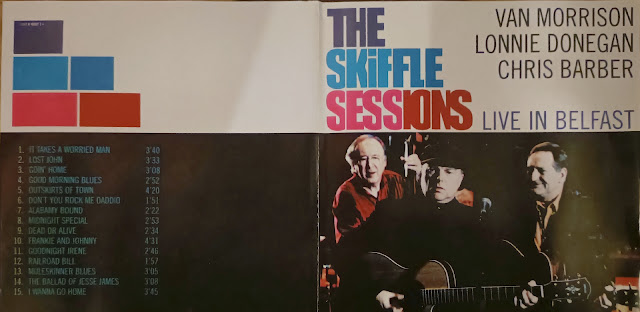
Van Morrison, Lonnie Donegan & Chris Barber "The Skiffle Sessions: Live in Belfast" 1998(rec) 2000(released)***

Like any grammar school essay, this review will start with a Wikipedia definition "Skiffle is a genre of folk music with influences from American folk music, blues, country, bluegrass, and jazz, generally performed with a mixture of manufactured and homemade or improvised instruments". It became immensely popular in the UK during the late 50's, to be subsequently forgotten; but not before leaving an important legacy in its wake: the success of skiffle convinced British youths that one doesn't have to be black to play jazz and blues, or a hillbilly to play country; if a Scotsman like Lonnie Donegan can do it, they thought, so can we. So they went on and bought themselves their first guitar - or made themselves one from scratch, using a cigar box and some wires. Thus, in 1956 Liverpool, John Lennon started a skiffle group called The Quarrymen; pretty soon Paul McCartney and George Harrison joined in. The skiffle craze passed the Irish sea, infecting Rory Gallagher and Van Morrison who also proceeded to form bands playing in this idiom. Individual Rolling Stones started their career playing with Alexis Korner, who was Chris Barber's guitarist at the time. Barber introduced trad jazz to the UK; his idea to include folk and blues songs into his repertoire is what gave birth to British Skiffle music. Donegan, a former member of Barber's band, struck out on his own, and had a huge hit in 1955 with a sped-up version of traditional folk blues "Rock Island Line". For a few short years, he was the biggest star of British radio, to be subsequently completely forgotten - by everyone, it seems, except Van Morrison, who organised his reunion with Chris Barber's band for this concert and CD. It's obviously a work of love, a most warm and convivial affair. Barber plays bass and trombone, while Donegan and Morrison share the lead vocal duties; if the latter is the better singer, the former's voice carries more authenticity to the project. Dr. John adds his New Orleans-style piano on two songs, "Good Morning Blues" and "Goin' Home". The presence of an American could be construed as an anomaly in an album that offers homage to a British phenomenon, but, seeing as it all began as an attempt to bring the music of New Orleans to Britain, one can see it as the closing of a circle: an American jazzman paying tribute to Brits paying tribute to American jazz and folk. The material leans heavier on jazz and blues than folk and country, somewhat inverting the analogy of original skiffle. The choice of overtly familiar material (traditionals, songs by Woody Guthrie, Leadbelly, Jimmie Rodgers etc.) is the weakest feature of this collection; one can immediately recall a better-known (or better performed) version of each tune here. I was surprised to hear them close the CD with "I Wanna Go Home", which I knew as The Beach Boys' "Sloop John B" from Pet Sounds. Little did I know that it's a traditional Bahamian tune which has been recorded by various folk singers over the years - Donegan's own version predated The Beach Boys' by 5 years. According to the liner notes, the concert is unrehearsed, which sounds unbelievable considering the perfect coordination between the musicians. I guess the lack of rehearsal time accounts for the fact that they chose these famous songs that everybody was already very familiar with. Ultimately, there's not much here that's novel or particularly interesting; just a fun, good-natured, exercise in nostalgia by the progenitors of British blues and rock - which is enough for me. It certainly was nice to see Donegan rise from decades of obscurity; this (his last ever) recording, together with a honorary MBE by the Queen in the same year, served as belated recognition of his important contribution to British music before his sudden death from a heart attack in 2002.
**** for It Takes A Worried Man, Goin' Home, Good Morning Blues, Outskirts Of Town, Goodnight Irene, I Wanna Go Home
*** for Lost John, Don't You Rock Me Daddio, Midnight Special, Dead Or Alive, Frankie & Johnny, Railroad Bill, Muleskinner's Blues, The Ballad Of Jesse James