Showing posts with label Neofolk. Show all posts

Thursday, 16 April 2026

Pazuzu "Awaken The Dragon" 1996***

I remember finding this CD in the clearance bin of the Metropolis record store in Athens. It was almost 30 years ago, and I was with a friend who advised me to buy it. He was into epic/power metal, but this was, according to him, a "folk" CD, which he was sure I would like. Now how could he possibly have known about folk albums, especially ones that I had never heard of? I had my doubts, but it was cheap enough for me to take the risk. At the time there weren't any streaming platforms, youtube and whatnot - if one wanted to know whether a record was good enough to buy, they'd have to wait until they heard it on the radio, or ask a record store clerk to play it for them (not too likely), or rely on the opinion of others, either friends or music critics. 

My friend must have heard it on some kind of metal radio show, seeing as Pazuzu (not to be confused with the newer band Oranssi Pazuzu from Finland) were a side project of Austrian Black Metal band Summoning. Summoning's lyrics was heavily Tolkien-inspired (sample titles from their discography: Minas Morgul, Dol Guldur) and Pazuzu (named after an ancient Messopotamian demon) deal in similar themes, while their music is of an appropriately medieval nature: one can imagine a song like the upbeat "Bal Of Thieves" playing at the Prancing Pony, while revelers dance merrily and, at one corner, Thorin the dwarf enlists the help of the grey wizard in his daring scheme to reclaim the stolen dwarven gold from a certain winged serpent. Now this isn't the story behind this CD, but it might as well be; after all there is a dragon here, too, and he is awakened. The music belongs to a genre I'm not really familiar with: people call it dark ambient or dungeon synth. Very much inspired by medieval folk, but darker and more atmospheric, making heavy use of synths often emulating the sound of traditional instruments like the harpsichord, as in "The Five Emperors". The song "Pazuzu" has a Dead Can Dance-like oriental melody, while "King Of Vermin" is the only track that reminds me of Black Metal because of the guttural "demonic" vocal. There are, of course, also lighter songs like the sea-shanty-like "In A Tavern" and the elegant "Royaume Des Rèves (Baronnesse Chap. II)" which features a female narrator speaking in French. "Outro" is a strangely ill-fitting new wave instrumental, while "Verfal" has a German (male) narrator using a theatrical but rather normal voice. Mostly, though, the narration employs a more sinister tone. The main narrator reminds me of Laibach's Milan Fras - especially when he talks in German, as in the appropriately funereal-paced "Im Mondschein (Die Tragik Des Todes)". Another similarity to the Slovenian band lies in the military-style drumming and heavy Wagnerian synths; but while Laibach have achieved cult recognition, Pazuzu are laughed at outside a very small circle of "dungeon synth" fans. I guess the main reason is that their subject matter and medieval fantasy obsessions are perceived as "silly". On the other hand, if you're a Dungeons & Dragons fan, you may have just found the perfect soundtrack for your role-playing games. Not that I am; after all, Dungeons and Dragons players are notoriously nerdy. Unlike, for example, Heroes Of Might And Magic. If I'm not mistaken, Part II of that video game came out around the same time that I bought Awaken The Dragon; I spent many hours playing  HoMM2 with this CD on repeat. Listening to it again after all these years, I can't help but feel nostalgic for the days that I could afford to waste countless hours on silly stuff like that without remorse.

*** for Awaken The Dragon - Millennium Two, The Five Emperors, Bal Of Thieves, Royaume Des Rèves (Baronnesse Chap. II), Until The Sun Returns, In A Tavern, Pazuzu, Outro

** for The Messenger And The Spiritwind, The King Of Vermin, Verfall, Im Mondschein (Die Tragik Des Todes)
Friday, 31 May 2024

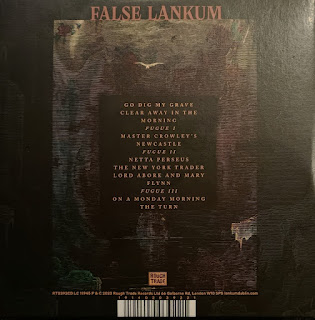
Lankum "False Lankum" 2023****

I was recently in Utrecht to see Lankum, an Irish group that's been the talk of last year in music magazines: their latest album topped end-of-the-year lists by Uncut and The Guardian, rose to No.3 in MOJO's list and No.2 here in The Netherlands (in OOR's list) - I can't remember another folk group ever receiving such honors! Nobody knew them before, and even now no-one I told about the concert had heard their name. But apparently the hype works, because Tivoli's grote zaal was sold out. The band justified all the great reviews, with a mesmerizing performance of their latest album - in sequence. Usually I don't care for concerts where the artist only focuses on their latest work, but this was billed as Lankum presents False Lankum, so I knew what I was getting into. The band played sitting down; theirs isn't music to dance to. If my mentioning Irish music had you thinking Michael Flatley's Lord of the Dance, you couldn't have been further from the truth. But they had great rapport with the audience: I can't remember another band getting such a warm reception in years, and they also chatted with the crowd like with old friends - their heavy Irish accent hampering communication only a tiny bit.

The concert started as starkly as the album does, with Radie Peat's enchanting voice singing the hair-rising lyrics acapella "Go dig my grave/ Both wide and deep/ Place a marble stone/ At my head and feet". Not exactly "Seven Drunken Nights", but as I already said, Lankum are drawn to the more somber side of Irish traditional music - and that's a pretty rich seam to mine. As the song progresses, other instruments join the singer's voice, the funereal drum and hollow drone dominating the second part of the song. In concert, the audience held their breath during the 8+ minute opener and the subdued follow up "Clear Away in the Morning", erupting in thunderous applause only after the medley (also including short instrumental "Fugue I") ended. These are followed by a seemingly traditional-style reel called "Master Crowley's". As Lankum are prone to do, halfway through the track they add a cacophony of screeching noises which lend a threatening tone to this simple instrumental tune. I don't know exactly how the droning background sound is produced; they feed the hurdy gurdy, concertina, and keyboards through a console which somehow distorts the sound, while during the concert they also had another guy at the sound desk, adding electronic effects - if I understood correctly, that was False Lankum producer John Murphy. In contrast to the disquieting instrumental that preceded it, "Newcastle" charms us with the fragile beauty of Radie Peat's lead vocal and excellent band harmonies. By the end of the concert, each member (apart from the drummer) had sung lead at least in one song; Radie isn't the only good singer in the band, and their ability to harmonize is among their greatest strengths. "Netta Perseus" begins with gentle acoustic guitar and violin, again descending into noise. This was, for me, the first misstep in the album; I felt that they ruined a perfectly good song by unnecessarily adding their trademark effects which not every tune calls for. "The New York Trader" now, yes. That story of a murdering captain, stormy seas, and mutinous crew calls for darkness and Lankum offer it plenty. The switch among light and dark continues, with the pastoral folk of  "Lord Abore and Mary Flynn" and "On a Monday Morning" alternating with more intense tracks like instrumental "Fugue III" and marathon closer "The Turn" which starts off with soothing harmonies but ends in dissonant feedback and electronic noise. This approach may not benefit each and every song, but it's Lankum's personal touch. It adds an extra layer of intensity to their otherwise morose song choices, it helped them rejuvenate traditional folk, and endeared them to both critics and fans of avantgarde/drone/math rock who wouldn't otherwise have come into contact with the treasure trove of the traditional Irish songbook. Despite its moments of spellbinding beauty and fierce intensity, False Lankum still makes for demanding listen. It won't be everyone's cup of tea, but the accolades it received were undeniably well deserved.

***** for Go Dig My Grave, Clear Away in the Morning, Newcastle, The New York Trader

**** for Master Crowley's, Lord Abore and Mary Flynn, On a Monday Morning, The Turn

*** for Fugue I, Fugue II, Netta Perseus, Fugue III

Thursday, 31 October 2019

Paul Roland "Masque" (Greek ed. Di Di Music) 1990🎃🎃🎃🎃

Halloween tonight, and there are a number of ways for someone to celebrate it: trick-or-treating obviously, or partying with friends in your Halloween costumes. At the very least one can sit home watching a horror movie: John Carpenter's Halloween maybe, or Friday The 13th. On occasion I've also posted reviews on Halloween-inspired albums like The Fuzztones' Monster A Go Go. If, however, you're less attracted to the camp side of the holiday, if you'd rather re-read Bram Stoker, Mary Shelley or Edgar Allan Poe instead of binge-watching The Walking Dead, Paul Roland might make for a more fitting Halloween musical accompaniment for you.
"Jack O' The Lantern and Will O' The Wisp/ The Devil's Legion rides out in the mist" - now isn't that an appropriate way to start my Halloween album review? These also happen to be the opening verses from Paul Roland's Masque LP. The song, "Dr Syn Is Riding Again", is a hard rock piece with a wild violin solo, and its subject is an 18th century smuggler known as "The Scarecrow". Pretty standard fare for Roland, whom Wikipedia describes as a "singer-songwriter, author, journalist and paranormal researcher". A veritable Renaissance man, one obsessed with the past and with stories of the occult and the macabre. As a musician, he's responsible for more than 30 albums, bringing to life a host of amazing characters: deviant artists, medieval knights, jesters and whores, Victorian murderers and alchemists, vampires, mad scientists, street urchins etc. His music is invariably described as psychedelic, neofolk, goth, progressive, you name it. In truth, although there are similarities to Syd Barrett, Donovan, Robyn Hitchcock, Marc Bolan and others, he's impossible to pigeonhole. His music is just the medium through which he delivers his stories. It's often semi-acoustic with some kind of orchestral backing, but I've also seen him play with a heavy rock band, and I've seen him accompanied only by a lady with a flute (on a beach festival at 2 in the morning, sandwiched between The Last Drive and garage rockers The Droogs). Masque followed on the heels of his hardest-rocking album, the Medieval-themed Duel, and presents us with a mixture of electric and acoustic stylings. There are upbeat rockers with loud drums, e.g. "Dr. Syn", "Mr Scratch" (in the words of Mr Scratch, a.k.a. Mephistopheles: "A fair exchange is no crime/What's a soul my friend for the guarantee of a hell of a time?") and "The Mind Of William Gaines". I always thought the latter (about scientists re-animating an abnormal brain to study its workings) was about a notorious murderer, but it turns out I had him confused with Ed Gein. William Gaines was just an editor of horror comics. It still has a very Halloween-ish, Hammer-horror type, vibe. But while the electric guitars and drums are present throughout the album, they mostly take a back seat to the violin and other strings, with a couple of songs ("Taxidermist", "Mr. Scratch") also featuring sax solos. "Pharaoh" (sung from the perspective of an ancient Egyptian royal mummy) is a slow Gothic tune with an oriental flute melody, while "Candy Says" is a catchy song about a child receding into her inner fantasy world and imaginary friends. "Triumphs Of A Taxidermist" is sung from the perspective of a serial killer who enjoys embalming and collecting victims (my favorite is the "salesman to whom I couldn't say no"). Grisly murder stories accompanied by tranquil violin melodies are after all a Roland specialty. "Grantchester Fields" paints an idyllic picture of the English countryside with, for once, no horrible implications (the "ghosts of summers past" are surely a figure of speech). Side 2 opens with "Masque", a melancholic piano ballad about an actor losing himself in the characters he portrays, while the slow orchestral "Cocoon" is about a scientific experiment gone awry, and "I Dreamt I Stood Upon The Scaffold" is a variation on the traditional Childs ballad "Gallows Pole", which was also covered by Led Zeppelin... only here, when the dreamer wakes from his nightmare, he finds himself in a prison cell with a priest and executioner standing above him. "Matty Groves" is another Childs ballad, mostly known from the Fairport Convention version although I first heard it here. And though Roland's voice can't compare to Sandy Denny's (few can, really), he paces the song well, and sings with the panache of a true storyteller: when I listen to him, I can feel Lord Donald's wrath before slaying his wife and her lover. The album then closes with a nice Celtic jig, appended to the end of "Matty Groves". That is, if you don't have the Greek edition of the album which adds a bonus EP with 4 more songs: "The Ratcatcher`s Daughter" is orchestral pop, probably inspired by the same-named 19th Century music hall number. "Sea Captain" is a nostalgic portrait of an old sea dog, the upbeat "Sporting Life" of a gambler and scoundrel, and "Baby Let's Play House" an unexpected Elvis Presley cover. The first 3 songs were later added to the album CD reissue, otherwise I'd urge you to seek this particular edition of the album - the bonus EP is that good.
***** for Candy Says, Matty Groves, The Sea Captain
**** for Dr Syn Is Riding Again, Pharaoh, Triumphs Of A Taxidermist, Grantchester Fields, Masque, The Mind Of William Gaines, I Dreamt I Stood Upon The Scaffold, The Ratcatcher`s Daughter, The Sporting Life  
*** for Meet Mr Scratch, Cocoon, Baby Let's Play House

Thursday, 22 October 2015

Paul Roland "House Of Dark Shadows" 1985 (LP comp) 1991 (expanded CD reissue)*****


Ask any musician for his influences and you'll get answers like The Beatles, David Bowie or John Lee Hooker. Paul Roland, I suspect, would come up with names like Edgar Allan Poe, HP Lovecraft, Jules Verne or Robert Louis Stevenson. His songs are steeped in mystery and gothic horror tales and populated by Victorian villains and adventurers. Often pegged as folk or neo-psychedelia, his music is sui generis: Sure, there's a strong 60's aura and echoes of Donovan, Roy Harper and Syd Barrett but also elements of Gothic, Progressive, New Wave, New Age and even Garage or Hard Rock. On stage they're mostly performed in a stripped-down acoustic manner without losing any of their ambience but studio versions may feature woodwind and string arrangements or electric guitars and loud drums. In the end it probably depends on the musicians accompanying him or the available budget but, regardless the packaging, it's the vocals and lyrics that manage to transport you to Roland's fantasy world. Each song is a visual mini-story ready to be painted on a canvas or expanded into a novel or a B-movie. Not surprising, since Roland is also renowned as a writer, having written a staggering 40 books on the subject of mysticism, crime and the occult - something I only found out when I checked his wikipedia page earlier today. Funnily enough my girlfriend, who wrote her PhD thesis on criminal profiling, only knew him from his true crime books but was unaware of his musical career.
"House Of Dark Shadows" collects early EP tracks and portions of his rare Werewolf of London (1980) and Burnt Orchids (1985) albums. As overview of Roland's work it's since been surpassed by other, more extensive, compilations but it remains a great collection of songs and makes for a good introduction to his style which hasn't changed much in the last 25 years. "Blades Of Battenburg" opens the album with some ominous organ, before setting in a classic rock sound, with a harpsichord solo for period effect. The lyrics are a typical example of Roland's style of verse: "Through the iron gates a carriage rolls/To the house, a mansion old/We are the blades of Battenburg/Downstairs our whispers are faintly heard...The halls are white, their shroud is cold/The vaults are sealed, their tales untold/Beneath a portrait of a brave young man/An old woman still in her bridal gown". "Burnt Orchids" is a dreamy acid folk ballad with orchestral backing while "Werewolves Of London" (no relation to the same-named Warren Zevon song) is a horror rocker with dramatic strings and saxophone set in  Victorian London. "Lon Chaney" is his tribute to the mysterious star of the silent movies who became known as the man with a thousand faces. He'd probably make the ideal interpreter for Roland's gallery of rogues presented in the next songs: "Dr. Strange", "The Puppet Master" and "Captain Blood". "Death Or Glory" is an anti-war new wave rocker and "Cairo" is an acoustic folk song with a suitably snaky Arabic melody which paints a romanticized picture of a decadent Oriental metropolis in the 1920's. "Green Glass Violins" is an orchestral ballad while "Flying Ace" is closer to country. "Ghost Ships" is an atmospheric song with...ghostly keyboards which reads like a poem by Edgar Allan Poe: "Looming through the fog glides the Ghost ship/ Rotting from crows nest to keel/ Not a soul was seen to steer her/Save a corpse lashed to the wheel". "Madelaine" is another of his eccentric characters ("as each year grows older, she grows more quietly insane"), brought to life with the help of a string quartet and kindred spirit Robyn Hitchcock. My CD version of the album is a 1991 reissue on the French New Rose label, containing extra tracks "Berlin" (an acoustic ballad praising the liberal and cosmopolitan air of that city in the 20's), live radio versions of the country-ish "Graveyard Train" and "Public Enemy", covers of Marc Bolan's "Hot George" and Buddy Holly's "Peggy Sue Got Married" and the bluesy "Jack Daniels". Like I said earlier, Paul Roland is one of a kind and his songs open a door into his fairytale world. Step right in...
***** for Blades Of Battenburg, Burnt Orchids, Werewolves Of London, Cairo, Madelaine, Berlin
**** for Lon Chaney, The Puppet Master, Captain Blood, Death Or Glory, Green Glass Violins, Flying Ace Ghost Ships, Graveyard Train
*** for Dr. Strange, Public Enemy, Hot George, Peggy Sue Got Married
** for Jack Daniels

Sunday, 7 June 2015

Swans "Love Of Life" 1992****


The Swans became initially known as an experimental noise-rock band that sprung out of New York's No Wave scene, an early incarnation of them also featuring Sonic Youth's Thurston Moore. The driving force of the band was guitarist/vocalist Michael Gira, but for a long period of time, he shared vocal and songwriting duties with keyboardist Jarboe. Jarboe's presence in the band coincided with a mellower acoustic sound - let's call it dark folk. This is only one of the ingredients in the (delicious) musical swan soup we're served here, however. Industrial, Goth and New Wave are just as vital. The presence of two lead vocalists allows us to change moods, as Jarboe's lighter, melodic vocals are counteracted by Gira's sombre baritone. Opener "Love Of Life" is a winner, dark yet accessible, propelled by tribal drums reminiscent of Joy Division or Siouxsie and the Banshees. "The Golden Boy That Was Swallowed By The Sea" is a dramatic ballad, this time with a whiff of pornography-era Cure. Curiously enough, Gira's tone also reminds me of the Byzantine psalms I grew up hearing in (Greek Orthodox) church. The album is interspersed with (unnamed) spoken word or musical snippets and, after two of those, we hear the first Jarboe lead vocal, a beautiful ballad with piano called "The Other Side Of The World". "Her" also starts off as a romantic acoustic number, but it is interrupted halfway by buzzsaw electric guitars and brutal drumming, later giving way to a teenage girl in the 60's speaking about the musical and youth revolution that went down in history as Summer Of Love. "The Sound Of Freedom" is a folkier song with a ringing quality that takes me back to Velvet Underground's debut. "Amnesia" is a goth rocker with hints of Joy Division and Sisters Of Mercy, also featuring some snaky oriental keyboard. "Identity" is an eerie atmospheric piece narrated by a child. After another short interlude, we continue with "In The Eyes Of Nature", another dramatic goth piece with pounding drums and pianos and atmospheric synths. After those, "She Crys (For Spider)" is like balsam, with its gorgeous melody and angelic Jarboe vocal. "God Loves America" is a funereal ballad lamenting the natural disasters brought by greed and consumerism: "All across America/The poison fires glow/And in the blood of our procreation/Annihilation grows...". Yet another snippet follows and the album closes with the stark acoustic ballad "No Cure for the Lonely". All in all, "Love Of Life" is an excellent album that will satisfy anyone with a  penchant for dark and atmospheric music. Keep your eyes open and if you see a copy in your neighborhood second hand store, don't hesitate. It's out of print and a new copy may cost you an arm and a leg. UPDATE: The album has now been re-released, both on standalone vinyl and (combined with White Light From The Mouth Of Infinity) on CD.
**** for Love Of Life, The Golden Boy That Was Swallowed By The Sea, The Sound Of Freedom, Amnesia, She Crys (For Spider)
*** for The Other Side Of The World, Her, Identity, In The Eyes Of Nature, God Loves America, No Cure for the Lonely