Showing posts with label Experimental. Show all posts

Wednesday, 14 October 2026

Hank Williams III "Ghost to a Ghost****/Gutter Town**" 2011

Would you buy a CD just because the singer is the grandson of a legend? Do you think that's what I did? Well, yes, I might not have picked up this album if not for Hank Williams' name on the cover. Because apart from the music, there's also a nice story tied to this album. You see, his dad, Hank Jr., had started out by copying Hank Sr.'s style as a surefire road to success, only developing his own personal style later in his career. But Hank 3 was the complete opposite: he started by playing in punk and metal bands, collaborating with members of bands like Pantera and Eyehategod. Then, when he was still in his early 20s, he was informed that some time ago he had fathered a son, and was now due to pay child support. Playing live drums in underground punk and metal bands wasn't going to cut it, so he decided to capitalize on his name and knock on the door of the country music industry. He wouldn't even have to sing: put a cowboy hat on his head, and he's the spitting image of his legendary grandfather—enough to give any true country music fan the chills. Nashville's Curb Records signed him on the spot. But Hank 3 didn't sell out; instead, he came up with his own idiosyncratic brand of outlaw country with a punk-rock attitude. But the 15 years he spent recording for Curb Records meant a constant struggle between the artist trying to defend his vision and the label trying to rein in his anti-conformist attitude. When he finally freed himself from his contract, his creativity was unleashed: he put out four albums simultaneously, each in a different style. Two of them were bundled together as Ghost to a Ghost/Gutter Town. Ghost To A Ghost is the more “mainstream” of the two, a rock-infused outlaw country affair built around standard country instrumentation, with banjo and fiddle up front. Its lyrics revel in hard livin’ — drinkin’ whiskey, shooting guns, drivin’ trucks, chasing casual sex, the whole mythology. At times, he even sounds like ol’ Hank Sr., though I can’t picture Senior singing “I’m lookin’ all around / tryin’ to find me a girl / Who wants-to-fuck!” (“Don’t Ya Wanna”). Then again, I can’t imagine any country fan remaining indifferent to this infectious tune, with its party fiddle, accordion, and Southern rock guitar solos. "Gutter Town" and “Outlaw Convention” are similarly upbeat classic country, while “Day By Day” gallops along with a Southern rock feel. “Ridin’ The Wave,” meanwhile, hurtles toward metal and punk territory, albeit with banjo and other traditional country instruments in tow. “Ray Lawrence Jr.,” featuring the eponymous singer, strips things back to rough-hewn acoustic country, before two haunted ballads, “The Devils Movin’ In” and “Time To Die,” the latter featuring mournful violin. Perhaps sensing that things are getting too serious, he follows up with “Troopers Hollar,” a raucous number featuring his dog Trooper hollering on lead vocals. “Cunt Of A Bitch” is a questionable affair mixing punk, country, and hip-hop, but the album saves its best for last. The title track, “Ghost To A Ghost,” pairs cinematic strings with a tango-like rhythm and Tom Waits’ unmistakable growl. Even Trooper’s barks blend into the arrangement, helping shape a highly idiosyncratic, dramatic near-masterpiece. The second CD, Gutter Town, is by far the more experimental of the two, with several tracks peppered with sound effects, from croaking frogs and howlin’ dogs to out-of-tune organs and other assorted noises, like the soundtrack of a horror movie set in the Deep South. There are rewards to be found amid the chaos, though: a handful of boisterous zydeco numbers give Hank 3 a chance to try his hand at Cajun French (“Gutter Stomp,” “Musha’s,” “Dyin’ Day”), while a trio of raw, underproduced country tunes (“I Promised,” “Move Them Songs,” “I’ll Be Gone”) offer a more traditional counterpoint. There’s also a bizarre sea shanty featuring Les Claypool of Primus ("With The Ship"). Once again, the highlight is a Tom Waits collaboration: “Fadin’ Moon” is a Louisiana-inspired number whose earthy instrumentation and theatrical fiddle lend it a wonderfully offbeat character. All in all, Ghost To A Ghost/Gutter Town finds Hank 3 at his most uninhibited. The first disc delivers his trademark Hellbilly sound in all its glory, pitting honky-tonk and outlaw country against metal-inflected aggression. It's hardly commercial fare, but fans of outlaw country and alternative rock should find plenty to enjoy, even if traditionalists who worship at the altar of his legendary grandfather are likely to recoil. Gutter Town, meanwhile, ventures into territory no country label would have allowed him to explore, wandering through the shadowy, swamp-soaked corners of his musical imagination. It would probably have been too weird to enjoy on its own, but paired with the more accessible first disc, it completes a gloriously unruly portrait of an artist who was never going to fit anyone else's idea of country music.

 **** for Gutter Town, Day By Day, Ridin' The Wave, Don't Ya Wanna, Time To Die, The Devils Movin' In, Outlaw Convention, Ghost To A Ghost

*** for Ray Lawrence Jr. Cunt Of A Bitch, Gutter Stomp, Musha's, Dyin Day, I'll Be Gone, Fadin' Moon

** for Troopers Hollar, The Dirt Road, I Promised, Chord Of The Organ, Move Them Songs, The Low Line, Thunderpain, I'll Save My Tears, With The Ship

* for Goin To Gutter Town, The Dream Of Before, Troopers Chaos, Chaos Queen, The Round, It's Goin Down

Saturday, 7 February 2026

Brigitte Fontaine "Est... Folle" 1968(orig.) 2025(reissue)*****

I had previously heard of Brigitte Fontaine, but was under the impression that she was just another French Chanson singer, like Dalida maybe, or Francoise Hardy. Then I read an article about this reissue which mentioned her as an avant-garde artist, someone in synch with the contemporary psychedelic scene. Apparently, her fans include Bjork as well as and members of Pulp, Stereolab, and Sonic Youth. Now these are some big endorsemenets, so I decided to check the album on Spotify, and was immediately hooked: the music is not as experimental as I expected (apparently, her subsequent work would be), sounding more lke a mix of chanson and acid folk. The orchestration (by Jean Claude Vannier, a Serge Gainsboug collaborator) is gorgeous but nuanced; not just beautiful, but also sometimes morose, others playful, even ironic. It reminded me of another favorite of mine from the same period, Tom Rapp's Pearls Before Swine - the similarities extending beyond the music also to the Hieronimus Bosch homage of the album cover - PBS used part of The Garden Of Earthly Delights triptych for their One Nation Underground LP cover, and a number of details from the same painting are incorporated here. At the time of this album's release, Fontaine was almost 30 years old, already accomplished as an actress and playwright; although it was the height of the yé-yé girls phenomenon, she refused to play along; there may be some similarities to Hardy at her more melancholic ("Il Pleut", "Une Fois Mais Pas Deux"), but more often she reminds me of Jacques Brel, especially on the more theatrical/cabaret-like numbers (e.g."Comme Rimbaud", "Je Suis Inadaptée"). Despite the relatively jaunty music, the lyrics are ironic and confrontational e.g. the former goes "I'm dirty, like Rimbaud/ Syphilitic, like Beaudelaire/ But maybe you don't like poetry, after all". She continues by trashing the luminaries of other art forms, and ends up with "I'm not a man, like Joan of Arc/But maybe you don't like women, after all". The latter song, meanwhile, confesses "But I can't help it/ I have to see the bad in everything/ I'm out of it, maladjusted." So yes, these are not your typical 60s yé-yé themes. It's way more interesting, provocative, and poetic. Thankfully, the bilingual insert contains the lyrics, both original and in the English translation. "Le Beau Cancer" and "L' Homme Objet" offer more sprightly Gallic jazz - if you liked the Amélie soundtrack, they will be right up your alley. "Il Se Passe Des Choses" and, especially, the melancholic "Dommage Que Tu Sois Mort" remind me of Nico circa Chelsea Girls - a likewise avant-garde female artist whose solo debut was also a compromise between their own experimental tendencies and a producer's idea of a romatic chanteuse. Not that that's a bad thing, mind you; in both cases the tasteful arrangements are among the best features of the respective LPs. "Il Se Passe Des Choses" is even darker, with a dramatic Marlen Detrich-esque vocal, and "Blanche Neige" is an experimental ballad, full of playful sonic touches and exotic sound effects. Somehow I was reminded of Siouxsie's side project, The Creatures. Which brings us to another experimental piece, "Eternelle". Probably my favorite track here, it's a rhythmic piece with quirky backing vocals. The album closes with "Cet Enfant Que Je T’Avais Fait" a duet with Jacques Higelin, a fine piece of orchestral pop; the similarites with Vannier's famous arrangments for Histoire de Melody Nelson are obvious. One of the perks of this latest reissue (apart from the crisp remastered sound, gatefold cover and glossy insert) is that it allows you to experience Vannier's orchestral work on its own, as the bonus LP contains instrumental versions of 7 of the tracks. We also get 8 demos, giving the songs a starker feel; they sound folkier, but definitively still weird. Lastly, we get a live version of "Il Pleut" from 1969. It's radically different; at 6 minutes it's more than twice as long as the studio version, bluesier and more improvisational, with a passionate vocal performance including a lot of wordless vocalizing. Her next album, which many consider to be her best, was a more experimental collaboration with the Art Ensemble of Chicago. She'd go on to produce other uncompromising records that sailed among pop, folk, electro and world music, which I aim to slowly get into. Brigitte Fontaine Est...Folle is, in any case, a great introduction; a highly idiosynchratic mesmerizing fusion of French chanson, orchestral pop and Velvet Underground-like 60s avante -garde. Best new album I've heard in months.

***** for Il Pleut, Le Bleu Cancer, Il Se Passe Des Choses, Une Fois Mais Pas Deux, Eternelle

**** for L' Homme Objet, Blanche Neige, Comme Rimbaud, Dommage Que Tu Sois Mort, Je Suis Inadaptée, Cet Enfant Que Je T'avais Fait

**** for all of Disc 2 (demos, orchestral, and live versions)

Saturday, 27 December 2025

These Trails "These Trails" 1973*****

This is another album I hadn't heard in many years. When I took this out for a spin, I thought "I remember this, it's a good one - native American acid folk". Close enough: it's really Hawaiian, but there really is a crucial native element here, as the music and lyrics are steeped in that island country's tradition and inspired by its tropical landscape. Maybe the font used on the cover played tricks with my memory, as it reminded me of old Western movies. The songs are mainly the work of a local couple: singer/guitarist Patrick Cockett was a native Hawaiian and student of traditional music, while singer-songwriter Margaret Morgan was a Hawaiian-born white girl from an old and distinguished family of sugar plantation owners. She was away studying in California, but they met at Hanalei beach in Kauai island during her college break, bonding over music, and ended up living together in a rural Hawaiian setting for a while. Her vocals are one of the most defining elements of the album: fragile and dramatic, reminiscent on occasion of Kate Bush or maybe Joni Mitchell, but with a pronounced vibrato often compared to Donovan. The songs initially only featured Margaret on lead vocals and dulcimer, with Patrick on vocals and acoustic guitar, using both traditional Western strumming and the Hawaiian slack key style. They must have already sounded quite nice in a folky kind of way, but it's when they took the songs to the "big city" (in this case, Honolulu) that magic happened: At Sinergia studios they were introduced to Dave Choy, sound engineer and ARP synthesizer pioneer, whose experiments with electronic music turned out to blend unexpectedly well with the couple's acoustic pastoral sounds. Another important element was Uruguayan composer/guitarist Carlos Pardeiro who joined the band in the studio, as did their friends Eric Kingsbury on guitar and Ron Rosha on the ipu, a percussion instrument made from gourds, commonly used to provide the beat for hula dancing. Last (and, from a musical point of view, probably least) of the contributors mentioned in the liner notes is Boogie Kalama, a surfer friend of the couple. He's credited with "feet" - no he doesn't stomp his feet or anything like that on record, it's just his feet that we see on the front cover photo. Opener "These Trails" is a short acid folk tune strongly reminiscent of Incredible String Band. "Our House In Hanalei" celebrates rural island living, and has a more definite Hawaiian feel, with soft percussion and beautiful harmonies. The use of the melodious pidgin dialect makes it even more charming. "Of Broken Links" is an atmospheric piece with multi-tracked harmonies while "El Rey Pescador" is a Spanish language track written by and sung with Carlos Pardeiro, who also adds some nice sitar textures. South American, Pacific, and Indian influences blend remarkably well here. "Psyche I" is an acoustic guitar instrumental that segues into "Share Your Water". The combination of ethereal female vocals and electronic effects reminds me of a 60s psychedelic band called The United States Of America. If you're not familiar with their work, you should check them out. It's followed by "Hello Lou", a delicate folk duet with string and synth orchestration reminiscent of Robert Kirby's work for Nick Drake. "Rusty’s House" is an unadorned folk tune segueing into the more cosmic and richly orchestrated "Lost in Space" with ARP simulating the sound of ocean waves. "Psyche II" continues from where "Psyche I" left off, adding more synthesizer sounds. "Sowed a Seed" is another experimental track with weird synth sounds and dulcimer, followed by the more conventional folk of "Rapt Attention". "Waipoo", named after the waterfall in Waimea Canyon, is full of naturalistic imagery and lush strings, and closer "Garden Botanum" is a quietly exuberant celebration of flowers and nature, full of arpeggios and synth washes. All in all, this timeless album resembles nothing else I've ever heard: yes, the words and vocals have this twee 60's hippy flower power element, but then the traditional Hawaiian instruments give it an ancient earthy feel, while the experimentation with early electronic music has a retro-futuristic effect akin to witnessing 2001:A Space Odyssey. These Trails is a singular album. Eccentric as hell, yet approachable and utterly enchanting. It's really a time capsule—an intimate snapshot of two musicians (and their circle of friends) channeling their surroundings into music. The record is credited to These Trails, but there was never a band as such; it was a title chosen by Choy because the record had to have a name. There were never any public performances of the music, and no follow-ups. Under pressure from her family, Margaret returned to college never to record music again; she didn't even stay long enough to listen to the final form given to her songs. Patrick has sometimes appeared playing alongside folkies Taj Mahal and Buffy St. Marie. The limited pressing of this LP sold out pretty quickly, for it to gradually became one of those rarely heard legendary collectors' items. Of course original copies are beyond the reach of most of us, but even reissues aren't easy to come by, so if you come across a copy, don't hesitate to grab it.

***** for Of Broken Links, El Rey Pescador, Share Your Water, Hello Lou, Lost in Space, Our House in Hanalei, Waipoo 

**** for These Trails, Sowed a Seed, Rapt Attention, Garden Botanum

 *** for Psyche I, Rusty’s House, Psyche II

Thursday, 11 December 2025

The Siegel-Schwall Band "Three Pieces For Blues Band And Orchestra/ Street Music (Russo)" 1972-1977(Rec) 1977 (comp)***

OK, I found this LP at the bargain bin of my neighborhood record store and it caught my attention; I don't believe I had ever heard of a blues/classical fusion work before. Rock yes, but blues not. And Siegel-Schwall sounded like a random choice for such a work - not highbrow enough, somehow. I got it, then tried to find out more about how it came to be. Apparently, Japanese orchestra maestro Seiji Ozawa actually got the idea of a blues/classical fusion work after seeing Siegel–Schwall Band perform live at a Chicago blues club - so, the band choice was anything but random. He pitched the idea to composer William Russo, who wrote the symphonic parts to Three Pieces for Blues Band and Symphony Orchestra as well as broad outlines for the blues parts, to be filled by the band themselves. The work debuted in 1968; at the time, it was an unprecedented combination - the only similarly bold experiment in roughly the same period that I can think of was The Moody Blues' Days Of Future Past (1967). By the advent of prog rock in the early 70's, the combination sounded interesting rather than outlandish, so Siegel-Schwall went into studio to record the piece with the San Francisco Symphony, conducted by Ozawa himself. Side two featured a different work, Leonard Bernstein's Symphonic Dances from West Side Story. Three Pieces... opens with a minute-long atmospheric intro followed by a blues boogie with beautiful electric guitar; here the orchestra nicely compliments the blues band, which seems to have the upper hand. On "2nd Part", it's the orchestra that dominates. Guitar and piano enter after 3 minutes, and harmonica after 6:30. The playing of the blues band on "3rd Part" is excellent, but for me the piece is somewhat marred by the orchestra occasionally being too loud. While this is quite normal in a symphonic setting, it sounded too bombastic and out of place to my ears compared to the gentleness of the blues band. It makes for an interesting comparison with another, more successful fusion work: more than 20 years later, the same San Francisco Symphony, conducted by Michael Kamen this time, would play a concert with Metallica immortalized in the Metallica S&M DVD and CD. Here the orchestra would never overpower the band, sparring with the powerful metal rockers during the louder parts, and adding drama and nuance to the (relatively) quieter ones. The original LP issue was released by classical music label Deutsche Grammophon, and sold quite well, reaching number 21 on the Billboard Jazz Chart and number 105 on the Billboard Top 200. My 1977 reissue on Polydor is quite different, as side 2 features another Russo composition called Street Music: A Blues Concerto. Taken from a different Deutsche Grammophon LP, this piece was also recorded by the San Francisco Symphony conducted by Seiji Ozawa. Since Siegel-Schwall had disbanded, it only features Corky Siegel on harmonica and piano. It consists of 4 movements: the first one opens with a mourning harmonica whose sound blends well with the strings; after 3 minutes the symphonic parts takes completely over. To me it sounded like the music of a movie or ballet, going through various moods that seemed to comment on something invisible happening onstage. The "2nd Movement" consists of alternating passages of boogie woogie piano and classical, never really integrating. The combination works better on "3rd Movement", while "4th Movement" starts with an upbeat harmonica intro, followed by classical segment, then a segment with nice harmonica/orchestra interplay, and ends with a bombastic symphonic coda. As a whole, I find "Street Music" rather less engaging, as I missed the blues guitar, but Corky Siegel's performance on harmonica is insanely good. He convinced me for the first time that this "humble" yet versatile and very expressive instrument actually has a place in classical music, which I never would have thought before. To summarize, I thought the blues playing by the band is particularly strong, while the symphonic part sounds great when it blends well with the blues. When it takes over, it sounds just like a random classical piece - or, to be more accurate, like soundtrack music. In any case, an interesting experiment which may sound pompous as an idea but it certainly has its moments.

Three Pieces For Blues Band And Orchestra: 1st Part****,  2nd Part***, 3rd Part*** 

Street Music: A Blues Concerto 1st Movement***, 2nd Movement**,  3rd Movement***, 4th Movement***

The liner notes, translated from German

Wednesday, 24 September 2025

The Smile "Wall of Eyes" 2024****

I read recently that Radiohead are touring Europe again; I honestly can't remember them ever playing in the NL in the 16 years I've been living here. Of course, maybe they did and it went by me, or I couldn't get tickets - otherwise I would have been there. Thankfully I did get to see them play live at Lycabettus theater in Athens some 25 years ago, around the time they escaped mainstream indie rock to delve into experimental electronic prog or whatever Kid A was. I just looked at the tour schedule and there aren't any NL dates planned. I don't know if I would go to their concert anyway, because of the boycott call by pro-Palestinian organisation Boycott, Divest and Sanctions (BDS). Musicians like Roger Waters and Brian Eno are on the forefront of that movement, others like Patti Smith, Serj Tankian, Rage Against The Machine etc. have been vocal in their support for BDS. On the other side of the argument there are also some artists I respect, including Radiohead and Nick Cave. In the recent past, they refused to join the boycott arguing that “playing in a country isn’t the same as endorsing its government”, or that one should not "punish" the citizens of a country for the acts of their government. They also cast reasonable doubts over the effectiveness of such measures: it took almost 30 years for the South African apartheid regime to fall, despite a successful boycott in culture, sports, etc. Of course, currently it goes deeper than apartheid: there's a recognized genocide under way, so the argument for a cultural boycott is way stronger now. Yet Johnny Greenwood of Radiohead and The Smile has spent part of 2024 and 2025 in Israel, collaborating with Israeli artist Dudu Tassa. Furthermore, according to BDS, Tassa "has repeatedly entertained genocidal Israeli forces in between these massacres of Palestinians in Gaza, willingly acting as a cultural ambassador for apartheid Israel". So Greenwood isn't just working with a random Israeli but a with supporter of IDF war criminals. Staying, I wager, politely silent while a few kilometers further, the IDF is involved in massacres. I myself am inclined to agree with BDS. I do think that by ignoring calls for boycott, artists are showing support, or at least, tolerance of the genocidal regime. Someone has to tell the Israeli people that shooting and starving children to death is not OK. And it can't be a perceived enemy. It has to be someone they love and respect, ideally one of their favorite artists. Issuing, as Thom Yorke did, a lukewarm statement condemning Netanyahu's "extremism" and asking for moderation by both sides (that is, the butchers and those trying to stop the slaughter) is a cop out, not brave resistance to peer pressure as Mr. Yorke wants us to think. 
Wow, it's been some time since I went off topic waxing political like that. Ι really did start writing with nothing but the presentation of this CD in my mind, but stream of consciousness brought me to the Gaza genocide topic. I guess it never completely leaves me, a sense of disgust for Western hypocrisy and the pampering of "our" war criminals. One expects it from the likes of Trump, but not from "sensitive" and "progressive" souls like Yorke.
Anyway, I may disagree with Mr. Yorke and Mr. Greenwood's artwashing of Israel, but I wouldn't put them in a box together with active supporters of Netanyahu's actions, so I'm not about to stop listening to their music. It would have been a pity to do so, when it's as interesting as their recent collaboration with drummer Tom Skinner (ex-Sons of Kemet) in The Smile. The three of them started playing together during the COVID-19 pandemic, releasing their debut A Light for Attracting Attention in 2022. The inactivity in the Radiohead front, combined with the appearance of this second Smile album, must have worried Radiohead fans - I'm sure they welcomed the announcement of this mini European tour with sighs of relief. But even if Radiohead's absence from recordings continues, The Smile have provided us with a great alternative: Thom Yorke's fragile falsetto and Greenwood's symphonic ambition and electric guitar outbursts, together with their willingness to experiment, are the main features of Radiohead's music anyway. Skinner brings a jazz-informed elasticity with complex, feel free-flowing rhythms, and constant time changes. "Wall of Eyes" opens the album with a soft bossanova beat and atmospheric strings. It's almost too pretty, so The Smile purposefully destroy the melody by adding some dissonant notes during the last half minute. "Teleharmonic" has a hypnotic quality with woozy synths and inventive drumming, while "Read the Room" is more tense with spiky post punk guitar and fluctuating speed and volume. "Under Our Pillows" shows the band's kraut rock obsessions: I liked its motorik beat, the electronic bleeps and Tangerine Dream-like synth coda not so much. In contrast "Friend of a Friend" is almost Beatlesy melodic, featuring nice piano, soft vocals and lush strings culminating in "A Day In The Life"- like crescendo. In contrast to the sweet music, the lyrics are an attack to corrupt politicians and their business friends using the pandemic for personal profit. "I Quit" is another atmospheric piece with a sampled guitar loop and cinematic strings. "Bending Hectic" is an 8-minute epic: an orchestral ballad with soft fingerpicked guitar for 5,5 minutes, it then ups the tension with screeching guitar and sinister strings. "You Know Me!" closes the album with Yorke's familiar falsetto, clanging piano and swirling strings. All in all, Wall of Eyes comes across a lot like a new Radiohead album - with a twist. Which tells you all you really need to know about it.

**** for Wall of Eyes, Teleharmonic,  Read the Room, Friend of a Friend, I Quit, Bending Hectic
*** for Under Our Pillows, You Know Me!

Sunday, 16 March 2025

Laibach "Opus Dei" 1987 ****

I'm visiting friends and family in Athens, where I am originally from. We were having dinner with friends, when one of them (also called Kostas) said he was going to leave early to go to a concert. I asked who's playing and he replied "Laibach" who I knew to be of his favorite bands. I'm not as big a fan as he is, but I think they're a very original and interesting band, and so I tagged along. The band was supposed to tour behind their classic Opus Dei LP, which I also happen to like a lot. It's become quite a trend for bands to perform a classic album in its entirety, followed by an encore featuring hits from the rest of their discography. I've been to such concerts by U2, The Who, Opeth, Love, etc. Laibach opted for a different approach: after an endlessly repeated drum loop that went on for an hour, they opened with some rather experimental, often discordant, songs, which I didn't recognize. As it turns out, these were early album cuts beloved by the fans, but not very likely to win over new ones. The presentation was nevertheless flawless: Milan Fras was half singing - half reciting slogans mimicking the language used by totalitarian regimes, while the screen presented  black & white film excerpts ranging from propaganda videos to news reel snippets to enigmatic weird stuff. After maybe 45' of this I was impressed but not won over, yet. It was the introduction of the second (female) singer that elevated the concert for me. Not only she added a more melodic semi-operatic element, but from that point on the discordant noise was toned way down and songs took on a more conventional structure while keeping all the typical Laibach traits: marching drums, Wagnerian keyboards, sharp riffs etc. A radical reworking of Dylan's "Ballad Of A Thin Man" gave way to their post punk cover of DAF's "Alle Gegen Alle". After a short intermission they continued with the songs from Opus Dei, followed by two remarkably beautiful ballads and an ironic but highly entertaining sing-along version of Foreigner's "I Want To Know What Love Is" - at that point they had been playing for more than 2 hours without losing steam, having frontloaded their setlist with the "difficult" stuff at the start, and ending with the crowd pleasers. For the 2nd encore, they treated us to "Strange Fruit"; a menacing Billy Holiday cover that removed the melody and hit you hard with the lyrics while images of a bombed-out city (Berlin? Gaza? Mariupol?) played at the background. All in all, not a performance one is likely to forget any time soon.
I guess I should start with a short introduction: Laibach is an art collective rather than just a rock band. Their music, interviews, performances, and record artwork, form an aesthetic that both simulates and satirizes the art favored by totalitarian regimes, drawing comparisons between pop culture and fascism without ever being explicit about it - indeed they embrace that esthetic with a straight face, leaving the listener to decide whether they're seriously influenced by fascism or mocking it; "We are fascists as much as Hitler was a painter" they've declared. The band was formed in Slovenia, then part of communist Yugoslavia, around 1980 - Laibach is the name Germans used for Slovenian capital Ljubljana during its occupation by the Nazis. The use of the German language and Nazi-style artwork must have been a red flag (pun unintended) to the commissars, but somehow they managed to overcome censorship. In the beginning their music was more experimental, but by the release of Opus Dei in 1987 they had hit the right balance, as evidenced by the two covers opening this CD: "Leben Heißt Leben" is a German language cover of pop hit "Live is Life" by Austrian band Opus. It features martial drumming and trumpets, operatic vocals, and heavy metal guitar soloing. The same elements, including the use of German, are employed for "Geburt Einer Nation", their infectious cover of Queen's "One Vision". Those two represent the most commercial/entertaining side of Laibach, but the rest of the album is also quite accessible: the industrial metal "Leben - Tod" reveals Laibach as the prototype for future successes by Rammstein, while "F.I.A.T." is more cinematic/orchestral. This is followed by "Opus Dei", which is basically the second cover of Opus' "Live Is Life". This one is sung in English; compared to the German version this is more epic, less dark and oppressive. "Trans-National" is more experimental and atonal, focusing on drums and electronics. "The Great Seal" is an orchestral piece evoking the more heroic moments of Hollywood soundtracks, culminating in a recitation of Churchill's famous "We shall fight them on the beaches" speech. The CD version of the album adds 4, then still unreleased, tracks written for the stage: Krst pod Triglavom: Baptism was a play about the defeat of pagan Slovenian Slavs in the hands of Christian Germans, and their subsequent forced mass Christianization. These tunes are much more experimental, featuring martial drumming, orchestral parts, and excessive use of samples. I'm not one to complain for free extras, but I have the feeling that these bonus tracks deduct rather than add to one's listening pleasure; they may be interesting, but way too different and less accessible than the vinyl version. Only the last track ("Krst [Baptism]"), which basically mostly consists of slow and super loud drumming, blends well with the rest of the album. Interestingly, the band has just released a re-recorded version of Opus Dei, featuring the current touring band with the dual vocal talents of Milan Fras and Marina Mårtensson. It was on sale during the concert, but I decided against buying it. Much as I liked the new singer, I can't imagine them improving on this. It is a classic, hugely influential, album in the intersection of Goth, Industrial, Classical, and Metal genres, as well as a perfectly accessible introduction to a highly original, albeit "difficult" group. 5* for the LP version, 4* for the CD. 

***** for Leben Heißt Leben, Geburt Einer Nation, Opus Dei
**** for Leben - Tod, F.I.A.T., The Great Seal
*** for Trans-National, How The West Was Won, Herz-Felde, Koža (Skin), Krst (Baptism)
** for Jägerspiel

Tuesday, 18 February 2025

The Brian Jonestown Massacre "The Future Is Your Past" 2023****

I recently saw The Brian Jonestown massacre at 013 Pop podium, in Tilburg. Coincidentally, this was only three months after seeing their old frenemies (as presented in the famous Dig! documentary), Dandy Warhols. Since the two concerts weren't so far apart, the similarities and differences between  the two bands became more pronounced: musically, both bands seem to derive inspiration from the psychedelic 60s. The DW include more funk and electronic elements while The BJM have a more classicist approach. Both bands veer into experimental psychedelia, but not too far. Both have catchy songs, but only one found success, and the reason is probably their stage presence: The DW have a very energetic live act, while BJM singer/bandleader Anton Newcomb just stood on the side of the stage, facing the band rather than the audience, barely bothering to interact with anyone. Who was front and center, at the position of the frontman? the maracas player - no kidding, the band has a full-time maracas player! (OK, he occasionally also plays the tambourine). Not to mention 3 guitarists, including Anton himself. At some point, the keyboard player also took up a guitar, which brought us to a total of 46 strings: three 12-string guitars, a 6-string, and a bass playing onstage. A new record among concerts I have witnessed; the previous one belonged to Joanna Newsom and her band: Joanna Newsom plays the harp, which is a 34-string instrument, yet she comes second in this weird contest. In the end, Anton had a few angry words with his guitarist, and left without playing an encore. "Classic Anton" was the remark of the girl standing next to me. Now I know why he he needs so many guitarists in the touring band - they must quit on him all the time! 
Anyway, from the abundance of goodies at the merchandise stand (everything except vinyl, which they had run out of) I chose two CDs at random: this (because it was their latest) and an older one, because it contained the biggest amount of songs. It sounds about how I expected it to: as always, quality songwriting with nods to 60's garage and psychedelia, especially The Velvet Underground but also The Yardbirds, Stones, Doors, and early Pink Floyd. Also many similarities to the indie/shoegaze scene, but probably weren't influenced by them as they are contemporaries - The BJM have been around for 35 years now! The Future Is Your Past is their 20th LP; it was written along with its predecessor during the COVID-19 lockdown. Supposedly this ended a period of writers' block for him. Writers' block? the guy had released one album per year in the six years that preceded the pandemic! Anyway, during the pandemic Newcomb locked himself in the studio and came out with two virtually finished albums. Fire Doesn’t Grow on Trees was released first, and got slightly superior reviews, but the songs on The Future Is Your Past are no leftovers. Indeed it is a consistently good and varied collection, which makes me think that there's probably much more where it came from, left behind on the cutting room floor. Opener "Do Rainbows Have Ends" is a catchy melodic song with jangly guitars sporting a somewhat drawling vocal. This is followed by "Nothing Can Stop the Sound" another mid-tempo song with swirling Doors-y organ. I love the consistent and emphatic repetition of the title, which also makes for a great slogan. My girlfriend said it reminded her of Joy Division, which I wouldn't have thought of myself, but yes; the keyboards and vocal are similar - of course Joy Division were also massively influenced by The Velvet Underground and The Doors. "The Light Is About to Change" is a boogie with a heavy groove, while "Fudge"s dreamy intro gives way to hazy shoegaze psychedelia. These are followed by a bunch of slower, more experimental, tunes: "Cross Eyed Gods" (atmospheric, almost gothic) and "As the Carousel Swings" (strongly reminiscent of VU, of the John Cale period). "The Mother of All Fuckers" is a bit more drony/noisy, while "All the Feels" sounds like a Syd Barrett tune. The album picks up speed with a short and fast garage rocker ("Your Mind Is My Cafe"), and closes with "Stuck to Yous", a plaintive ballad slowly gathering steam to bring the album to a turbulent finale. I haven't listened to BJM's full discography, but this may be one of their best, and certainly most accessible, albums. The band included two songs from it in their setlist in the Tilburg concert, so these are the ones I chose as sample videos for this post. Enjoy!
**** for Do Rainbows Have Ends, Nothing Can Stop the Sound, Fudge, As the Carousel Swings, Your Mind Is My Cafe, Stuck to Yous
*** for The Light Is About to Change, Cross Eyed Gods, The Mother of All Fuckers, All the Feels

Friday, 25 October 2024

Nick Cave & The Bad Seeds "Wild God" 2024****

It's been 7 years since the previous time I saw Nick Cave & The Bad Seeds play live at Amsterdam's Ziggo Dome. That concert reminded me why they're one of my favorite bands, in a way that listening to their latest albums didn't; Nick has always been a terrific performer, but his desire to connect with his audience seems to be intensified after his personal tragedy. The loss of his teenage son was recent then, and his grief more palpable. This time, I had the impression that the healing process is well under way. Onstage, he inhabited -as he did in the past- various personas: the crooner sitting on his piano, the storyteller, the actor, the manic preacher, even the rocker - with ample help, of course, from the always fantastic Bad Seeds, augmented this time with a 4-piece gospel choir and Radiohead bassist Colin Greenwood. Only downside, to me, was the setlist; half of it was made up from the new album (they played 90% of it), with the other half cherry picking tracks from a deep discography of 20 or so titles.

Recent years had seen The Bad Seeds take a back seat while Cave and his current henchman Ellis drowned their albums in hazy synths. Additionally, Cave has lately often performed/recorded solo on piano, or as a duo with Ellis. To be honest, I wasn't thrilled with that direction, irregardless of the quality of the songwriting; The Bad Seeds are too good a band to be underused. Here, they make a partial return, as the song structure and instrumentation follows more conventional forms. Wild God sounds like a natural progression from Push The Sky Away moving towards a more ambient sound a la Sigur Ros or Spiritualized. Final mix was done by Dave Fridmann (Mercury Rev/Flaming Lips). When you know that, you can't disregard the similarities between album opener "Song of the Lake" and, say, The Lips' Yoshimi or Rev's Secret Migration - all those big, exhilarating, strings and choirs. The choir takes on an even bigger role on the uplifting title track, which is followed by the life-affirming "Joy" tracking the road from tragedy to redemption. It's the song that captures the spirit of Wild God best - Joy was initially going to be the album title, but Cave thought it might be too give the wrong impression, of one-dimentional happiness, when it's about overcoming adversity and finding joy in experiencing life in all its complexity and wonder. "Final Rescue Attempt" is closer to the piano balladry of his critically acclaimed Boatman's Call, with some judiciously applied electronic elements. "Conversion" sounds suspiciously close to something religious, but trust Cave to confuse the personal with the mystical; there's a talk of beauty, and of a girl, and love, of course, either personal or universal. Driven by the gospel choir, the song gets progressively more ecstatic with the repeated chorus of "touched by the spirit" and Cave repeatedly shouting "you're beautiful". "Cinnamon Horses" and "Long Dark Night" are a couple of gentle ballads, followed by "O Wow O Wow (How Wonderful She Is)", a poignant love song dedicated to former lover and bandmate Anita Lane, who passed away recently. The pair co-wrote "From Her To Eternity" during the early years of The Bad Seeds, and collaborated sporadically even after their separation. A recording of Anita nostalgically reminiscing about the old days renders the song even more heartbreaking. "O Wow O Wow" may not be among Cave's best compositions, but it's one of his most heartfelt and touching songs, and as great and generous epitaph as one could ever hope for. The album closes with "As the Waters Cover the Sea", a short song of openly religious nature ("As He steps from the tomb/In His rags and His wounds"... "He brings peace and good tidings to the land" etc). I guess it brings a nice closure to the album, but it's disappointingly unambivalent for Cave, more suitable for a collection of carol songs than for an album called Wild God. Musically, this is a better than average Nick Cave & The Bad Seeds LP, on a par with Push The Sky Away or No More Shall We Part - I will not compare it to their albums from the 80's/early 90's, which to me are untouchable. What's more important, though, and unexpected coming from an artist often portrayed as "dark" or "gothic", is its heart-warming message.

Right now there's also a limited transparent vinyl LP version available. I got mine from a record store in Belgium, as part of an "indie" package (I guess only available at independent record stores?) also including a Nick Cave poster and "Wild God" pin. The artwork is, as you can see, depressingly plain, somewhat inappropriately for an album that's meant to be celebrating joy. Except if the word is used ironically, as in "Joy Division".

***** for Wild God, Conversion 

**** for Song of the Lake, Joy, Final Rescue Attempt, Cinnamon Horses, Long Dark Night, O Wow O Wow (How Wonderful She Is)

*** for Frogs, As the Waters Cover the Sea

Friday, 31 May 2024

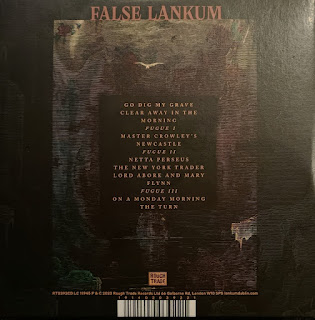
Lankum "False Lankum" 2023****

I was recently in Utrecht to see Lankum, an Irish group that's been the talk of last year in music magazines: their latest album topped end-of-the-year lists by Uncut and The Guardian, rose to No.3 in MOJO's list and No.2 here in The Netherlands (in OOR's list) - I can't remember another folk group ever receiving such honors! Nobody knew them before, and even now no-one I told about the concert had heard their name. But apparently the hype works, because Tivoli's grote zaal was sold out. The band justified all the great reviews, with a mesmerizing performance of their latest album - in sequence. Usually I don't care for concerts where the artist only focuses on their latest work, but this was billed as Lankum presents False Lankum, so I knew what I was getting into. The band played sitting down; theirs isn't music to dance to. If my mentioning Irish music had you thinking Michael Flatley's Lord of the Dance, you couldn't have been further from the truth. But they had great rapport with the audience: I can't remember another band getting such a warm reception in years, and they also chatted with the crowd like with old friends - their heavy Irish accent hampering communication only a tiny bit.

The concert started as starkly as the album does, with Radie Peat's enchanting voice singing the hair-rising lyrics acapella "Go dig my grave/ Both wide and deep/ Place a marble stone/ At my head and feet". Not exactly "Seven Drunken Nights", but as I already said, Lankum are drawn to the more somber side of Irish traditional music - and that's a pretty rich seam to mine. As the song progresses, other instruments join the singer's voice, the funereal drum and hollow drone dominating the second part of the song. In concert, the audience held their breath during the 8+ minute opener and the subdued follow up "Clear Away in the Morning", erupting in thunderous applause only after the medley (also including short instrumental "Fugue I") ended. These are followed by a seemingly traditional-style reel called "Master Crowley's". As Lankum are prone to do, halfway through the track they add a cacophony of screeching noises which lend a threatening tone to this simple instrumental tune. I don't know exactly how the droning background sound is produced; they feed the hurdy gurdy, concertina, and keyboards through a console which somehow distorts the sound, while during the concert they also had another guy at the sound desk, adding electronic effects - if I understood correctly, that was False Lankum producer John Murphy. In contrast to the disquieting instrumental that preceded it, "Newcastle" charms us with the fragile beauty of Radie Peat's lead vocal and excellent band harmonies. By the end of the concert, each member (apart from the drummer) had sung lead at least in one song; Radie isn't the only good singer in the band, and their ability to harmonize is among their greatest strengths. "Netta Perseus" begins with gentle acoustic guitar and violin, again descending into noise. This was, for me, the first misstep in the album; I felt that they ruined a perfectly good song by unnecessarily adding their trademark effects which not every tune calls for. "The New York Trader" now, yes. That story of a murdering captain, stormy seas, and mutinous crew calls for darkness and Lankum offer it plenty. The switch among light and dark continues, with the pastoral folk of  "Lord Abore and Mary Flynn" and "On a Monday Morning" alternating with more intense tracks like instrumental "Fugue III" and marathon closer "The Turn" which starts off with soothing harmonies but ends in dissonant feedback and electronic noise. This approach may not benefit each and every song, but it's Lankum's personal touch. It adds an extra layer of intensity to their otherwise morose song choices, it helped them rejuvenate traditional folk, and endeared them to both critics and fans of avantgarde/drone/math rock who wouldn't otherwise have come into contact with the treasure trove of the traditional Irish songbook. Despite its moments of spellbinding beauty and fierce intensity, False Lankum still makes for demanding listen. It won't be everyone's cup of tea, but the accolades it received were undeniably well deserved.

***** for Go Dig My Grave, Clear Away in the Morning, Newcastle, The New York Trader

**** for Master Crowley's, Lord Abore and Mary Flynn, On a Monday Morning, The Turn

*** for Fugue I, Fugue II, Netta Perseus, Fugue III

Thursday, 19 October 2023

Acid Mothers Temple & The Melting Paraiso U.F.O./ The Observatory "Trails to the Cosmic Vibrations" 2018***

Two world traveller friends of mine found this at a record store in Singapore, and were kind enough to bring me a copy as a present. It is a split EP by two bands, Singapore's The Observatory and Japan's Acid Mothers Temple & The Melting Paraiso U.F.O. (AMT for brevity's sake). What initially drew their attention was that each side plays at different RPM speed (33 for AMT, 45 for The Observatory). Plus the gimmicky cover art, which produces multi-colored psychedelic effects with the use of a foil included in the package (see:above). I was only slightly familiar with AMT, from reviews I had read and half-watched youtube videos - although youtube can be a handy medium to discover music, I can't stand listening to music on the laptop and will rarely watch full clips of bands unknown to me. Anyway I had seen enough to be somewhat interested in AMT but their discography is a mess and I wouldn't know where to begin. They play some sort of experimental space rock, influenced by Can, Gong, and the atonal work of modern composers like Stockhausen. Hawkwind are another important influence, especially evident in this specific track called "Flatwoods Monster A Go Go ~ Cometary Orbital Drive 00∞00". Hidden inside the 20-minute cacophony there's a piece with "normal" song structure, and it's a good one; it takes place roughly between minutes 8 and 16. The other (45RPM) side was rather more interesting to me, if not for anything else then because I didn't have any other Singaporean rock music in my collection. Despite being the more obscure of the two, I like The Observatory better. Like AMT, they've been around quite some time: apparently the band members are veterans of other Singaporean bands who formed Observatory in 2001 and already have 8 LP's under that name. Their song "Vibrational" starts off as dreamy acoustic psychedelia reminiscent of certain early Pink Floyd soundtrack work, and gets progressively louder. It was recorded live at the National University of Singapore (NUS) Arts Festival 2017, and features 30 students as guest guitarists. Nevertheless it thankfully doesn't sound as clattered as one might expect, as the multitude of guitarists is only intermittently audible. Impressed with what I heard, I was convinced I should delve deeper, and found more of their stuff on bandcamp. They combine experimental prog with moody vocals, melancholic melodies and occasional violent instrumental outbreaks. If you're into the likes of Porcupine Tree, Tame Impala, Radiohead, Sigur Ros, Anathema etc, I think you'd also like these guys. A word to the wise; their albums are limited edition (this one came out in 300 copies only) so if you hear something you'd like to add to your collection, move fast!
**** for Vibrational (The Observatory)
*** for Flatwoods Monster A Go Go ~ Cometary Orbital Drive 00∞00 
(Acid Mothers Temple & The Melting Paraiso U.F.O.)

Sunday, 15 August 2021

Syd Barrett "Barrett" 1970****

Syd Barrett's two solo LPs were among my favorite pieces of vinyl when I discovered them during my late teens. I was enchanted by the weirdness and deceptive simplicity of the music, curiously detached singing and surreal and indecipherable poetry. I sensed there was something wonderful beyond the surface, a mystery that rendered these albums different from everything else I had heard until then. I guess that this is result of getting drawn into the world of a mad genius. Genius being the key word here. Usually, mental illness is off-putting, an obstacle to communication, and a cause for uneasiness and emotions of pity towards the person that suffers from it. But madness like Barrett's is captivating, like seeing pieces of a puzzle that you sense would reveal a wonderful picture if assembled - only that assemblage is impossible without the key of that special madness. In the mid 60's, 20-year old Barrett was the undisputed leader of Pink Floyd, a band at the forefront of the new psychedelic movement. Then, during late '67 - early '68,  he started faltering. His behavior got more erratic, he missed gigs, and if he was present he was often unable to play a single note, just standing there and staring at nothingness. Whether his mental illness was created or only exacerbated by LSD, drugs certainly played a role in his condition. His bandmates first drafted in Barrett's high school pal David Gilmour to substitute for him when he couldn't perform, and then ousted Syd from the group altogether. Hard as it may seem, it was a sensible decision for a band with ambitions. Those who didn't know how deep Barrett's problems went thought that Pink Floyd wouldn't get very far without their leader - indeed Barrett wasn't just the lead singer and guitarist but the principal songwriter as well, having written most of the songs on their debut and all the early singles including Top 20 hits "Arnold Layne" and "See Emily Play". Even the band's managers chose Barrett over the rest of Pink Floyd and quickly booked a studio for him to record his first solo album. The recording lasted on and off for a year, and was a tortuous process for everyone. Barrett had many half-baked ideas, but couldn't finish any of them, and even when something worked he was unable to repeat it. The album, called Madcap Laughs, was finally finished with the help of former bandmates Roger Waters and David Gilmour who took time out of Pink Floyd's busy schedule to help their old friend. It was released in January 1970, although the original recordings dated from '68 - '69. It was a weird folky lo-fi experience with flashes of the old genius, but proved successful enough for EMI to give the green light for a sequel. The sequel, simply named Barrett, was produced by Gilmour and Pink Floyd organist Richard Wright. The two of them, alongside drummer John Shirley, also function as Barrett's backing band. Compared to its predecessor, the production here is fuller, sometimes even sounding like the work of a real band - which is a testament to Gilmour's talent and persistence to first coax Barrett into giving a coherent performance and then to orchestrate it somehow so as to resemble a pop song despite Barrett's idiosyncratic sense of timing. Two songs are particularly successful in recreating that band sound - and both were influential enough to have bands named after them: "Baby Lemonade" and "Gigolo Aunt". The former features a great guitar part that didn't originally belong to the song but was stuck at its beginning by Gilmour who thus transformed a piece of absent-minded noodling into the perfect song intro. Although relatively upbeat musically, it's still a rather bleak song (sample lyric "I’m screaming, I met you this way/ You're nice to me like ice"). Richard Wright's distinctive keyboards on both songs evoke similarities to Pink Floyd's early psychedelic pop singles. "Love Song" is just a sweet tune, and Wright's contribution on piano and organ give it a charming baroque air. "Dominoes" is nostalgic with a rather lethargic vocal, and "Is It Obvious" a disjointed folk ditty. "Rats" and "Wolfpack" are also difficult, featuring louder vocals and discordant acoustic guitars without any melody. "Maisy" is a throwback to Pink Floyd's blues roots, sounding a bit like a drowsy John Lee Hooker on barbiturates. "Waving My Arms in the Air/ I Never Lied to You" and "Wined And Dined" are a couple of affable psychedelic folk tunes, while closer "Effervescing Elephant" is a quirky children's rhyme about zoo animals with playful vocal and whimsical tuba backing - more reminiscent of Bonzo Dog or the Monty Pythons than of Pink Floyd. Barrett contains Syd's last songs; soon afterwards he disappeared from public life altogether, moved back to his mother's house in Cambridge and never played music again, preferring other hobbies like painting, photography, and gardening. The insect painting on the album cover is one of his own, by the way. Both his LPs are wonderful examples of whimsical and quintessentially British psychedelic pop. The melodies are usually quite lovely and wordplay occasionally brilliant, with a superficial childlike innocence hiding a sometimes dark and desperate underbelly. After all these years, Madcap and Barrett retain their mystery and charm, and I never get tired of them. Unconventional, but highly recommended - just don't expect to hear anything similar to The Wall or Dark Side Of The Moon.

***** for Baby Lemonade, Love Song, Dominoes, Gigolo Aunt, Effervescing Elephant

**** for Rats, Waving My Arms in the Air/I Never Lied to You

*** for It Is Obvious, Maisie, Wined and Dined, Wolfpack


Friday, 2 July 2021

Frank Zappa "Zappa Picks - By Larry LaLonde Of Primus" 2002(comp)***

This is one of many FZ compilations I have in my collection. I know that multiple comps are a messy way to get into an artist's work, with all the inevitable overlapping tracks and stylistic changes between different eras and evolutional stages in their life. Usually what I do is first get a good best-of comp (minimum 15 tracks). Then I go for the classic individual releases: the ones that combine great reviews and biggest sales. If I really like an artist, I work slowly through their complete discography. But that's not the way to go with Zappa: Allmusic lists 35 four or five-star albums, and some of his best-known songs aren't even included. At my pace, and with Zappa's extreme productivity, there's no way I'm getting all his "essential" albums in this lifetime. So I pick up comps ("Oh look: Here are a couple of great songs that I don't have, plus a few plain good ones, There are also 4-5 that I do already have, and 4 or 5 that I haven't heard yet. It's not too expensive, let's get it!").

Of all the Zappa compilations in my collection, this is probably the most idiosyncratic (which is, in any way, a word that perfectly fits this artist). Rykodisc, the label that has (or had?) the rights of the FZ catalogue, is renowned for the meticulous work they do on reissues and anthologies. Their first attempt to anthologize this material was in the old and tried "greatest hits" manner. That compilation, called Strictly Commercial, is of course brilliant and will be presented here later. But it's hardly representative, since FZ was anything but commercial. So they opted to ask musicians to compile their own favorites. The series (called Zappa Picks) didn't get further than 2 volumes, this one which is compiled by Primus's Larry LaLonde and another compiled by Jon Fishman Of Phish. These are a completely different beast to Strictly Commercial. FZ is famously a musician's musician, which accounts for the inclusion of many complex, experimental, almost impossible to play, instrumentals. On the plus side, LaLonde mixes it up a bit by including different styles and by mixing songs into a continuous medley that displays all the schizophrenic qualities of FZ's individual albums. Next to the instrumentals ("Five-Five-Five", "Alien Orifice", "Echidna's Arf", "Black Page No.2", the rocking "On The Bus", Hot Rats' jazzy "Little Umbrellas", and the synth-heavy "G-Spot Tornado" from the appropriately named Jazz From Hell), there are a few conventional rockers with smoking hot guitars and funky overtones ("Camarillo Brillo", "Fine Girl", "Wind Up Workin' In A Gas Station", "Doreen") and others combining rock, disco, avant-garde and general silliness ("St. Alphonso's Pancake Breakfast", "Wild Love", the comical/sleazy "Fembot in a Wet T-Shirt"). "Dog Breath" is a sample of the early psychedelic days containing comedy, pop, doo-wop, jazz, opera and the kitchen sink. "Sofa No. 2" is a pretty tune whose charm Zappa tries to mask with a splash of weird German pseudo-operatic vocals, "Evelyn, A Modified Dog" is a short poem reading over some nice piano backing, and "Village of the Sun" (about his hometown) the closer he gets to a heartfelt nostalgic ballad. According to the liner notes "Dumb All Over" was LaLonde's initiation to FZ, and what a powerful introduction it is: the hollow funky beat, scorching guitar, distorted vocal, and one of Zappa's best lyrics, a scathing rejection of organized religion and of fanatics on all sides. This is not my favorite version of the song though: I prefer the live one because the lyrics are more intelligible. Finally, you may want to ask whether this works well as an introduction to Frank Zappa. The answer is Yes, if you want to acquaint yourself with all the facets of his work and experience his glorious madness head-on; some of his discography's highlights are present, and LaLond made sure there's a lot of variation and a nice flow to the compilation. On the other hand, to the untrained ear (including mine) a couple of selections may seem overloaded to the point of cacophony. So if you're a song-oriented person who likes simpler, conventionally structured, tunes this is not where you want to start. Go straight for Strictly Commercial. You won't be disappointed.

***** for Dumb All Over, Little Umbrellas, Sofa No. 2

**** for Five-Five-Five, Camarillo Brillo, Fine Girl, St. Alphonso's Pancake Breakfast, Fembot in a Wet T-Shirt, On the Bus

*** for Alien Orifice, Evelyn, A Modified Dog, Wild Love, Dog Breath, Echidna's Arf (Of You), Wind Up Workin' in a Gas Station, Black Page No.2, Doreen

** for G-Spot Tornado, Village of the Sun

Sunday, 28 March 2021

801 "Live" 1976*****

As wikipedia says "801 Live is the live album by 801". Well, who would have guessed? You shouldn't let the literal and unimaginative title fool you though, there's lots going on here despite the fact that it seems to be a spontaneous and low-key affair. First things first, just who is 801? One could rightfully call them "Phil Manzanera and friends", as the Roxy Music guitarist is obviously in charge here. But Brian Eno merits equal billing since he wrote many of the tracks and sings lead on them. The other players are also listed on the album cover, but none of them is a household name so calling 801 a "supergroup" as some do is a bit of a stretch. The band played a total of 3 gigs, the last of which was recorded for this album. The LP rightfully got great reviews and was considered at the time to be the best-sounding live album ever, due to recording technology used. Indeed it combines the clear sound of a studio recording with the exhilaration of a live one. The album opens with ambient guitar instrumental "Lagrima" segueing into an unbelievable cover of The Beatles' "TNK (Tomorrow Never Knows)" with spacey keyboards, nimble bass and dreamy vocals. Dare I say better than the original? Too close to call really, but in any case one of the best Beatles covers ever. "East of Asteroid" is an instrumental jazz rock mix of two Manzanera tunes called "Mummy Was An Asteroid..." and "East Of Echo". Amazing playing, especially the guitar and drums - difficult to believe that drummer Simon Phillips was only 18 at the time! "Rongwrong" is a semi-pastoral ballad that reminds me of early Pink Floyd. Eno's "Sombre Reptiles" sounds livelier than on Another Green World, while on "Baby's On Fire" he reminds us that the man we think of as a production guru and master of ambient music could rock out with the best of them. Great guitar solo, too! "Diamond Head" is an atmospheric Floydian instrumental with beautiful solos by Manzanera, followed by "Miss Shapiro", another song that sounds livelier and better than the studio version on the Diamond Head LP. Afterwards the band lets loose with a rocking cover of The Kinks' "You Really Got Me" and closes with a galloping version of Eno's "Third Uncle" from Taking Tiger Mountain... Now this is a song I first heard by Bauhaus and always associate with them, which makes me realize how far ahead 801 were from the rest: just as the music world was starting to split between "classic rock" and "punk", they were playing a mix of prog, glam and post-punk unlike anything else out there. Even in 2021, they don't sound a bit outdated! So, this is what you get with 801 Live: interesting compositions, classic songs turned inside-out, amazing musicianship, and Eno at his rockiest and most fun. Normally I hesitate to award 5* to an album that isn't a stone cold classic but I can't find the slightest fault here - so I guess it must be a stone cold classic after all!

***** for TNK (Tomorrow Never Knows), Baby's on Fire, Third Uncle

**** for East of Asteroid, Rongwrong, Sombre Reptiles, Diamond Head, Miss Shapiro, You Really Got Me

*** for Lagrima