Showing posts with label Netherlands. Show all posts

Tuesday, 25 February 2025

The Blue Diamonds "Ramona" 1959-1971(rec) 1998(comp)***

I found this CD at the bargains section of my local record store, and bought it along with a few others virtually given away for the price of €1. Obviously these wasn't stuff I actively wanted, but I bought them to close some gaps in my collection. This CD in particular, is my first indo-rock album. I did already have other albums by Dutch-Indonesian bands, such as Massada and The Bintangs, but "indo-rock" is not just about the ethnicity of the bands but about a local music genre that functioned as a predecessor to Dutch rock, more or less as skiffle did in UK. It always amazed me, why rock'n'roll should be imported to The Netherlands via its Asian minority, when the Dutch people were culturally, ethnically, and geographically much closer to America. There are explanations, which I'll get to later. Anyway, I got to thinking of how these Indonesians got here at the first place, and how and why a small nation like the Dutch became masters of an empire including Indonesia. Pretty soon I fell into a rabbit hole, navigating from one online encyclopedia to the next. The story is very very dimly related to the record at hand, so feel free to skip the red letters if you just want to know more about The Blue Diamonds. So, the formation of the Dutch East Indies colony has its roots in the late 16th century and the fight between the Dutch and Portuguese over control of the spice trade. In Greek we have a saying about that, it goes "two donkeys fought over someone else's barn". Anyway, an Amsterdam-based capitalist venture called the East India Company (VOC) acquired by the Dutch state the spice monopoly for the region, as well as the right to wage war, dispense justice, found colonies, and annex foreign territories - by the sole virtue of being white and better armed. They started, of course, with the so-called Spice Islands (aka Moluccas). Back then, Europeans named places after the products they could snatch from them; for example in Africa there was a Gold Coast (now Ghana), an Ivory Coast (still called by that name), and a Slave Coast (comprised by parts of modern-day Benin, Nigeria, and Togo). The Dutch had, of course, their own Gold Coast colony in Ghana, and their Slave Coast colony in Benin - both initially run by the Dutch West India Company (GWC) formed shortly after the VOC and operating in a similar manner. Back to the spice islands, it turned out that the locals didn't have much interest in the heavy Dutch garments and other goods the Dutch had to trade, and much preferred to deal with the English and Portuguese. Solution: massacre them all and occupy their lands. As much as 95% of the inhabitants of nutmeg-producing Banda Islands were killed by the soldiers of governor-general Jan Pieterszoon Coen, while the rest of them were enslaved. The population of the islands was then replenished with slaves from Java and other places with VOC presence. VOC rule was supplanted in 1800 by the Batavian Republic, and later its successor the Kingdom of The Netherlands, which kept adding to their overseas territories using much the same methods that the VOC did, until it encompassed all of what is today known as Indonesia. This was lost to the Japanese during World War II, after which the Dutch returned only to face an insurrection by the local populace. There was fierce fighting - in my town there is a modest monument commemorating the locals who died for "orde en vrede" in the war of 1945-1949 meaning of course not the freedom fighters but the occupation troops; how ironic is that? In the end the Dutch withdrew and the country gained its independence in 1949. At which time, almost all the Dutch left the country along with most of the Indos, a.k.a. people of mixed ethnicity or Indonesians who may have held positions in the colonial army or administration, and possessed the Dutch citizenship. The brothers Ruud and Riem de Wolff were among them. Like many Indonesians, they had a rich and varied musical education, which included influences from other Pacific islands such as Hawaii, music from American army stations radio (short wave stations from Australia and the Philippines), as well as the local Kroncong music, a distant descendant of the proto-fados which were brought there by Portuguese sailors centuries ago. Nowadays, despite racial differences, Indo people are the most assimilated minority in The Netherlands. But in those early years, they tended to form their own communities. At the time, Dutch radio was dominated by local folk and pop styles as well as German and French music. Some youths discovered American music (probably brought by American GIs stationed in nearby Germany?) but they were listeners rather than players. Being far more cosmopolitan and musically inclined than the locals, it was up to Indo rockers like the Tielman Brothers from Breda and the Wolff brothers from Driebergen to form the first "rock" bands - I'm using quotation marks, as "indo rock" wasn't rock per se. It was far more influenced by American 50's pop and country; in the case of the Wolff brothers duo (under the moniker of The Blue Diamonds) that meant specifically The Everly Brothers. Their debut 7' (Decca Records, 1959) was a cover of The Everly's "('Til) I Kissed You". It's included here along with other Everly tunes like "Let It Be Me" and "Cathy's Clown". Their second single was a cover of Neil Sedaka's "Oh Carol", while the closest this CD comes to rock'n'roll is Buddy Holly cover "That'll Be The Day". Their most famous song was "Ramona" originally written for a film with Dolores del Río, and a big hit for "singing cowboy" Gene Autry in 1928. The Blue Diamonds' version is sped up, with nice harmonies. It became the first record to sell 250.000 copies in The Netherlands, not to mention a million in Germany, as well as the first Dutch single to enter the Top 100 in the USA. This is followed by a couple of songs made famous by Bing Crosby ("Have I Told You Lately That I Love You" and the cha cha-style "In a Little Spanish Town", another tune from the 20's ("Rio Nights"), and a bouncy swing number ("Hey! Ba-Ba-Re-Bop"). Next to that, they cover contemporary hits from around the globe ("Lady Sunshine Und Mister Moon" Germany, "Sukiyaki" Japan, Roy Orbison's "Dream Baby"). "Little Ship" is a little-known song written by the songwriting team of Doc Pomus and Mort Shuman, known primarily for the hits they wrote for Elvis. Basically the brothers were very versatile with the material they chose, investing every song with their trademark harmonies. Their regular live group didn't usually record with them - at the insistence of record companies, all instruments were handled by "professional" musicians who played in various orchestras of the time. This may account for the rich sound and production values of the singles, but also for a marked lack of excitement compared to real rock-'n'-roll groups. The above mentioned songs were all released between 1959 and 1963. In 1964, The Beatles and Rolling Stones arrived to Holland ushering the Nederbeat era, spearheaded by a bunch of bands from The Hague (The Motions, Golden Earrings, Q65 etc) playing in a much harder style than The Blue Diamonds. Yet these persevered: two songs here denote 1971 as their release year, although the sound doesn't show any progression compared to the earlier tracks. These are slightly sped-up versions of Nat King Cole's "Mona Lisa" and the old spiritual "Down By The Riverside" albeit with completely different lyrics. Purely on musical terms, there's not much to recommend here: it's pleasant-sounding (if you like oldies) and fairly well-played, but it consists of covers, mostly similar of inferior to the original versions. There is, nevertheless, a historical and sentimental value to these recordings; especially for millions of Dutch who lived through this period.

*** for ('Til) I Kissed You, Cathy's Clown, Ramona, In A Little Spanish Town, Rio Nights, Dream Baby, Lady Sunshine Und Mister Moon, Hey! Ba-Ba-Re-Bop, That'll Be The Day, Mona Lisa, Down By The Riverside

** for Oh Carol, Let It Be Me, Have I Told You Lately That I Love You, Little Ship, Sukiyaki


Friday, 12 April 2024

Gouda record stores

I asked the AI to create a logo for me with the title Gouda Records, but it wouldn't comply. First time I ask something from ChatGPT (well, second time really - the first time, I asked it to write a record review and got a whole lot of -admittedly well written- nonsense), and all I got was instructions on how to draw it myself - as if I needed help on the ideas department! ChatGPT, you're all A and no I! Go back to writing some fool's doctoral thesis, and leave the creative stuff to us real men! See how nice I did it myself on MS Paint?

Anyway, what you may not know (I, at least, didn't, until my first visit to the Netherlands) is that Gouda is actually a city. For everyone in Greece, gouda is what you use when you want less flavor in any cheese-related dish. It melts quite nicely, adds some grease and a bit of yellow color to your food, and dilutes the taste of other cheeses when you use it as part of a cheese mix. But, to be fair, the only gouda we know in Greece is the "young" variety. During my last visit to Gouda, we sat at the Kaasbar on Market Square and tasted about a dozen varieties in various stages of maturing and with various added spices (fennel, chilli, mustard etc.). Fair is fair, there are also some really nice goudas - even young ones can be quite enjoyable when you get that creamy texture right. Back to Gouda the city, it won't surprise you to learn that it's the world capital of gouda cheese, but there's also another delicacy invented here which you should try, and that's the thin caramel cookie the Dutch call stroopwafel. Other than that, there's a marvelous medieval city center with all the trappings of traditional Holland: the canals and cute small bridges to traverse them, typical narrow Dutch houses, cobblestone streets, even windmills. There is also the impressive old Town Hall (ca. 1618) on market square where, every Thursday from April to August, the cheese market takes place: farmers make a public spectacle of auctioning their produce to cheese merchants in the age-old traditional manner, a great photo opportunity for tourists.
On Saturdays, it's just a regular market; you can buy fish, vegetables, a cheap tracksuit or a mobile case. Around the square there are many bars, cafes, and shops, including a record store: Rock Maniac (Markt 11) is of a respectable size for a medium-sized town. Here you'll find a good variety of new vinyl encompassing all genres (usually €25-30), used records (mostly €10-20, some offers for €1,5 or €5), and a rather smaller selection of CD's (new €10-20, used €5). There are two more record stores in the city center: Free Music High Fidelity (Turfmarkt 12) is housed in a well-preserved old Dutch house, situated right on the canal. It has a nice ambience and an eclectic, slightly overpriced, selection of vinyl (new LPs mostly over €35, some used around €15). The focus here seems to be more on hi-fi equipment than on the music. Last but not least (actually my favorite), there's Decades Vinyl & Vintage (Nieuwehaven 326). From the title, I expected to find an antique shop that also sells records; there are a lot of nice antique shops in the town, especially bookstores, some of which also sell records but don't expect to find anything of value there. Decades sells a few ornaments and other bric-a-brac, but it's mainly a real treasure trove of old vinyl; you won't believe how much good stuff there is to find in such a small shop. I was especially impressed by their jazz and soul collection, but there's also a lot of rock, reggae, latin and country. Prices mostly between €7 and €20, but there are also a few crates of offers (€3, also some good stuff here but in below-par condition). 
So that's my report on the record stores of Gouda, the 5th Dutch city I've presented in this blog after Rotterdam, Delft, Deventer, and The Hague. You'll notice that I'm still missing Amsterdam, which is the capital and biggest market for vinyl in the country; that's because, ever since I moved to Holland, each of my visits to Amsterdam is dedicated to a different purpose. If there's any time left for record browsing, I always spend it at Concerto. Given the size of the city, I'd need to plan a whole day trip exclusively for mapping the record store situation, which I aim to do at some point. 

Tuesday, 13 February 2024

Herman Brood & His Wild Romance "Shpritsz" 1978****

If you asked me before I came to live in The Netherlands, which is the most famous Dutch rock band/singer, I might have said Golden Earring or Shocking Blue. Among the more recent ones, I'd say The Nits or Anouk. I mean, some of their songs are radio staples in Greece and intranationally. And, of course, there's a number of atmospheric prog metal bands (The Gathering, After Forever, Within Temptation etc) that are among the best in the world in their genre. But ask any Dutch person, and the most common answer you'd get would be Herman Brood (in Dutch that's pronounced Bro-od, with 2 O's). Maybe he was not the most qualified singer or musician, and only had one international hit, but he certainly was the person who best embodied the Sex & Drugs & Rock And Roll stereotype. By the time he had his first success with this album he had already spent more than a decade in the music business, most notably as a keyboardist for Cuby & The Blizzards, which was sort of the Dutch version of John Mayall's Bluesbreakers. His drug use got him fired from that band, spending the next years in and out of jail for theft and for selling drugs, while he committed to various musical projects for short periods of time -  his junky lifestyle always took hold eventually, and his bandmates would evict them from the band. Until, that is, he formed his own group, Herman Brood & His Wild Romance. Their first album Street (1977) got them noticed, but it was on the follow up Shpritsz that the band really came into their own - thanks in no small part to the addition of Belgian guitarist Danny Lademacher. I was about to tell you that the album title was nonsensical, but I just read that it probably comes from the German verb "spritzen" which apparently can be construed both as "to inject" or "to ejaculate". How's that for sex & drugs & rock'n'roll? The music style is very much in sync with the punk and new wave phenomenon sweeping UK and America: short, fast tunes with some funky elements including the use of horns and female backup singers. The guitarist puts in a few hard rockin solos, but it's Brood's wild piano playing that's the most striking instrumental element. He isn't a conventionally accomplished vocalist, he just delivers his lines in tune to the music with a relaxed sing-talking style reminiscent of other street poet/singers like Lou Reed and Ian Dury. Opener "Saturday Night" is easily the standout track; as the album's lead single it even charted in the US. Controversial titles didn't help songs like "Dope Sucks" and "R & Roll Junkie" get radio play, yet these are also quite good. The lyrics are in general irreverent and often funny despite describing difficult and decadent situations; in combination with the upbeat music they somehow make the gutter sound like a fun place to wallow in. Most of the songs are Brood (co)writes - with the exception of a mid-tempo cover of Otis Redding's "Champagne and Wine". "One", "Hit" and "Pain" also display more of a New Orleans R&B influence and "Hot-Talk" is a playful jazz ditty. If there's a downside to the album is that all 15 tracks follow more or less the same template, yet there are no duds, and there are enough hooks to keep you from getting bored. Shpritsz turned out to be Brood's apogee as a singer. He never witnessed that kind of success again, and gradually lost interest in music, investing himself in painting. Somehow his biggest claim to fame wasn't the music he left behind but the unabashedly hedonistic and self-destructive lifestyle which culminated in his suicide by jumping to his death from the roof of the Amsterdam Hilton at the age of 54. It's a shame really, for creative people to be celebrated for their wild behavior and their problems with addiction and/or mental health issues rather than for their talent. I'm not just thinking of Brood here, but also of his Greek counterpart Pavlos Sidiropoulos with whose music I grew up with, as well as of more famous idols like Jim Morrison and Kurt Cobain. There's a romantic attraction to suicidal or plainly self-destructive artists, but despite prophetic lyrics like "When I do my suicide for you/ I hope you miss me too" there's nothing depressing about this LP; just great upbeat rock and roll that's ripe for rediscovery (internationally I mean, since it's considered an all-time classic in his native Holland). MOJO magazine dedicated one of its Buried Treasure columns to it, and I totally agree with them.

***** for Saturday Night, R & Roll Junkie

**** for Dope Sucks, One, Doin' It, Champagne (& Wine), Back (In Y’r Love), Hit, Never Enough, Pain, Doreen

*** for Get Lost, Hot-Talk, Prisoners, Skid Row

Thursday, 27 April 2023

Trinity "El Cumbanchero b/w Wild Cat" 1973***

So, I took another LP out to place on my turntable, and lo and behold a 7' single fell out the supposedly empty sleeve. I hadn't noticed its existence when I bought that used record from my neighborhood record store, a few weeks ago. And it's not one of those cases where the album comes with a bonus 7', either. The previous owner must have lost the original sleeve and just stuck the single inside another record. Curious to hear what I got, I placed it on the turntable mat, lowered my stylus, and... imagine my surprise to hear a couple simulating sex while a band played a frenzied percussion-led latin funk rhythm on the background. That was apparently Side Two, called "Wild Cat". I turned it then over for Side One, which is another upbeat Latin instrumental; a cover of Rafael Hernández' Latin/dance classic "El Cumbanchero" with various electric guitar effects. The single came out on 1973 on the Dutch Pink Elephant label, which released a lot of Beat/R&B singles - most notably by Shocking Blue of "Venus" fame. It's attributed to Trinity, a possibly non-existent group with no other releases in its name. The only other credits are for Jürgen Koppers (engineer) and Peter Joosten (producer). Very danceable little single, I can imagine it being rather popular with DJ's at the Amsterdam nightclubs of the time. And -now that I think of it- unearthed just in time to celebrate its 50-year anniversary. What a nice coincidence! Enjoy!

Thursday, 9 September 2021

Liesbeth List "...Zingt Theodorakis" 1967****

I've been living in The Netherlands for almost 12 years now, but I happened to be in Greece visiting family when news came of the death of famous composer Mikis Theodorakis. It has understandably caused a big sensation, as Theodorakis probably is the single most important figure ever in Greek music, a classically trained composer who chose to embrace folk music and write songs for the common people. His most famous piece of music internationally may be the theme for the 1964 acclaimed film Zorba The Greek, but it pales in comparison to some of his other work. These days, Greek TV and radio are filled with his music and incredible life tales. Tales ranging from his rubbing shoulders with the greatest stars of international arts and politics to imprisonment in the hands of fascist dictators. Not much I can add to all that, except to present one of his lesser known albums: the Dutch-language 1967 LP Liesbeth List zingt Theodorakis.

At the time, List was a promising young singer/actress known for her renditions of French chanson. Her record company tried to dissuade her from performing depressing and supposedly uncommercial material such as this, but to her credit she insisted. The decision proved correct, earning the singer her first platinum record. More importantly, it helped rally European support for the composer who was languishing in a Greek prison cell for his resistance against the colonels' junta. Side A of Liesbeth List Zingt Theodorakis consists of The Ballad of Mauthausen, a poem cycle by Iakovos Cambanellis inspired by his own experience as an inmate in the Mauthausen concentration camp in Austria. Opener "Hooglied (Song Of Songs)" tells the story of a Greek prisoner searching the camp for his Jewish beloved. It is introduced with Spanish guitar and subtle symphonic backing, until List's clear, resonant, and emotive voice kicks in around 1'30'' in. She sounds less like French chansonieres and more like Marlen Dietrich, or more accurately like the original (one year prior) Greek interpreter of the song, Maria Farantouri. This is more evident on the heroically paced second song "Antonis". The third and fourth songs "De vluchteling (The escapee)" and "Als je terug zult komen (When The War Ends)" are more lyrical and List's vocal delivery here is also sweeter. Side A then closes with a reprise of basic theme. It's probably worth noting that List spent the first years of her life as a prisoner: when the Japanese occupied the Dutch East Indies (now Indonesia) during World War II, baby Liesbeth and her mother were placed in a concentration camp. Her mother, who was forced to serve the soldiers' sexual needs as a so-called "comfort girl", suffered from depression as a result of that treatment, and committed suicide shortly after liberation, leaving her to be raised by an uncaring stepmother. Theodorakis himself was also no stranger to harrowing experiences: having chosen the losing side in the Greek civil war, he was sent to the Makronissos camp for "re-education" of communists, a process that routinely involved torture and, in Theodorakis' case, getting buried alive twice. The victim of a different civil war is the subject of another song here: "Klaaglied (It was on an august morning)", a.k.a. "The Laughing Boy" was written for Irish Republican hero Michael Collins, even though in Greece it came to be identified with murdered pacifist and Leftist MP Grigoris Lambrakis. It is a lyrical and emotional piece, an elegy in terms of content but not particularly melancholic musically. The next two ("Mijn kleine bootje (I have no mother to break her heart)" and "De klokken van de hel (The bells of hell)" are a couple of typically slow ballads, followed by a very theatrical piece (once again I'm reminded of Dietrich or Lotte Lenya) called "De Leiders Van Het Land (I remember in september)". I should probably add here that the whole of Side B is part of a song cycle composed for the theatrical performance of The Hostage, a play by Brendan Behan that revolves around the Irish struggle for independence. For its first appearance on vinyl, Theodorakis sang the vocal himself. Later it was also recorded by Maria Farantouri, and that's the definitive Greek version. Unlike Mauthausen though, List's version of The Hostage predated the one by Farantouri. The record closes with the upbeat and playful "Als je trouwen wilt met mij (I will give you a golden ball)". The orchestration throughout the album is excellent, featuring mostly acoustic guitar, piano and mandolins. Theodorakis' background in classical and film music is evident in the frequent but judicious use of the strings and woodwind instruments - even though he didn't personally oversee the musical arrangement here, this is quite similar to the original Greek one. A beautiful work in every respect, ...Zingt Theodorakis was a deservedly big success, which List followed with a record of Jacques Brel interpretations, before finding even bigger success with her duets with co-patriot Ramses Shaffy. Greek speakers may find the pairing of Theodorakis' music and Dutch singing strange, but once they get past it they're bound to enjoy it and even feel a little pride for the world-wide influence of Greek song. Others who are unfamiliar with Greek music but like French chanson, North European schlager or lyrical orchetrated music in general should also check this out. The album has been re-released on CD but original vinyl copies are also easy enough to find on discogs and other online platforms.

***** for Hooglied (Asma Asmaton), Antonis (O Andonis), Klaaglied (It was on an august morning AKA The Laughing Boy)

**** for De vluchteling (O Drapetis), Hooglied (Herhaling), Het was de achttiende dag van november (On the eighteenth day of november), Mijn kleine bootje (I have no mother to break her heart), De klokken van de hel (The bells of hell), Afscheid (Open the door softly), Als je trouwen wilt met mij (I will give you a golden ball)

*** for Als je terug zult komen (Otan Teliossi O Polemos), De leiders van het land (I remember in september)

Tuesday, 27 April 2021

Van Halen "Fair Warning" 1981***

This is my second consecutive King's Day without celebrations, and after living in The Netherlands for more than a decade it feels like missing something vital - you see, contrary to other popular Dutch holidays like St. Nicholas' Day, Christmas and New Year, which are mostly celebrated in a cycle of family and close friends, this is the country's biggest public feast: a national holiday marked by lots of outdoor concerts, loud street partying, and massive public drinking. People wear clothing and accessories in orange (the color of the royal house of Oranje), flags are hung from the masts, and everything is decorated in either orange or red, white & blue (the colors of the Dutch flag). On the day itself (April 27) all the streets turn into a huge flea market where everyone sells their own old stuff; fantastic for bargain hunters. It was on such a day, maybe 5 years ago, that I acquired 6 Van Halen CD's -their entire discography featuring original singer David Lee Roth- from their previous owner for something like €10. Unfortunately, today is more than just an un-festive Kings' Day; it's also the first spring without Eddie Van Halen, the celebrated guitar virtuoso who died a few months ago at the age of 65. 

Eddie and his (drummer) brother Alex Van Halen were born in The Netherlands, and relocated to California as kids. Their musician father enrolled them to classical piano classes, which they aced but left to pursue their passion for rock music. Their 1978 debut Van Halen was an immediate smash, thanks mainly to Eddie's guitar pyrotechnics. Fair Warning is their 4th LP in four years, and usually considered as exhibiting the first signs of fatigue. Compared to their other albums, it is darker, with less of a party feel; possibly the mood was soured because the personal relation between Eddie and singer David Lee Roth was not at its best. Musically they also went to opposite directions, with the guitarist wanting to experiment more while the singer wasn't willing to sacrifice their commercial potential, and producer Ted Templeman wanted to keep it as simple and as close to the band's live sound as possible. According to the guitarist, when his proposed changes were outvoted, he would later sneak in the studio at night and record overdubs which went unnoticed at playback. The dark mood extends to the album cover, derived from a painting by Canadian artist William Kurelek, and depicting violent scenes featuring children. It's further mirrored in the lyrics of opener -and album highlight- "Mean Street", introduced with an outlandish guitar solo before turning into a gritty rocker reminiscent of Thin Lizzy - I hadn't previously realized how similar Roth's vocals can be to Phil Lynott's, probably because they are about as different as two frontmen can be. It took a song with a similar lyrical sensibility to bring the similarities out. The content of next two songs is lewd and sexual, but again with a darker flavor from their previous "good times with girls" tunes. The music reminds me of Aerosmith (the bluesier "Dirty Movies") and Guns 'N' Roses (the heavier "Sinner's Swing!") respectively - though of course never derivative. "Hear About It Later" features a melodic intro, unconventional instrumental bridge, and catchy chorus. Somehow, though, they don't all gel together enough to create a truly memorable song. "Unchained" doesn't have any such problem, being one of the band's live favorites with its ultra-memorable riff, call-and-response vocal and amusing in-song banter. Eddie's use of the MXR M-117 flanger pedal here did wonders to boost its sales. It's followed by "Push Comes to Shove" an uncharacteristically funky tune with a reggae beat. Next up is swinging R&B-metal hybrid "So This Is Love?", which was also their lead single from Fair Warning. The album closes with two short (just under 2 minutes) pieces, a synth-based instrumental ("Sunday Afternoon in the Park") and sub-Zeppelin rocker ("One Foot Out the Door"). Both subtract rather than add to the LP's overall rating, but at least the closer sports a brief but fiery guitar solo. Needless to mention, of course: Fiery guitar solos is what this record is all about. 

***** for Mean Street

**** for Dirty Movies, Unchained, So This Is Love?

*** for Sinner's Swing!, Hear About It Later, Push Comes to Shove, One Foot Out the Door

** for Sunday Afternoon in the Park

Saturday, 28 November 2020

Kayak "50 Jaar Nederpop" 1976-1980(orig) 2008(comp)***

I had heard of Kayak as being one of the best Dutch prog bands, so some time after moving to The Netherlands I picked up this CD to make a first acquaintance with them. Their original LP's are also easy to find in the record fairs here, I also have one I bought cheaply which I am going to present on another occasion. This compilation though was rather disappointing, more pop with progressive leanings rather than real progressive music. The bands I was most reminded of are The Moody Blues, Supertramp, and ELO. Later I found out that the compilation only covered 5 years of the band's life (1976-1980), which seemed strange since this series (50 Jaar Nederpop) usually presents a good overview of the bands' career. It is possible that the compilers had licencing issues, but it's just as possible that they just chose to present the band's more commercially successful period. I don't know how many copies of these LP's were sold (their ubiquitousness in Dutch second hand shops suggest a lot) but I can certainly imagine these songs becoming FM radio staples in the late 70's. Which isn't necessarily a good thing. Like I always do with compilations, I will present the songs chronologically. The Last Encore (1976): The CD begins promisingly with classical-style piano by keyboardist Ton Scherpenzeel and the excellent ballad "Relics From A Distant Age". Singer-drummer Max Werner's vocals are somewhat high-pitched but expressive. Why he was later replaced as a singer and relegated to playing drums only is a mystery. "Nothingness" is another winsome ballad with a dramatic mellotron swashes (also by Werner if I'm not mistaken) a la Moody Blues. "Do You Care" and "Back To The Front" are upbeat orchestral pop a la Supertramp. Starlight Dancer (1977): The eponymous song is a bombastic orchestral ballad that reminded me of Manfred Mann's Earth Band. It's followed by the curiously disco-fied, but still pleasant, "I Want You To Be Mine". "Dead Bird Flies Forever" is another piano-based ballad. Same recipe with the previous ones, but blander-tasting. "Turn The Tide", and especially "Sweet Revenge" are the album's rockers but let's face it: this band doesn't do rock as well as it does ballads. "Ruthless Queen" from Phantom Of The Night (1978) plays to their strengths, featuring a catchy chorus and pretty melody. It became their biggest hit. New singer Edward Reekers is pretty good but not too different from his predecessor. Maybe a bit more suited to the band's new M.O.R. direction. "Phantom Of The Night" is another, typical of the period, dramatic ballad while "No Man's Land" is a forgettable fast rocker and "Keep The Change" a commercial upbeat number with nice harmonies. If I didn't know I'd say it was recorded in the 80's. I know it sounds like I'm saying it was ahead of its time, but given the quality of 80's mainstream rock this is no compliment. "Lost Blue Of Chartres" from Periscope Life (1980) is a symphonic instrumental, followed by "Anne", an emotive ballad enriched with a pretty melody and medieval-sounding parts. They raise the bar of expectations, but the last 3 songs from the album are upbeat commercial rock with no saving grace. The last track is named "Total Loss", which kind of says it all. To summarize, this doesn't seem to be the best introduction to Kayak. Only 5 out of 8 of the band's first period LP's are represented - not to mention none of the second period (2000-now). It certainly is of marginal only interest to prog fans. I'm not sure to whom exactly it would appeal to, except maybe for people who remember these hits from Dutch radio and want to have a souvenir of the era. Not that there's anything bad here, but there's also nothing memorable except for a few beautiful ballads. The best element is Ton Scherpenzeel's keyboards. No wonder he was later invited to join Camel, which is to say to play in prog's proverbial premier league.
**** for Relics From A Distant Age, Nothingness, Ruthless Queen, Lost Blue Of Chartres, Anne 
*** for Do You Care, Back To The Front, Starlight Dancer, I Want You To Be Mine, Dead Bird Flies Forever, Turn The Tide, Sweet Revenge, Phantom Of The Night, Keep The Change
** for No Man's Land, Periscope Life, Stop That Song, Total Loss

Tuesday, 27 October 2020

The Bintangs "Genuine Bull" 1975****


I had read about this being one of the best rock LP's that came out of the Netherlands in the 70's but I still hadn't gotten around to listening to it when I found a copy in my neighborhood record store for a very reasonable €5. Of course the price might have something to do with the fact that the previous owners had written their names with big letters on the cover - "Julio" must have been the original owner but his name was stricken off and "George" wrote his name both on the front and back cover as well as both sides of the record labels. As for the vinyl itself, there were many signs of use but at least George hadn't carved his name on it, so I decided to give it a try and was justified: slight noise in the quiet part between songs but otherwise fine sound. Or at least as fine a sound as possible for a collection of songs that could have sprung out of The Rolling Stones' notoriously murky sounding Exile On Main Street. The sound of that album was attributed to the excess consumption of various substances during its recording, but there's no indication of something similar happening here. Here they seem to keep it deliberately raw and loose in order to emulate the rockier 70's Stones moments, making the most of Gus Pleines' Jagger-like vocals. Interestingly they take the opposite approach to The Stones' Exile... which had seen them decamping to a French mansion to record: The Bintangs traveled to the UK to record in the famous Rockfield Studios in Wales with Link Wray producer Steve Verroca, who also wrote some of the songs. The music is blues based rock, featuring some nice bottleneck guitar, rolling piano and occasional sax. Opening Southern rocker "Hobo Man" is one of the highlights, followed by raucous garage rocker "Insight Inside Out" and the bluesier "Agnes Grey" - the latter reminded me of The Animals with its House-of-the-rising-sun guitar intro. "Open and Busted" (which was also chosen for a 7' single release) is another slice of hard rock, while Side A closes with the swampy mid-tempo beat of "Biyou Woman" with vocals this time reminiscent of Dr. John or Captain Beefheart. "New Orleans, New Orleans" is a singalong R&B tune, a bit too loose and simple for my taste. "Handmade High-Heeled Fleshcoloured Boots" is another re-hash of the Stones' Exile... sound but garage/blues "Traveling Mood" offers more variation with its Jerry Lee-like piano and Troggs-style vocal. "Do John" sports a Bo Diddley beat, nice harp and fast guitar solos that reminded me of Ten Years After's Alvin Lee. Incidentally, around the same time Lee was a potential candidate for Mick Taylor's position in The Rolling Stones. He was rejected, some say because Jagger didn't want any guitarists who could sing - I know that Richards does sing sometimes, but don't tell me he can sing, have you heard him? The closer, and one of the LP's most popular tunes, "Cold War Generation Kids" combines the swagger of The Stones' "It's Only Rock'n'Roll" with the glam-punk energy of The New York Dolls. All in all a great blues rock record. Had the Rolling Stones followed Exile In Main Street with something like this, few would complain - other than Mick Jagger that is, who was bent on bringing the group back to more commercial paths. For some reason Genuine Bull didn't succeed to break The Bintangs internationally, and they only retain the status of local heroes (as well as of the longest-running Dutch rock band, soon to celebrate their 60th[!] anniversary). If you already haven't, it's time you discovered them, too! 
**** for Hobo Man, Insight Inside Out, Agnes Grey, Open and Busted, Biyou Woman, Traveling Mood, Do John, Cold War Generation Kids
*** for Handmade High-Heeled Fleshcoloured Boots
** for New Orleans New Orleans 

Tuesday, 21 July 2020

Les Zazous ‎– Singles Party (The Best Of Les Zazous, 1983-2001)****

Apparently these guys are my neighbors (sort of). They come from Katwijk-aan-zee, about 30 km from my current home. I know that not all rock bands come from big cities like New York or London, but come on - Katwijk-aan-zee? It's a no-count seaside town in West Holland. There's a sandy beach which wouldn't be bad if it led to the Mediterranean, but who the hell wants to dive in the North Sea? I looked it up in wikipedia for something interesting to write about, and what do you know? In ancient times, it used to be the end of civilization. To the South (e.g. here in Delft), The Roman Empire: aqueducts, marble bathhouses, paved roads (all leading to Rome, of course). To the North, Germanic barbarians, specifically a tribe called the Chiatti. Between them, the Old Rhine and, right where Katwijk-aan-zee now stands, a Roman Fortress called Lugdunum Batavorum. Seeing as this used to be an unhealthy swamp in Roman Times, Batavorum must have been among the worst postings for a Roman soldier - possibly right after Petibonum, the fortress closest to Asterix's village.
The name of Les Zazous comes from a French proto-beatnik/mod youth subculture, you might like to check them out here. The band had been active from 1983 to 2001, a long time. They're often mentioned as playing neo-psychedelic or garage revival music, but to me it's just timeless power pop: from The Beatles and The Who to Big Star to The Raspberries to the British C86 movement, there's a tradition of melody, catchy choruses and jangly guitars, with the occasional loud riff to keep things from getting too sugary. That said, the first 5 tracks here coming from the band's last CD @Electric Babyland (1998) maintain some of the above characteristics while ditching the 60's influences - with the exception of the harpsichord and horns of the Sgt-Peppers-influenced "Sundaymorning 6 A.M.". The rest are pretty much typical 90's: "Aphrodisiac" has a bouncy dance beat reminiscent of baggy Brit-pop bands, while "This Town" and "Everybody's Watching Me" could be by any 90's American college radio band. From the Deadline EP (1998) we get the upbeat, Supergrass-like, eponymous number, and the melodic Big Star-like "Tell Me What You Want". Until here, it's all radio-friendly indie pop, good but somewhat generic. Folky ballad "Seven Seas" from Exota (1993) has more character, with distinctive accordion, bright acoustic guitar and nostalgic lyrics. "Crying In My Sleep" is another nice folk rocker, and "The Saddest Girl In Town" a ballad with pretty piano and strings, originally also from Exota! but included here in an alternate version. If I have any problem with what I've heard so far is that it's too commercial, too easy on the ear. So why were these songs not international hits? It may have something to do with the band coming from Katwijk instead from, say, Manchester or even Athens, Georgia. The next two tracks are a bit more interesting to me: rhythm and blues-style "Chain Gang" and Kinks-like "Another Town" from their debut Les Zazous (1987). The latter got played on John Peel's radio show , which resulted in a brief appearance in the UK Indie Charts. Another song that reminded me of The Kinks is the satirical (think "Dandy") previously unreleased "Rockstar In The Supermarket", while the melodic "Tears Will Tell On You" (from Pop, 1990) and more guitar-oriented "Inside Your Mind" (Wake Up Wake Up EP, 1986) are reminiscent of California's Paisley Underground scene. There's also a lively garage rock cover of The Stones' "Play With Fire" (originally the B-Side to the Tears Will Tell On You 7' single), while the CD closes with 3 previously unreleased tracks: a jaunty take on the theme from the musical "Hair", the Who-influenced "Farewell To Arms" (both from 1997), and swing "Django In New York" referencing the original zazou idol of the 40's, Django Reinhardt, and recorded during the band's early days (1985). This CD makes for an excellent compilation of should-have-been-hits, ranging from 60's-style mod psych to indie (Brit) pop. Worth listening to in any decade.
**** for This Town, Deadline, Seven Seas, Crying In My Sleep, Chain Gang, Play With Fire, Inside Your Mind, Another Town, Django In New York
*** for Aphrodisiac, Everybody's Watching Me, Sundaymorning 6 A.M., The Saddest Girl In Town, Tears Will Tell On You, Tell Me What You Want, Rockstar In The Supermarket, Hair, A Farewell To Arms

Wednesday, 3 June 2020

Massada "Pukul Tifa" 1979***

I've been finding these cheap Massada albums at the second hand stores here in Holland for quite some time. If all their album covers looked like this I never would have given them a chance, but the album art of their debut Astaganaga was pretty enough for me to take it to Sounds Records' listening station and give it a spin. I was certainly pleasantly surprised by the results: I expected some kind of cheesy 70's disco, but here was one of the best Latin Rock LP's I had ever heard, and I had never read about it in any of my English music reference books or magazines. It appears the band never really broke out of the Netherlands: although the liner notes of this (their second) album boast of the debut's international success, this seems to have been restricted to Belgium, Suriname, and the Dutch Antilles - all Dutch-speaking territories. The band members were mostly South Moluccan in origin, and they initially played under the name of Eagles at various Dutch-Moluccan feasts. For those who aren't familiar with that nation, they are the Polynesian natives of the erstwhile "spice islands" - former Dutch colonies which now form a part of (or are occupied by, depending on who tells the story) Indonesia. Many thousands of them had left their islands and settled in The Netherlands after the withdrawal of The Dutch and their liberation/occupation by the Indonesian army. Anyway, when the (American) Eagles started getting known in The Netherlands, their Dutch namesakes changed their name to Massada, an ancient citadel in Israel. They released their debut LP in '78, and followed it up with Pukul Tifa ("Beats the Drum" in Malay) a year later. As the title suggests, there is a strong rhythmical element, with various percussive instruments (congas, timbales, bongos etc) dominating the band's sound. That said, "Impulse of Rhythm" which opens the LP is a subtle low melody getting slowly reinforced with flute and smooth guitar. As it gets louder, it segues into a Latin Jazz number called "There's No Time to Return". This exhibits all the quality of Santana in their heyday. Great work from the 9-piece band, especially the percussionists and lead guitarist Chris Latul (sitting at the middle looking like Genghis Khan). "Fathers Within One Father" also features some strong musicianship (sax and, again, guitar) but is marred by the sub-disco beat and synths. Side two opens with the atmospheric instrumental "Arubai" whose gentle percussion and laid-back guitars conjure images of an exotic beach. It's followed by a short Afro-Latin drum interlude called "Tjakalélé!" and lead single "Unknown Destination", a pleasant dance number. The disco beat, cheesy synths, and smooth vocals sound completely outdated, but there's an airiness to the musicians' playing that transcends that description. Halfway through, the song is hijacked by a loud electric bass giving it a meatier, funkier, sound. The album closes with "Air Mata Tumpa" ("Tears are Flowing"), a ballad with choral vocals which (I daresay, even though I'm not familiar with the region's music) sounds at last more Polynesian than Latin. I enjoyed the album a lot, mostly because it doesn't just stick to the Latin dance rhythms but also contains some nuanced and understated jazz playing. Well worth discovering if you come across a copy. Same goes for their previous LP Astaganaga (to be presented in a later post) which is arguably superior.
**** for There's No Time to Return, Arumbai 
*** for Impulse of Rhythm, Fathers Within One Father, Tjakalélé!, Unknown Destination,Air Mata Tumpa

Sunday, 2 February 2020

Toprot ‎"Straight Outta Moerwijk" 2019***

I've said it before, I like all anarcho-punk bands, so Toprot couldn't be an exception. Granted, these young guys from The Hague got their name from a disease affecting cannabis plants and identify themselves as "drunk punk" rather than anarcho-punk, probably to avoid sounding too serious, but they're also closely tied to an anarchist squat in Den Haag Moerwijk called De Samenscholing, and engage in political activities (playing benefits in support of refugees etc). The 7' EP Straight Outta Moerwijk seems to be their first release, at least according to discogs. They sing in both English and Dutch but there is no lyrics sheet included, so I'll be damned if I know what about - other than their apparent disdain for yuppies, hippies and hipsters. I personally find the anti-hippie sentiment too 1977, even punk guru Jello Biafra now agrees that the hippie movement left an overal positive legacy. Hipsters yes, they are a modern plague. As for yuppies, before coming to The Netherlands I'd say that they were an 80's thing. In Greece wearing a suit and tie at work is like wearing a Burger King uniform, you can't wait to get rid of them. In Holland, though, young people wear their suits and ties proudly even when they're not obliged to, and actually study "finance" and "business management" by choice, not just because they suck at everything requiring a modicum of ability. Back to the album at hand, the music is your typical fast-and-furious hardcore punk: 6 songs within 10 minutes, roughly recorded and played with an amateurs' enthusiasm though not amateurishly. If you like 80's punk like Black Flag, Exploited or GBH this may be something for you - the closing tune "Shiver For Ma Livah" even has a bit of oi!-like chorus thing going. If you'd like to know more about the band, check their facebook site
*** for Against Hippies, Vies Pijn En Dronken, A.B.A.B, Vuiluh Hipsters, Die Yuppie Die, Shiver For Ma Livah

Wednesday, 12 June 2019

Miners Of Muzo "Apogee" 1985***

Believe it or not, there used to be a time before internet. For information on music, records etc. we used to depend on books, magazines, radio, and friends. Another source was the liner notes on records. It was around 1990 that I learned from the insert of Music Maniac's Gimmick compilation (more about that LP on another post) the complete discography of The Miners Of Muzo. I already had their two albums which were available locally (one by Music Maniac and one released by a Greek label) but it turned out there were two others that were impossible to locate. I remember asking about them at the back room of the 7+7 record shop in Monastiraki. The clerk, who was not just any clerk but a member of local garage heroes Sound Explosion, told me he had the albums on tape, and that the only person he knew who owned the actual records was Grigoris Vaios, a famous Athenian rock DJ who worked at the same store - much later I found out that Vaios was also co-founder of the Wipe-Out label and a big record collector (according to this article he owns 20.000 LP's and 14.000 CD's - mostly garage and psychedelia). I later acquired both these albums (Dig Deeper for... and Apogee) for a relatively steep price: Apogee cost me around 4000 drachmas, which is a mere €13 nowadays, but was at the time a big deal: half a day's wage. Both these albums can be obtained cheaper on discogs now, but as I said before... no internet back then, finding a record meant a lot of physical searching - but then, the joy of finding it...OMG!

The clerk at 7+7 was enthusiastic about Dig Deeper and less so about Apogee, although he did like the title song and the cover of "Signed D.C." Of course his band (Sound Explosion) had always been strict 60's purists, and Dig Deeper had a straight Nuggets-style garage sound which would naturally appeal to him. Apogee on the other hand caught the band during the transformation from a Birthday Party-like noise/new wave band to melodic garage rockers. By no means mere 60's revivalists, this Dutch band from Tilburg are more in sync with Californian paisley underground (Dream Syndicate, Green On Red) and Australian punk (Radio Birdman, Lime Spiders, Beasts Of Bourbon). The album opens with the electrifying hi-energy rocker "Arson Baby" and closes with a hard rockin' cover of Alex Harvey's "Midnight Moses". In between there's some noisier psychobilly ("Lil' Black Voodoo Doll", "Who Do You Love"), psycho/goth talking blues ("Lou Ann"), and an emotive cover of Love's "Signed D.C." "I'm The Gun" sounds a lot like certain mid-tempo Stooges tunes. The remaining tracks also happen to be my favorites in this LP: fast guitar-driven rockers, with nice use of organ and saxophone, and catchy choruses with vocal harmonies. I often catch myself singing along to "The Apogee Of Love" and "My Heart My Home", always a good sign. The Miners have a CD compilation called About Time which is a perfect starting point for anyone who wants to get into this band. Apogee, as well as their other albums (to be presented here in the future), is inessential but certainly recommended for fans of 80's garage/alternative sound. They haven't been very active since the mid-90's, although they've recently reappeared with a new CD and some sporadic gigs here in Holland. If I can, I'll catch them live sometime, and I'll be sure to share my impressions and a few photos of the event.
**** for Arson Baby, Over & Done, The Apogee Of Love, Come On, My Heart My Home, Signed D.C.
*** for Who Do You Love, I'm The Gun, Lil' Black Voodoo Doll, Midnight Moses
** for Lou Ann

Friday, 1 February 2019

Harry Muskee Band "Love Vendetta" 1977****

Rather unknown internationally, Harry Muskee was a living legend in The Netherlands. He came from the north of the country, where he was especially loved - in his native province of Drenthe, as well as in neighbouring Groningen, which is where I lived in 2011 when his death was reported in the local media. Only then did I realize how popular a figure he was: more than the leader of 60's stalwarts Cuby & The Blizzards, he was the embodiment of the Blues to his fellow countrymen. In their minds, at least, Muskee was as much an authentic bluesman as Muddy Waters. Skin colour or nationality had nothing to do with it - and, indeed, why should they? He did serve the blues faithfully for decades. Like his British counterpart Alexis Korner, he started from trad jazz but decided to turn to the blues after listening to John Lee Hooker for the first time. In 1964, he founded beat/blues band Cuby And The Blizzards, whose music was more or less similar to contemporary British Blues Boom bands like John Mayall's Bluesbreakers, Yardbirds, Animals, Savoy Brown etc. They proved to be quite successful, while an early incarnation of the band featured future Dutch rock star Herman Brood on keyboards. They broke up in 1972, with Muskee forming other units before reverting to the more successful Blizzards name. "Love Vendetta" was the only LP he made under the Harry Muskee Band moniker. Something of a lost classic, it appears to have never been re-released. More pop/rock-oriented than his previous records, it opens with the upbeat "Devil Daisy" with soul horns and female backing vocals, somewhat reminiscent of mid-70's Rolling Stones. It was the album's first single, followed by "Mr. Cool" sporting a Country-meets-Southern Soul vibe. Another popular album track was "Victor". For some reason, and despite the bluesy instrumentation, this reminds me of Cockney Rebel. "Claws" and "Bad News" are typical, Eric Clapton-style, blues rockers, and "Piece of Mind" a nice instrumental. "Solid Sender" and "Love Vendetta" are atmospheric slow blues with emotive guitar (played by Bernard Reinke). Probably my favourite songs on the record, thanks to their smoky late night vibe. An album that's definitely worth saving from obscurity, highly recommended for fans of Clapton, Joe Cocker, J.J.Cale, Chris Rea, Eric Burdon etc.
**** for Devil Daisy, Victor, Solid Sender, Love Vendetta, Bad News
*** for Claws, Mr.Cool, Piece of Mind 

Tuesday, 15 January 2019

Bob Dylan "Daddy Rolling Stone" rec.1961-1969 (bootleg 1970)****

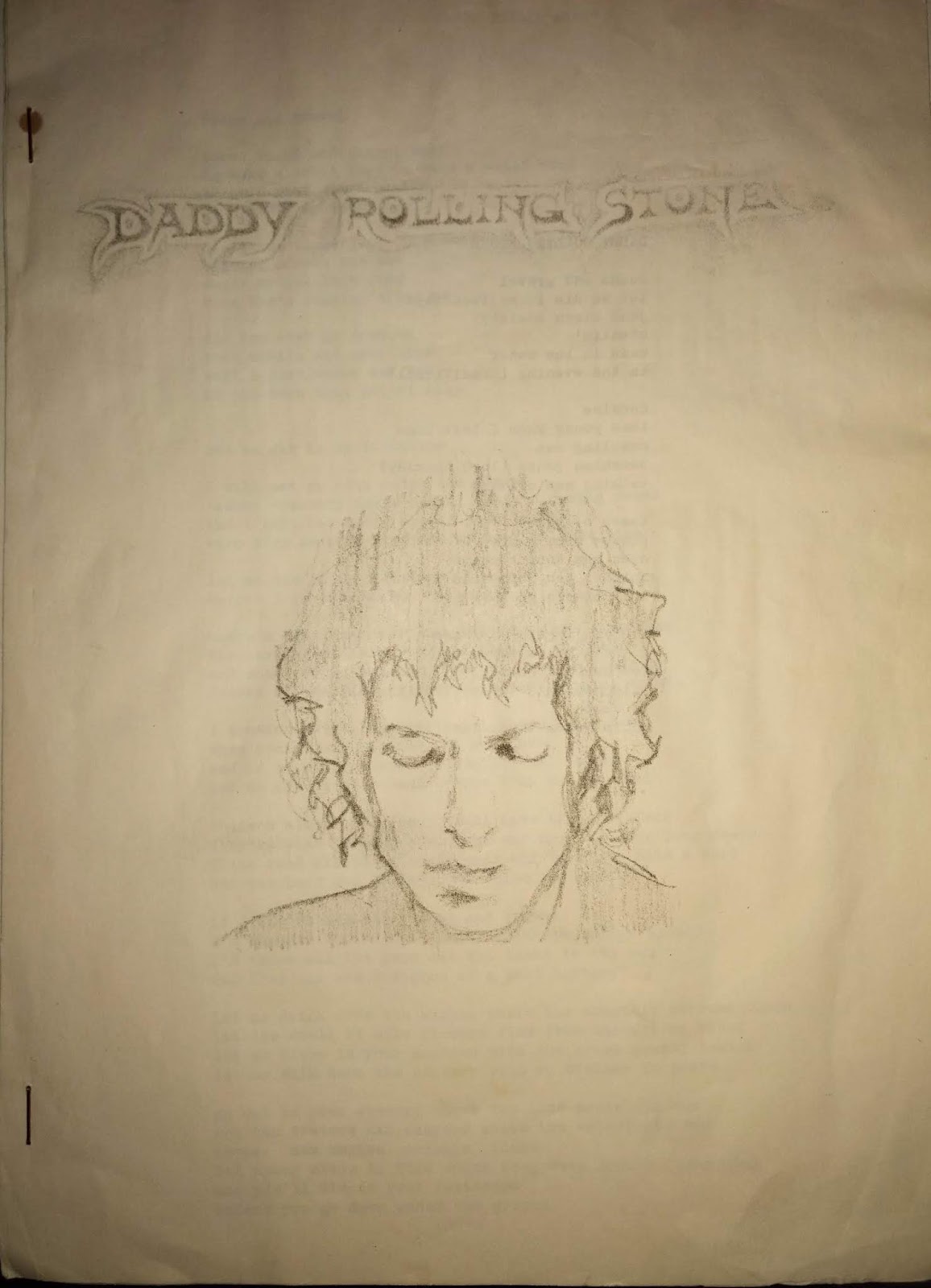
I got this 1969 or 1970 Bob Dylan bootleg from a record shop in Leiden. It's a great copy with very few hairline marks, and includes the original artwork by Dutch cartoonist and illustrator Peter Pontiac and original lyric booklet. All housed in an unmarked white sleeve, as can be expected for an illegally marketed product (even now, it's banned from sale in discogs). It's a collector's item, even though the contents are not the valuable rarities they once were: Dylan has recently been making his legendary archive of unreleased recordings available at an incredible rate: his official Bootleg Series is reaching now number 14, not mentioning unnumbered releases like Live At The Gaslight 1962 and various other copyright-free demos and live recordings from 1961-1962, all now available in superior quality. No, I bought it thinking about what it represented at the time of its release. Remember, Dylan retired from the public eye after his motorcycle accident in 1966. Up to then, people were looking forward to his next record as if he was a prophet pointing the way. When the psychedelic revolution came, instead of leading, he disappeared into a cabin with The Hawks (later renamed The Band) to make a bunch of recordings he initially left on the shelf, while the two albums he released in 1967 (John Wesley Harding) and 1969 (Nashville Skyline) were acoustic folk and country in stark contrast to what he had been doing before his accident and what his fans expected (and wanted) to hear. Which is when, in July 1969, rock's very first bootleg album appeared. It became known as the Great White Wonder because it was released in an unmarked white sleeve. Later editions came stamped with the title but still no artist name on. About half of it consisted of acoustic demos and solo recordings made in a Minnesota hotel room in December 1961. But what really blew people's minds were the new songs he had recorded with The Band at the Woodstock cabin in '67, and which were arguably superior to his recent LP's. Immediately other artists fell on this songwriting treasure trove: The Byrds, Jullie Driscoll, Joan Baez, Manfred Mann, and -of course- his co-conspirators The Band recorded their own hit versions many years before Dylan's own emerged (as The Basement Tapes, in 1975). GWW was quickly followed by other Dylan bootlegs, including Stealin', John Birch Society Blues and Isle of Wight Live. Drawing from all of these sources and released almost simultaneously, albeit in The Netherlands only, Daddy Rolling Stone must have been Europe's first introduction not only to these songs, but to music bootlegs in general.
LP1 contains Dylan solo acoustic demos and live recordings, while LP2 features The Band. No information is given other than the titles, but by comparing with what has been released elsewhere one can make an educated guess about the origin of these recordings. For example "Rocks & Gravel" (heavily borrowed from bluesman Mance Lipscomb) and "Let Me Die in My Footsteps" are known to have been recorded during the Freewheelin' sessions (1962) but left out of the album at the last moment. The former has officialy resurfaced in the True Detective series soundtrack, and the latter in Dylan's Bootleg Series Volumes 1 - 3, as has the talking blues "John Birch Society Blues", recorded live at Carnegie Hall at 1963 - provided of course it's the same version. A lot of the other acoustic tunes on LP1 come from the heavily bootlegged Minneapolis Party Tape, recorded in 1961 at the apartment of his activist/actress friend, Bonnie Beecher. These include the traditional "Wade in the Water" and "Stealin'", Brownie Mc Ghee's "In The Evening", Woody Guthrie's "Ramblin' 'Round", and the wonderful "I Was Young When I Left Home" (later included in The Bootleg Series Vol. 7: No Direction Home: The Soundtrack). Revd. Gary Davies' "Cocaine", Lord Buckley's "Black Cross" and the talking blues "Hezekiah Jones" were probably recorded at The Gaslight café in 1962 (the whole concert was officially released in 2005, initially only available to buy at... Starbucks). Two songs ("Cocaine","New Orleans Rag") are cut short, signifying that they have been lifted off another bootleg, Stealin', where they were also edited. Unlike the stark solo performances on disc 1, the songs on disc 2 are very familiar: recorded with the help of The Band at that Woodstock cabin, they include some of Dylan's best known songs, then appearing for the first time. 
The lyric booklet
The poetry is as excellent as ever, while the music draws from all kinds of American tradition: folk, blues, soul, country and rock. The performances here may not be as fleshed out as the ones appearing in the official release but they still sound full, with The Band all playing with gusto and singing together with Dylan. His great song of hope and redemption "I Shall Be Released", sung from a prisoner's perspective, has a gospel feel. "Open The Door Homer" is warm folk rock, "Tears Of Rage" a soulful ballad, and "Please Mrs. Henry" a drunken bawdy tune. "Nothing Was Delivered" sports some bluesy piano and guitar, while the mystical "This Wheel's on Fire" is dominated by Garth Hudson's churchy organ. All of the songs have a singalong campfire quality to them, which is even more evident in the more country-ish "You Ain't Going Nowhere" and "Too Much of Nothing". The sound quality is generally below par, but otherwise the versions here do not depart too much from the ones officially released later. Three songs probably come from Dylan and The Band's live appearence in the Isle Of Wight festival in '69: the traditional ballads "Wild Mountain Thyme" and "Minstrel Boy", and a band version of Dylan's "To Ramona", originally a solo number from his '64 album Another Side Of Bob Dylan. Such was the quality of these unreleased songs that they were immediately snatched by other artists who had hits with them, but the importance of them appearing out of nowhere in an unmarked sleeve to be sold under the counter in '69 is easy to forget now that they've been available in better form for decades. As a testament to that age, bootlegs like this and Great White Wonder remain valuable and worth spending the extra penny to add in one's collection.
***** for I Shall Be Released
**** for Let Me Die in My Footsteps, I Was Young When I Left Home, Tears of Rage, Please Mrs. Henry, Open the Door Homer, Nothing Was Delivered, This Wheel's on Fire, You Ain't Going Nowhere, Wild Mountain Thyme, Minstrel Boy
*** for Rocks & Gravel, John Birch Society Blues, Stealin', Wade in the Water, In the Evening, Cocaine, Ramblin' 'Round, Black Cross, To Ramona
** for Hezekiah Jones, New Orleans Rag