I'm in the process of re-listening and re-evaluating my record collection, in no particular order. I'll be sharing the results of my evaluation and thoughts on the music in this blog.
I'm not a huge theater buff, but there are a few performances that have impacted me deeply, one of which was Lulu, starring future tv/stage star Kariofyllia Karambeti in one of her first roles. I was in my late teens at the time, and had never before seen such an amoral work of art. Immoral ones yes, but those are fun: a mischievous wink of the eye, a momentary revelling in breaking the rules. But there's no mirth in this play: here, the unscrupulous Lulu is a willing sex object to men and women alike. She acts callously towards people who profess to love her, abuses weaker characters and gets abused by stronger ones, finds refuge and fitting employment in a brothel, and ends up murdered at the hands of her sadistic customer Jack (the Ripper). As a matter of fact, I think that most of the characters die on-stage. It's been 30-something years since I saw the play, but I remember being immersed in the writer's gloomy worldview and leaving the theater both depressed and impressed. I know that there's an opera version of the story, but a heavy metal song cycle? Interesting!
Even more interesting, when one learns who it is bringing this song cycle to life. Lou Reed and Metallica, the pen and the sledgehammer. Could that pairing work? Reviews at the time were... not good. Indeed, some even called it the worst album of all time, certainly the worst in both artists' discography. That dissuaded me, a little. Yet when I came across a cheap 2nd hand copy, I decided to give it a try. Well, first of all, this may be inspired by Lulu, but it's not a straight ahead rendition of the story. It's more of a concept album/song cycle, similar to Reed's Berlin(1973) - A Berlin gone horribly wrong. First of all, Lou Reed isn't known for shying away from edgy material, but his libretto here is positively nasty: full of gratuitous violence and horrid sadomasochistic sexual imagery. There's also a lot of racist, misogynistic, politically incorrect language - though it's made clear that it's not the perspective of the writer himself but instead that of a seriously disturbed, self loathing, young woman. What makes it extra uncomfortable and weird is that her part is narrated in first person in Lou Reed's old man's croaky voice. His delivery also totally lacks passion, but I guess that chimes in with the emotionally detached viewpoint of the original play. Lastly, the biggest fault of this album is the lack of integration between the words and music. It seems that Reed, having written a cruel libretto, sought a suitably brutal musical backing, and who among A-list rockers would be better suited to that job than Metallica? Unfortunately, the music and singing/narration seldom match, as if each of them was creating their own part independant of the other. I was very surprised to hear Reed encouraging Hetfield "come on, James!" before one of his rare solos as if they were in the room together, because they don't sound like they've ever been in the presence of each other during the recording of this. Let's take a step back now, and look at the album track-by-track: Our introduction to the main character "Brandenburg Gate" starts off with an acoustic bit. It sounds like any song on an average Lou Reed album, with no hint of Metallica except for Hetfield singing the single line "small town girl" over and over in lieu of a chorus. Unfortunately, the band's playing isn't just unremarkable; it's bad. "The View" fares better; it actually sounds like a collaborative effort, in places where the pace quickens and James takes over the vocal, it's recognizably Metallica - even though lines like "I am the view/I am the table!" isn't exactly their typical lyrical fare. It's so rock'n'roll it even has a guitar solo! "Pumping Blood" is a mess of a song; it contains some of the album's most disturbing lyrics, and seemingly describes Lulu's murder in the hands of Jack The Ripper; but then shouldn't it be placed at the end of the album, rather than near the beginning? Metallica resort for a while to their familiar thrash attack; if one could isolate that bit from Lou's screams, it'd be the only salvageable moment of the song. "Mistress Dread" might actually have worked as a thrash metal instrumental - but with Lou shouting lines like "I am your little girl/ Please spit into my mouth" (and much worse) it veers on the unlistenable. Thankfully, it's followed by "Iced Honey" - a regular alternative rock track. CD1 closes with "Cheat on Me"; a 11-minute long meandering piece with a long synth intro. As in other songs, Hetfield chimes in with a short repeated phrase; some dislike these vocal interludes but I find them crucial in breaking the monotony of Lou's lead vocal. "Frustration" starts off CD2 with a promising heavy riff, but on the whole it's too disjointed to even call a proper song. "Little Dog" is an excruciatingly long slow acoustic ditty. "Dragon" heats up after the 3-minute mark, turning into something a Metallica fan might endure for the sake of their favorite band's past achievements. "Junior Dad" surprised me as a title; who's the junior dad in Lulu? Indeed, nobody; the song seems to be a letter to a deceased parent. Lou is backed by atmospheric experimental synth music while he recites a heartfelt poem. Aside from the spoken word element, it's completely different to the rest of the album, or anything Metallica may have previously appeared in. The closest relative I can think of is Nick Cave's Ghosteen LP , although that was released many years later. 20 minutes of that are sure to test the patience of any Metallica fan still listening, but I find it to be one of the album's better pieces. It just doesn't belong here. To sum up, this isn't the total catastrophe many present it as; There are 3 complete songs and 7 trainwrecks; while none of the trainwrecks is convincing on its whole, they all contain interesting ideas. Like Lou's infamous Metal Machine Music, Lulu is an (ultimately failed) art experiment. It's deliberately meant to repel, not attract, listeners, except for the bravest and most open-minded. David Bowie apparently called it a masterpiece. I don't know if he actually did enjoy it, but I'm sure he appreciated its innovative and uncompromising spirit. Metallica on the other hand had been coasting on autopilot up to that point; this detour wasn't a characteristic move for them, and did nothing to enhance their reputation, but neither did it harm them. I guess it gave them the chance to experiment without offending their ultra-conservative audience, who largely ignored this collaboration. As for Lou Reed, this turned out to be his last album. It'd be nice if he had indeed gone out with a masterpiece, but at least he didn't produce stale copies of his past hits ad nauseum like some other rock legends. This isn't recommended listening for fans of either artist, but who knows? David Bowie has always been ahead of his time; maybe, after another dozen years, we will listen this album again, and will acknowledge this with hindsight as a misunderstood masterpiece. In the meantime, I don't see myself listening to this too often.
*** for Brandenburg Gate, The View, Iced Honey, Dragon, Junior Dad
** for Pumping Blood, Mistress Dread, Cheat on Me, Frustration, Little Dog
I asked the AI to create a logo for me with the title Gouda Records, but it wouldn't comply. First time I ask something from ChatGPT (well, second time really - the first time, I asked it to write a record review and got a whole lot of -admittedly well written- nonsense), and all I got was instructions on how to draw it myself - as if I needed help on the ideas department! ChatGPT, you're all A and no I! Go back to writing some fool's doctoral thesis, and leave the creative stuff to us real men! See how nice I did it myself on MS Paint?
Anyway, what you may not know (I, at least, didn't, until my first visit to the Netherlands) is that Gouda is actually a city. For everyone in Greece, gouda is what you use when you want less flavor in any cheese-related dish. It melts quite nicely, adds some grease and a bit of yellow color to your food, and dilutes the taste of other cheeses when you use it as part of a cheese mix. But, to be fair, the only gouda we know in Greece is the "young" variety. During my last visit to Gouda, we sat at the Kaasbar on Market Square and tasted about a dozen varieties in various stages of maturing and with various added spices (fennel, chilli, mustard etc.). Fair is fair, there are also some really nice goudas - even young ones can be quite enjoyable when you get that creamy texture right. Back to Gouda the city, it won't surprise you to learn that it's the world capital of gouda cheese, but there's also another delicacy invented here which you should try, and that's the thin caramel cookie the Dutch call stroopwafel. Other than that, there's a marvelous medieval city center with all the trappings of traditional Holland: the canals and cute small bridges to traverse them, typical narrow Dutch houses, cobblestone streets, even windmills. There is also the impressive old Town Hall (ca. 1618) on market square where, every Thursday from April to August, the cheese market takes place: farmers make a public spectacle of auctioning their produce to cheese merchants in the age-old traditional manner, a great photo opportunity for tourists.
On Saturdays, it's just a regular market; you can buy fish, vegetables, a cheap tracksuit or a mobile case. Around the square there are many bars, cafes, and shops, including a record store: Rock Maniac (Markt 11) is of a respectable size for a medium-sized town. Here you'll find a good variety of new vinyl encompassing all genres (usually €25-30), used records (mostly €10-20, some offers for €1,5 or €5), and a rather smaller selection of CD's (new €10-20, used €5). There are two more record stores in the city center: Free Music High Fidelity (Turfmarkt 12) is housed in a well-preserved old Dutch house, situated right on the canal. It has a nice ambience and an eclectic, slightly overpriced, selection of vinyl (new LPs mostly over €35, some used around €15). The focus here seems to be more on hi-fi equipment than on the music. Last but not least (actually my favorite), there's Decades Vinyl & Vintage (Nieuwehaven 326). From the title, I expected to find an antique shop that also sells records; there are a lot of nice antique shops in the town, especially bookstores, some of which also sell records but don't expect to find anything of value there. Decades sells a few ornaments and other bric-a-brac, but it's mainly a real treasure trove of old vinyl; you won't believe how much good stuff there is to find in such a small shop. I was especially impressed by their jazz and soul collection, but there's also a lot of rock, reggae, latin and country. Prices mostly between €7 and €20, but there are also a few crates of offers (€3, also some good stuff here but in below-par condition).
So that's my report on the record stores of Gouda, the 5th Dutch city I've presented in this blog after Rotterdam, Delft, Deventer, and The Hague. You'll notice that I'm still missing Amsterdam, which is the capital and biggest market for vinyl in the country; that's because, ever since I moved to Holland, each of my visits to Amsterdam is dedicated to a different purpose. If there's any time left for record browsing, I always spend it at Concerto. Given the size of the city, I'd need to plan a whole day trip exclusively for mapping the record store situation, which I aim to do at some point.
Now this one didn't come from Random Selection; sometimes I just review my Latest Acquisitions because that's what I happen to be playing at home. I got this from a Brussels record shop recently: it was raining and I got inside this record shop to get out of the rain; seeing as I stayed in there for well over an hour, I decided to buy something. Not that I was unfamiliar with the Back From The Grave series; quite the opposite actually. I've been an avid garage rock fan/collector since my teens, and have played volumes 1 to 7 (released between 1983 and 1988) to death - I know the lyrics of almost every song by heart. Over time, though, I became oversaturated with this kind of music. Every new 60's garage compilation released since the mid-90's seems to pale in comparison with Nuggets, Pebbles, Back From The Grave, even the more sprawling Highs In The Mid 60's series. Is it because it all sounds the same, or is it because the compilers are scraping the bottom of the proverbial barrel? Maybe both. Anyway, back to the beginning of the series: 40 years ago, Crypt Records chief and record collector Tim Warren put out the first Back From The Grave LP, collecting obscure 45rpm singles recorded circa 1966. The difference between this and previous series like Pebbles and Nuggets was that he limited himself to the rawest sounding, and most aggressive, exemplars of the genre, eliminating any tracks displaying pop, folk, of psychedelic influences. The liner notes included a multitude of information on these very obscure bands as well as (humorously exaggerated) offensive remarks about every other genre of music, while the cover art always depicts mid-60's-clad zombies attacking caricatures representing all other music genes e.g. hip hop, jazz, disco, prog, techno, metal, alternative rock etc. As I said before, volumes 1 to 7, released in vinyl during the 80's, were among my favorites. Sometime during the 90's, volume 8 was released. I got it on CD, as I was mostly buying CD's at the time. It was OK, but hasn't made as deep an impression as the earlier ones. Fast forward another 18 or so years, and two further compilations appeared: volume 9 and 10 carry the tradition with similar track choices and cover art, but at the time I didn't rush to get them as I already have dozens (maybe even 100's) of great albums in the same style. Anyway, last week I wanted to buy something from that record store and thought that this one would be a safe buy, given the quality of previous volumes. One difference was that this time mr. Warren gives us some information on his method of recording those old 45's and digitally cleaning the sound. The quality of paper, printing, and vinyl is also better than the originals used to be, while the notes are full of amusing anecdotal details. I quote from wikipedia "there are only two copies of The Warlocks’ crazy mad ‘Beware’ in existence because the guitarist didn’t like being left off the recording and drove over the boxes of 45s in his truck! There's a band who drove to gigs in a hearse, one who employed their own band hairdresser, another who were just four 16 year olds". One might say that digital sound cleaning goes contrary to Warren's old "the rawer the better" ethos, but I say that it doesn't take away any of the music's original rawness, just helps preserve it as well as possible. That said, it's my impression that there's a slight dip in the quality of the music, not everything here is as aggressive or distinctive as with previous ones. The first tracks are among the strongest: opener "Circuit Breaker" is wild Animals-like R&B, followed by Zombies cover "It's Alright with Me". Here, surf-like drums give way to farfisa-led garage pop, then a slow blues interlude, then lots of screams and a short guitar/organ freakout. The Warlocks' "Beware" combines groovy organ with threatening vocals while side 1 closes with the rather unimaginative Bo Diddley pastiche "I'm Hurtin'". For a few seconds, it sounds as if someone snuck in a ska tune to start off Side 2, but pretty soon "The Edge of Time" turns into a real garage scorcher . "Don't Ask Me no Questions" sports a mean harmonica intro and a punked up Motown beat, while "It's a Cry'n Shame" is a fuzzed-up Yardbirds-style rocker. The Noble Savages' "Animal" lives up to its title, while the aforementioned 16-year olds (The Starfyres) close side 2 with a classic garage theme, the ex-girlfriend put-down "No Room for Your Love". All in all, maybe half of the songs on this LP are quite exciting while the other half are average but still listenable if you like raw 60's rock'n'roll. Previous entries had a much better killer-to-filler ratio, but this nevertheless still makes for a worthwhile addition to a legendary series.
**** for Circuit Breaker (The Pastels), It's Alright with Me (The High Spirits), Beware (The Warlocks), The Edge of Time (The Raevins), Don't Ask Me no Questions (Lord Charles & The Prophets), It's a Cry'n Shame (The Gentlemen), Animal (Knoll Allen and the Noble Savages)
*** for Like Father Like Son (The Emeralds), Tamborine (The Why-Nots), When I Feel Better (Unknown), Sad and Blue (The Donshires)
** for Something Better (The Turncoats), I'm Hurtin' (The Classics), Whizz #7 (The Shakles), No Room for Your Love (The Starfyres)
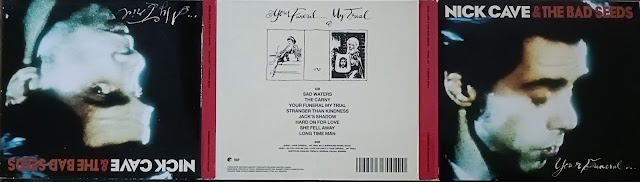
Thanks random selection, this was a good one! I enjoyed listening to this album again in its entirety. Nick Cave is a songwriting giant, one of the all-time greatest, a fact which people are slowly waking up to. Nevertheless, at that early stage of his career, he was lumped together with a disparate bunch of artists and fashion freaks collectively and derogatorily dubbed "Goths". Renowned for the screamed vocals and live antics of his previous band Birthday Party as well as for his decadent junkie lifestyle, he wasn't considered serious enough to be called an artist or commercial enough to be called a rock star. My first experience of his music was an atmospheric scene in a poetic German movie called The Wings Of Desire, where he performed this album's "Carny" in a Berlin club. The next year I got into university, and that was when my musical self-education (and record collection) seriously started; I really dug into Cave's work, and was lucky enough to see him play live often enough. After his concerts, I'd hit the bars around Exarchia and there he'd be, drinking quietly until closing time. To fans who approached him, he was courteous but distant. You couldn't really tell he was an addict, but there was certainly a dark aura about him. That was when he was still based in Berlin; he had moved there in 1982 drawn by the decadence, cheap living, and vibrant artistic scene. Immediately he enlisted two locals for his band: drummer Thomas Wydler, and guitarist Blixa Bargeld who was to become his lieutenant for almost two decades. Blixa was never a great instrumentalist, but to me The Bad Seeds were never the same after his departure. Mick Harvey, a friend and bandmate from Cave's formative years in Australia, completes the band's lineup on this album. Bassist Barry Adamson was on his way out, and only appears on a couple of tracks here. The album was recorded at the Hansa studios, famous from Bowie's Berlin trilogy, and only a few meters' distance from The Wall. I can't imagine it was a happy time, recording under the gaze of Soviet guards standing on their concrete towers ready to shoot defectors on sight - but Cave is famously not in the happy business. That said, although the album is morose and experimental in sound, and often lyrically sinister, it's also at times achingly beautiful - never more so than in opener "Sad Waters" whose subdued bass and dreamy vocals are covered under a misty veil of atmospheric organ. At moments, very Joy Division-like. "The Carny" on the other hand sounds more like Tom Waits, mutant carnival music featuring instruments like xylophone and glockenspiel alongside a multitude of spooky sound effects as Cave narrates the story of a dead horse called Sorrow. "Your Funeral My Trial" is another beautiful ballad moving with an (ahem) funereal pace. The piano and organ are, once again, dominant. Cave croons in lyrical mood, but as you probably guessed by the title, this isn't your typical love song. Sample lyric "Here I am, little lamb/Let all the bells in whoredom ring/All the crooked bitches that she was/Mongers of pain/Saw the moon become a fang". "StrangerThan Kindness" isn't written by Cave; it is a poem by his former lover Anita Lane put to music by Blixa Bargeld. I love the trembly guitar that produces a similar effect to John Cale's viola in Velvet Underground. This is where Side A of my own vinyl copy ends; the Greek edition came out as a single LP with a gatefold cover, while the international one was a double album consisting of two EP's playing at 45 RPM. Side A, corresponding to the international edition's Record 1, was almost perfect. Side B/Record 2 is a different beast: Troubadour Cave takes a back seat to Madman Cave, with whom we were already familiar from Birthday Party. I loved "Jack's Shadow", it couldn't be better even if the story made sense: Jack and his shadow escape from a dungeon, his shadow becomes a wife, and then he peels it off himself with a knife. Apparently it's somehow inspired by the story of writer, and convicted murderer, Jack Henry Abbot. It's got a dramatic vocal sung over unruly bass and piano. Some of the unidentified noises could be Blixa: Cave always said that what he loved about his playing was that he made his guitar sound like anything except a guitar. The next song "Hard On For Love" is even more rowdy while the lyrics manage to mix the Bible with pornographic imagery. "She Fell Away" is another frantic piece, before the final "Long Time Man", a relatively straight cover of a 60's murder ballad by Tim Rose; this sounds like it should belong to Cave's previous LP Kicking Against The Pricks, a covers album that contained a number of similarly-themed folk and blues songs. Decades after I bought my Funeral... vinyl copy (for 900 drachmas, as the sticker on it attests) Cave's entire discography was re-released on Deluxe double CD/multi-tracked DVD-Audio packages. This prompted me to re-buy Your Funeral...My Trial, as well as a few others which I only had on vinyl - so, now I have three formats of the album, four if you count mp3. The DVD-Audio is well worth hearing; I mean I'm not a headphone guy, I prefer the music to fill the space around me, which befits an atmospheric album like this better than any typical guitar-bass-drums LP. While this is a skeletal rock band playing, they are quite inventive in the studio: Thomas Wylder reportedly plays a fire-extinguisher as a percussion, Blixa's guitar playing we already talked about, and Mick Harvey plays just about everything, and anything, else. Credit for the sound should also go to the producer Mark "Flood" Ellis,who later also produced seminal albums by Depeche Mode, U2, Smashing Pumpkins and many others. Extras of the deluxe edition include an inessential B-side called "Scum" (an amusingly petty attack on a rock journalist) but also an informative booklet and short documentary. Those 80's and early 90's albums by Nick Cave & The Bad Seeds are often considered inferior to his later, more intellectual, output, but I disagree. I find them to be more vital, edgy. and underground - but then again, it's the work of a smacked out young man wallowing in decadence at a Berlin squat. You wouldn't want him to remain the same. Nowadays he makes elegant and literary adult records, and dispenses philosophical advice online. One thing's constant: he's still a fantastic live performer. Especially when he's backed by The Bad Seeds, who (even without Blixa and Harvey) are still arguably the world's greatest backing band.
The CD/DVD-Audio Deluxe edition
***** for Sad Waters, The Carny, Your Funeral My Trial, Stranger Than Kindness, Jack's Shadow
When random selection produced this CD for review, I realized an omission on my part: when an artist I like passes away, as it happened with Gordon Lightfoot a year ago, I usually spend some time listening to their records. In his case, I must have been preoccupied with something else; I don't remember listening to these songs recently. Granted, I don't have many of his albums in my collection: just this compilation and a 60's LP on vinyl. I remember owning one or two more vinyl records of his, but I seem to have sold them during the great vinyl purge. Infuriatingly, this compilation is one of those budget CDs that contain no information on the artist or recording year of the tracks within. I can't fathom why; would it cost more to add a few words? They wouldn't even waste more paper, the inner side of the booklet is completely blank. In any case, I researched the provenance of the selections, and it turns out that this isn't so bad a selection: almost all of the albums he released during this period (a dozen, in as many years) are represented by one of two tracks each, neatly presented in chronological order, the better to appreciate the artists' evolution. Starting with his very first 7' single "(Remember Me) I'm The One", a 1962 Elvis-like ballad, and the only cover here. The next entry ("I'm Not Sayin") comes from 1966, and his LP debut, Lightfoot. It shows a definite Dylan influence, with a touch of Phil Ochs in the vocal department. From 1967's The Way I Feel we get "Go Go Round" and "The Way I Feel", songs that remind me of Simon & Garfunkel. These are followed by the more upbeat, socially conscious, "Black Day In July" (Did She Mention My Name, 1968), a vivid recounting of the bloody Detroit race riots of the previous year. "Bitter Green" (Back Here On Earth, 1968) is lighter, with a hint of country a la Glen Campbell. "If You Could Read My Mind" (Sit Down Young Stranger, 1970) is another ballad in the same vein; from here on his songs retain the same influences but have richer, albeit always tasteful, orchestration, bridging the gap between earnest folk and MOR easy listening. I can only think of one other artist who did it as successfully, and that was Cat Stevens. "Talking In Your Sleep" and "Summer Side Of Life" come from the Summer Side Of Life LP (1971), "Beautiful" from Don Quixote (1972), and "Sundown" and "Carefree Highway" from 1974's Sundown. All are great, but the best are the ones on the two opposite ends of his pop folk hybrid: "Rainy Day People" (Cold On The Shoulder, 1975) is a smooth pop ballad, while "The Wreck Of The Edmund Fitzgerald" (Summertime Dream, 1976) is narrative folk at its very best. The compilation closes with "Race Among The Ruins" (also from Summertime Dream), and two selections from Endless Wire (1978): "The Circle Is Small" and "Daylight Katy". After that, Lightfoot's international popularity declined, although he still held national treasure status in his native Canada. Now, as with any compilation, the question is how good is this as an introduction to the artist? The plus points here are that it covers his most acclaimed period, and aims to be representative by including something from each release. Is this really "The Best Of" Gordon Lightfoot? To be fair, the compilers don't make any such claim; and indeed, there are some obvious omissions. On the other hand, what's here is pretty good; after all, if Dylan's quote that “Lightfoot died without ever having made a bad song” is true, one could not go too wrong with selecting material for this comp. I'd give this collection 3,5* for the songs, but 2* for the packaging. It should suffice for the very casual fan who only knows 3 or 4 of his songs, which they'd probably find here. I was one myself, but I'm now tempted to dig deeper.
***** for The Wreck Of The Edmund Fitzgerald
**** for I'm Not Sayin', The Way I Feel, Black Day In July, Bitter Green, If You Could Read My Mind, Talking In Your Sleep, Sundown , Rainy Day People
*** for (Remember Me) I'm The One, Go Go Round,Summer Side Of Life, Beautiful, Carefree Highway, Race Among The Ruins, The Circle Is Small, Daylight Katy
I've already written about the formation of Bevis Frond in a previous post about their debut proper, Miasma. Fast forward a dozen years, and Nick Saloman isn't playing everything himself; he's fronting a real band instead (i.e. himself on vocals and guitar, Andy Ward on drums and Adrian Shaw on bass). Being a big garage/neo-psychedelia fan at the time I was very excited to see them play when they first came to Athens (1998 at the AN Club) and was incredibly bummed to miss that gig due to high fever (mine, not Saloman's). Thankfully I got another chance next year, when he appeared at the (bigger) Rodon Club. To me, this was one of the year's major concerts, so you can imagine my surprise when I saw there were hardly 50 people present in what was then the city's biggest indoors live rock venue. It was nevertheless a great gig, Saloman displaying excellent musicianship as well as a lack of showmanship - just an affable guy who looked nothing like a rock star, and who wasn't dismayed by the empty club, happy to chat with his few loyal fans and to play his heart out for more than 2 hours. I seriously have never seen Rodon that empty during its two-decade existence; local bands could at least count on friends and family showing up. So long into one's career, and to still remain a cult artist - others would have given up, yet another 25 years went by since then, and here I read once more glowing reviews for his latest album in the pages of Mojo and Uncut. It brought that night at Rodon to mind, and made me pick up this CD for a new listen; it was recorded only a few months before the Rodon concert, at the other end of the world: San Francisco, USA. The album preserves the aural part of the concert as it was - no overdubs or tweaking of any sort, so I expect this must be similar to what I heard at the time. I can't say whether the setlist was also similar; I do remember hearing some tracks from New River Head which was among my favorite albums at the time, but not "Signed D.C." the track which closes this CD. The sole cover here (from Love's 1966 debut), this bluesy tune soon turns into a 10-minute psychedelic freakout jam reminiscent of Bevis' earlier experimental work - which is all good and fine but there's something he (I just decided that from now on I will use "Bevis Frond" to describe both Nick Saloman the man, and his band) is even better in, and that's composing great rock songs that sound rooted to the late 60s/early 70's. Opener "Hole Song #2" from the sprawling North Circular LP (1997) is a grungy number, followed by a Neil Young & Crazy Horse-like rocker from Miasma (1987). Two more songs come from (his then latest album) North Circular: Floydian ballad "Love Is" and fantastic rocker "The Wind Blew All Around Me" with its fine guitar solo and memorable chorus. From 1988's Triptych we get the Byrdsian "Lights are Changing" while the same influences are evident on "He'd Be A Diamond" from 1991's New River Head. Other tracks from that LP here include the title track (somewhat reminiscent of Screaming Trees) and atmospheric "Stain On The Sun". Then it's forward to 1992'sLondon Stone and noisy "Well Out of It", and blues rocker "Stoned Train Driver" (Superseeder, 1995). Lastly, from Son Of Walter (1996) we get the mid tempo "Red Hair". The power trio format is a perfect fit for these songs: Bevis' inventiveguitar playing (think Jimi Hendrix meets J. Mascis) is perfectly complemented by the veteran rhythm section (by members of such 70s stalwarts as Hawkwind and Camel) while the arrangements generally stick close to the originals. To tell the truth I'm not a huge fan of theaudio vérité sound (hence the 3* rating) even though the label is obviously proud of it. Given the tracklist and quality of performance, and in the absence of any Best-Of compilations, this live CD might make the perfect introduction to Bevis' work - if only it was a bit better recorded and produced. Never mind; any one of Bevis' countless records is a testament to his criminally underrated songwriting genius. Judging by the reviews of his latest album, half a century later the world is beginning to catch on.
**** for Maybe, New River Head, Stoned Train Driver, Lights are Changing, He'd Be A Diamond, Stain On The Sun, The Wind Blew All Around Me
*** for Hole Song #2, Love Is, Red Hair, Well Out Of It, Signed DC
I was recently reading a piece on Paul McCartney & The Wings on Mojo magazine, when I suddenly remembered that I have a CD by the recently deceased Denny Laine, which I hadn't listened to for what seems like forever. It still has a £1 price sticker on it, so I probably bought it from a London charity shop - my guess is that it was during my second visit there, almost 20 years ago. Knowing of Laine's contribution to The Moody Blues and Wings, I must have been curious about his solo work but not impressed with what I heard here, or I wouldn't have forgotten about its existence until now. The majority of the tracks here come from his then latest,All I Want is Freedom (1990). The eponymous song that opens this collection is an upbeat number, followed by the mid-tempo "On The Radio" - both pleasant enough as far as 80's commercial pop rock goes. 7 more tracks come from that LP - I rather like the more R&B flavored "Light on the Water" and melodic "Rescue My World"; not that there's something wrong about the rest, but neither are there any standouts. The production is busy with a lot of synths, backup vocals, horns etc. but also sounds horribly faceless and dated. It seems to emulate the commercially successful 80's work by Steve Winwood, Phil Collins, or Robert Palmer, but doesn't work as well. Whatever the reason, All I Want is Freedom failed to get noticed, but instead of giving up Laine repackaged it with a few older tracks in the form of this compilation. This time the selling point were some well-known titles - even though these weren't the original versions but re-recordings taken fromtheJapanese Tears LP (1980): R&B cover "Go Now" was the big hit of his Moody Blues days (a UK No.1 in early '65), reprised here with minimal changes. "Say You Don't Mind" was a solo single from '67 that bears the mark of that period - it charted later, in an orchestrated version by Colin Blunstone, so listeners would be familiar with it. "I Would Only Smile" was included in a similar, if slightly superior, version in The Wings' Red Rose Speedway (1973), also sung then by Laine rather than The Wings' lead singer Paul McCartney. Beatle Paul appears, as bassist and co-writer, on the fine country number "Send Me the Heart". From Laine's next solo LP Anyone Can Fly (1982), we get only 3 entries: the eponymous folky track, reggae-ish "Running Round in Circles" and standout "Who Moved the World?" with its tasteful guitar and rich Philly sound orchestration. Closer "Bad Boy Makes Good" seems to be a new (or, at least, hitherto unreleased) track; it has an organic sound similar to Nilsson or Billy Joel. I find it strange that almost all of All I Want is Freedom was included here, when all of the tracks from the older albums are obviously superior in quality; furthermore, 6 other solo LP's recorded by Laine between 1973-1990 are completely ignored, as are his contributions to The Moody Blues, Wings, and Ginger Baker's Air Force. All this makes The Rock Survivor a seriously flawed introduction to the artist even though, as a result of it being endlessly repackaged and re-released, it's his most ubiquitous release. This CD made for pleasant enough listening, but it goes back to the shelf to gather dust for another couple decades - or maybe forever, considering the limited time and sheer volume of music in my collection.
**** for Go Now,I Would Only Smile, Who Moved the World?
*** for All I Want Is Freedom, On the Radio, Rescue My World, Send Me the Heart, Light on the Water, Running Round in Circles, Say You Don't Mind, Anyone Can Fly, Bad Boy Makes Good
** for Game Set & Match, Bad Money, Talk of the Town, Heart for a Ride, I'll Stay