I'm in the process of re-listening and re-evaluating my record collection, in no particular order. I'll be sharing the results of my evaluation and thoughts on the music in this blog.
I've owned the Woodstock O.S.T. for ages, but it's not an album I return to very often, since these performances are rarely the definitive versions of the songs in question. Still, it's an essential piece of any serious rock collection. Watching the performances on video is, of course, a different matter altogether. A few days ago, I stumbled upon this compilation in the bargain bin at my neighborhood record store and decided to add it to my collection as well. This 3-CD set features selections from the mother of all Woodstock reissues: Woodstock – Back to the Garden: The Definitive 50th Anniversary Archive; a mammoth — nay, brontosaurus-sized — Grammy-winning, 38-CD box set containing the complete recordings of the music performed at the legendary Woodstock festival, August 15–18, 1969, presented in performance order. The set employs state-of-the-art audio restoration techniques to breathe new life into the original recordings, while stripping away later fixes and overdubs intended to correct performance and recording mishaps, often at the expense of authenticity and sonic fidelity. Since few of us can afford the full monty — the median sale price on Discogs tops $2000 — more compact 10-CD and 3-CD/5-LP editions were released alongside the complete set. So, time to unbox my recent purchase, see what the compilers have chosen to include, and find out how it stacks up against my old vinyl Woodstock O.S.T.
First off, The 50th Anniversary Collection contains 42 tracks, 30 of which are songs, the remainder being stage announcements and spoken interludes. Sound issues aside, its main selling point is the inclusion of performances by some—but not all—of the artists who appeared at the festival but declined to be filmed and were consequently left off the original movie soundtrack. Among them are Janis Joplin, The Band, Creedence Clearwater Revival, the Grateful Dead, and Blood, Sweat & Tears. The tracks are arranged in chronological order. The tracks are arranged in chronological order. According to eyewitness accounts, festival opener Richie Havens played for hours because technical problems delayed the arrival of the artists scheduled to follow him. The CD opens with his signature tune, “Handsome Johnny,” which I remember from the movie but which was left off the original OST. It is followed by his set closer “Freedom (Motherless Child)”, which Havens famously improvised on the spot after running out of songs in his repertoire. We continue with acoustic folk from Tim Hardin (“Reason to Believe”, not included in the OST), Arlo -son-of-Woody- Guthrie (“Coming Into Los Angeles”), and a duet by Joan Baez and the virtually unknown Jeffrey Shurtleff (“Drug Store Truck Drivin’ Man”). So far, so good—but what kind of rock festival is this, anyway? It's all acoustic folk!
The only "rock" band to perform on the first day was Sweetwater, a group now all but forgotten, whose performance was omitted from both the film and this collection. Day Two proceedings kick off with Country Joe McDonald delivering his anti-war message through the satirical “I-Feel-Like-I’m-Fixin’-To-Die Rag.” This is one of those rare cases in which the Woodstock performance became the definitive version of a song. Country Joe gets the audience involved in his now-legendary call-and-response routine: “Gimme an F! Gimme a U! Gimme a C! Gimme a K! What's that spell?” He gets an estimated 300,000 to 400,000 people shouting “Fuck!” in unison, again and again, before launching into his musical fuck-you to the political and military establishment. Santana go out next, and their appearance here is a historic moment: having released their debut less than 2 weeks prior to the festival, the band was virtually unknown outside of the Bay Area but their explosive mix of Latin Rock sweeps the vast crowd off their feet. Of the two tracks ("Jingo" and "Soul Sacrifice") only the second is included in the OST.John Sebastian wasn't scheduled to perform at Woodstock, but he stepped in to entertain the crowd during a lengthy break, delivering a solo acoustic set.
The 50th Anniversary Collection includes his rendition of “Darling Be Home Soon,” a song originally recorded by his former band, the Lovin' Spoonful. Canned Heat follow with an electrifying set of blues-rock. We get “Going Up the Country” and an extended workout on “On the Road Again,” although only the former was included on the original O.S.T. Disc Two opens with a marathon, 20-minute rendition of “Dark Star” by the Grateful Dead, followed by two tracks from Creedence Clearwater Revival. John Fogerty was so dissatisfied with the band's performance that he initially refused to allow their songs to be included in the film and soundtrack. Listening to “Bad Moon Rising” and “I Put a Spell on You,” it's hard to see what bothered him so much. Janis Joplin's performance was likewise considered subpar by her own standards at the time. The story goes that she was too drunk and exhausted after a ten-hour wait to deliver her best, finally taking the stage after 2 a.m. But listening to this set, I'd say that's a misconception: her singing is soulful and powerful, and the Kozmic Blues Band provides equally impressive backing. I guess even on her off night, Joplin was head and shoulders above 99.9% of the competition. Speaking of soul, here come Sly And The Family Stone delivering a high energy soul rock meddley “Dance to the Music / Music Lover / I Want to Take You Higher” driving the crowd into a frenzy, singing and dancing along with the band. Many consider their set to be the absolute highlight of the entire festival. The Who hated just about everything about the Woodstock experience, but they were at the peak of their powers at the time, and it shows. As they played the “See Me, Feel Me” section of "We're Not Gonna Take It" from Tommy, the sun rose over the festival grounds, creating a magical moment captured on film and preserved on both albums presented here. They brought their set to a suitably destructive close by smashing their instruments during “My Generation,” a performance included in the 50th Anniversary Collection.Jefferson Airplane were the last band scheduled to play on Saturday night, but by the time they took the stage, it was already Sunday morning. Their set was ragged, with lengthy psychedelic jams, and Grace Slick was not in the best of vocal form, although her stage presence remained as electrifying as ever. Nevertheless, the two tracks featured here, “Somebody to Love” and “Volunteers,” are both concise and energetic. Then-unknown Joe Cocker kicks off the festival's third day proper. His rendition of the Beatles' “With a Little Help from My Friends” is one of the film's highlights and an indispensable inclusion on both albums under review. Ten Years After's Alvin Lee delivers a masterclass in speed and dexterity with his guitar work on “I'm Going Home.” Both tracks appear on both albums, but the next two are exclusive to the 50th Anniversary Collection: The Band's “The Weight” and Blood, Sweat & Tears' fine jazz-soul take on “Spinning Wheel”. Crosby, Stills & Nash take the stage in the early hours of Monday morning. It's only their second live performance together, and Stephen Stills admits they're “scared shitless.” Their harmonies shine on the acoustic “Suite: Judy Blue Eyes,” but the electric portion of the set is even more impressive, with Neil Young joining them for “Sea of Madness” and “Wooden Ships”. The Butterfield Blues Band's “Love March” is an extended, horn-driven jam, while the album closes with Sha Na Na's rockabilly revival of “At the Hop.” And yes, you read that right: no Jimi Hendrix, no “The Star-Spangled Banner.” The most iconic moment of the Woodstock film is inexplicably missing.
***** for The "Fish" Cheer / I-Feel-Like-I'm-Fixin'-To-Die Rag (Country Joe McDonald), Jingo (Santana)
**** for Handsome Johnny (Richie Havens), Coming Into Los Angeles (Arlo Guthrie), Soul Sacrifice (Santana), Going Up The Country (Canned Heat), Dark Star (The Grateful Dead), Bad Moon Rising (Creedence Clearwater Revival), I Put A Spell On You (Creedence Clearwater Revival), Kozmic Blues (Janis Joplin), Piece Of My Heart (Janis Joplin), Dance To The Music/ I Want To Take You Higher (Sly & The Family Stone), We're Not Gonna Take It (The Who), Somebody To Love (Jefferson Airplane), With A Little Help From My Friends (Joe Cocker), I'm Going Home (Ten Years After), Spinning Wheel (Blood, Sweat And Tears), Sea Of Madness (Crosby, Stills, Nash & Young), Wooden Ships (Crosby, Stills, Nash & Young)
*** for Freedom (Richie Havens), Reason To Believe (Tim Hardin), Drug Store Truck Drivin' Man (Joan Baez With Jeffrey Shurtleff), Darling Be Home Soon (John Sebastian), On The Road Again (Canned Heat), My Generation (The Who), Volunteers (Jefferson Airplane), The Weight (The Band), Suite: Judy Blue Eyes (Crosby, Stills, Nash & Young), Love March (The Paul Butterfield Blues Band), At The Hop (Sha Na Na)
As mentioned earlier, the original Woodstock O.S.T. has reportedly undergone a number of alterations, most notably the replacement of “Sea of Madness” with an entirely different live performance. The Sly and the Family Stone medley is considerably shortened, while other tracks, including those by Arlo Guthrie and Joe Cocker, feature overdubs. None of this is necessarily a bad thing; soundtrack albums often differ from what we hear in the film itself. The original O.S.T. remains a terrific listen, even if it doesn't always faithfully document how the performances actually sounded at Woodstock. It is also secquenced for better flow rather than chronologically. About three quarters of the album is repeated from the 50th Anniversary Collection. There are, nevertheless, some tracks not included on it. These include two songs by John Sebastian "I Had a Dream" and "Rainbows All Over Your Blues". From Country Joe & The Fish we get the funky "Rock And Soul Music" (the band played on the 3rd day, while their singer played a solo set on the 2nd) while Joan Baez's protest folk "Joe Hill" is another showcase for the clear crystal of her voice. Which brings us to the festival's stunning finale: Jimi Hendrix was scheduled to close the proceedings on Sunday night, but delays pushed his performance into Monday morning. By the time he finally took the stage, around 9 a.m. on August 18, much of the crowd had already left. Backed by his newly formed band, Gypsy Sun & Rainbows, Hendrix delivered a two-hour set that culminated in his now-iconic rendition of “The Star-Spangled Banner” — a cultural milestone that reclaimed the national anthem for the freaks and hippies. The collection itself closes with a noisy, distorted rendition of “Purple Haze”. Both albums include spoken-word excerpts that are essential to conveying the atmosphere of the festival. In this respect, I'd give the edge to the movie OST, despite its numerous and significant omissions. In purely musical terms, however, Back to the Garden: 50th Anniversary Collection had been coming out on top—until its baffling omission of Jimi Hendrix's set. Leaving out the festival's most iconic performance is a serious misstep. I can't, in all honesty, recommend it. Get the movie OST, it is the classic Woodstock experience. Or, if you can afford it, the more expansive 10-CD edition.
***** for The 'Fish' Cheer (Country Joe McDonald), Star Spangled Banner (Jimi Hendrix)
**** for I Had A Dream (John B. Sebastian), Freedom (Richie Havens), Rock & Soul Music (Country Joe & The Fish), Coming Into Los Angeles (Arlo Guthrie), Sea Of Madness (Crosby, Stills, Nash & Young), Wooden Ships (Crosby, Stills, Nash & Young), We're Not Gonna Take It (The Who), With A Little Help From My Friends (Joe Cocker), Soul Sacrifice (Santana), I'm Going Home (Ten Years After, Medley: Dance To The Music/Music Lover/I Want To Take You Higher (Sly & The Family Stone), Purple Haze & Instrumental Solo (Jimi Hendrix)
*** for Going Up The Country (Canned Heat), At The Hop (Sha-Na-Na), Drug Store Truck Drivin' Man (Joan Baez), Joe Hill (Joan Baez), Suite: Judy Blue Eyes (Crosby, Stills & Nash), Volunteers (Jefferson Airplane), Rainbows All Over Your Blues (John B Sebastian), Love March (The Butterfield Blues Band)
The Blues Project’s Live At The Cafe Au Go Go was among my first 50 or 60 LPs, bought in the late ’80s. At the time, I had a girlfriend whose brother had a nice collection of ’60s psychedelia, and she would smuggle his records over for me to listen to and make mixtapes from. I liked this one so much that, rather than just tape it, I went out and bought it. It stayed in my collection for many years, until it fell victim to the Great Vinyl Purge. I bought myself a CD compilation called Anthology which contained (almost) the whole album, so the LP went the way of the other duplicates: as per my usual method, I sold the vinyl and kept the CD. Smart move, right? (Not). Years later, I came across this double LP for a nice price. It had some of my favorites, but—crucially—it also contained a number of tracks by later incarnations of the group that weren’t included on Anthology. Just the opportunity I needed to rectify my mistake and add some Blues Project to my vinyl collection.
As you can see from this sample, the Pop History series, released in Germany in the early ’70s, isn’t exactly the most aesthetically pleasing thing around, but it remains a good way to get your hands on some really good—and sometimes rare—music, in the form of budget-priced double-LP compilations housed in gatefold sleeves. But, like they say, it’s what’s in the grooves that matters, so let’s take a look at what’s here. First off, we have three tracks from my old favorite, Live At The Cafe Au Go Go (1966). These include the fiery garage rock of “I Want To Be Your Driver,” the marathon blues workout of “Two Trains Running,” and the acoustic folk ballad “Catch The Wind”—one example of each of the styles represented on the album, although I would have liked to hear more of the rockers from that LP. From the critically acclaimed Projections (1966), we get one of the band’s true signature tracks, “I Can’t Keep From Cryin’ Sometimes.” Written by Al Kooper, this classic blends moody Greenwich Village folk-blues with an intense, escalating psychedelic midsection. “Wake Me, Shake Me” is a ferocious, gospel-infused blues-rocker, with a rousing chorus and uplifting Hammond organ. On the instrumental “The Flute Thing,” it’s Andy Kulberg’s jazz flute that steals the show—this marks the first, but certainly not the last, time the band flirted with prog. “Steve’s Song,” written and sung by Steve Katz, is a baroque flavored piece, featuring gentle acoustic guitar and flute. “Violets of Dawn” is a folk-rock cover of a song by Greenwich Village mainstay Eric Andersen. In 1967, after playing at the historic Monterey Pop Festival, the original iteration of the band split, as Al Kooper and Steve Katz left to form Blood, Sweat & Tears. Live at Town Hall (1967) was cobbled together from live tapes and studio outtakes. Neither of the two tracks included here was recorded live: “Fly Away” is a folk-rock number, while “No Time Like the Right Time” is a psych-pop tune. Both songs are mid-tempo, show commercial potential and pop appeal, and feature strong vocal harmonies. Two more songs here come from the same era, and were released as standalone singles: "When There's Smoke, There's Fire" is punchy pop-rock track and "Mojo Hannah" a gritty, funk-laden rhythm and blues track. By the time of Planned Obsolescence (1968) the remaining members had essentially morphed into the band Seatrain, but the album was released under The Blues Project name to fulfill their recording contract. “Dakota Recollection” is a 12-minute excursion into prog-jam territory, featuring some great flute and violin playing. “Niartaes Hornpipe” is a quirky instrumental folk piece, while “Calypso” is a nostalgic ballad with baroque influences. Only “Endless Sleep,” a moody cover of Jody Reynolds’ rockabilly classic, partly justifies the “Blues” prefix, as by this point the band had moved deep into prog-folk territory. A reformed version of the band, featuring original guitarist Danny Kalb and drummer Roy Blumenfeld, released a couple of albums in the early ’70s. “If You Got to Make a Fool of Someone,” from Lazarus (1971), is a great prog-soul (is that a legitimate subgenre?) gem, while “Cheryl’s Going Home,” from the eponymous Blues Project (1972), is a garage-folk piece that wouldn’t sound out of place on Projections. All in all, this may be a collection of great—and some merely good—songs, but it’s far from an ideal introduction to the band. The two overlong pieces weigh it down, while the track order makes little sense: it’s neither chronological nor arranged to group similar songs together and create a better flow. Or is that deliberate, to show off the band’s versatility? In any case, despite my objections to the track selection and flow, I feel obliged to award Pop History Vol. 20 four stars, solely on the strength of the quality of the individual tracks.
***** for I Want To Be Your Driver, I Can't Keep From Cryin' Sometimes
**** for Steve's Song, Wake Me Shake Me, Violets Of Dawn, The Flute Thing, Fly Away, No Time Like The Right Time, Niartaes Hornpipe, Calypso, If You Got To Make A Fool Of Someone, Cheryl's Going Home, Mojo Hannah
*** for Two Trains Running, Catch The Wind, Dakota Recollection, Endless Sleep, When There's Smoke There's Fire
I recently came across this album on an internet piece called 10 forgotten blues rock albums from the 1980s that deserve another listen. And I thought... forgotten, yes, indeed, I really had forgotten I had it. And...does it? deserve another listen? Well, since I'm going to do it anyway, so why not present it on my blog? I'll start from the name: The Kinsey Report was a groundbreaking, taboo-busting scientific research on human sexual behavior - I learned about it, like many others I guess, when the biopic of the same-named scientist came out (featuring Liam Neeson, well worth watching I thought at the time). And it has absolutely nothing to do with this album, except that the 3/4 of the band are brothers Donald (guitar & vocals), Kenneth (bass), and Ralph (drums) Kinsey. Second guitarist Ron Prince is the fourth musketeer. Also, sex is one of the subjects negotiated here. But, of course it is; what popular music album isn't about sex, even a little bit? Fun fact: 97% of the thousands of subjects participating in Dr.Kinsey's research reported experiencing sexual thoughts and fantasies in their daily life. So, if you're writing songs, it's going to get in there. Of course relationships (especially broken ones) are a big subject matter for the blues, as are sexual innuedos e.g. "Back Door Man" (in this case an original composition, not the old Willie Dixon number). At least The Kinseys mix it up with social commentary e.g. on the funky "Poor Man's Relief" and atmospheric inner city blues "Full Moon On Main Street". Re-listening to this LP, I must admit that its good reputation is well deserved - and, at the same time, that it's not surprising that it's "forgotten". The reason being that it's way too similar to other (good) blues records from the same period that I have in my collection; e.g. the funky "I Can't Let You Go" reminds me of Robert Cray, while "Got To Pay Someday" kicks off with hard rock guitar a la Gary Moore; "Come To Me" and the upbeat "Give Me What I Want" are closer to the style of Stevie Ray Vaughan. There's also clean, B.B. King-like rhythm and blues ("Lucky Charm") and, of course, some "blue" blues, that is slow pieces with atmospheric guitar and smoky late-night vibes, like "Answering Machine", "The Game Of Love", and "Full Moon On Main Street". In any case, while the music isn't terribly original, it's very well played: Donald Kinsey (who had previously played with Bob Marley and Albert King) is a soulful vocalist and a talented guitarist, while the production retains a bit of raw authenticity - which wasn't a given in the 80's when even legends like B.B. King made boring generic pop-blues LPs burdened by overpolished and levelling production. Thankfully, Alligator Records managed to avoid the worst pitfalls; most of their albums that I have from that era (by Albert Collins, Koko Taylor, Johnny Winter, Lonnie Mack etc) are gritty electric blues. Edge Of The City is an, above average, example of that sound.
**** forPoor Man's Relief, Got To Pay Someday, Give Me What I Want, Full Moon On Main Street, Lucky Charm, Back Door Man
*** for I Can't Let You Go, Answering Machine, The Game Of Love, Come To Me
Only a week ago I wrote I only had one album off the best-of-year lists I published; yet within a couple of days I had gotten myself a second one, Classic Rock's #18, Bloom. I became aware of Larkin Poe a few years ago when I heard the Lovell sisters (Megan & Rebecca) sing backing vocals on an album by ZZ Top's Billy Gibbons. I liked their singing and made a mental note to check out their own work. The two young ladies (still in their early 30's despite being around for 15 years) are Larkin Poe, although there are obviously more musicians involved in recording and touring. They apparently named the band after their great-great-great-great-grandfather, a cousin of Edgar Allan Poe. Music-wise, at least on this album, they don't sound as country as I was expecting; if I was looking for just one word to describe the band's sound, "rootsy" would do much better. It's mostly Southern rock full of soulful vocals, hard rock riffs and bluesy slide guitar while the country element mostly comes out in the ballads, especially when the girls harmonize as in the closing "Bloom Again". Other country-ish ballads include "Little Bit", "Easy Love Pt. 2", and "You Are The River". Then there are some upbeat numbers halfway between gritty blues and commercial country pop: "Mockingbird", "Easy Love Pt. 1", "Fool Outta Me" - the instrumental part rocks, but Rebecca's vocals kind of remind me of Shania Twain - not a bad thing if you're chasing success, but I like her singing best in the grittier, bluesy hard rock, numbers ("Bluephoria", "Nowhere Fast", "If God Is A Woman", "Pearls") with their Beth Hart-meets-the-White Stripes vibe. Had it stayed on this course, this album would have gotten an extra star from me, but as it is there's a wider appeal to it. The production is a bit too polished for my taste, presumeably making it more appealing to commercial country radio, but I can't fault the passionate playing - I especially like the alternating loud sound of the electric guitar and more expressive and soulful slide and pedal steel. In the end, this record ticks a lot of boxes: the lyrics reflect on matters of love and life in general with maturity and insight, and the music will appeal equally to fans of rock, country, and blues. It’s hard to imagine any listener who enjoys those genres feeling let down.
**** for Easy Love Pt. 1, Bluephoria, Easy Love Pt. 2, Nowhere Fast, If God Is A Woman, Pearls, You Are The River
*** for Mockingbird, Little Bit, Fool Outta Me, Bloom Again
OK, I found this LP at the bargain bin of my neighborhood record store and it caught my attention; I don't believe I had ever heard of a blues/classical fusion work before. Rock yes, but blues not. And Siegel-Schwall sounded like a random choice for such a work - not highbrow enough, somehow. I got it, then tried to find out more about how it came to be. Apparently, Japanese orchestra maestro Seiji Ozawa actually got the idea of a blues/classical fusion work after seeing Siegel–Schwall Band perform live at a Chicago blues club - so, the band choice was anything but random. He pitched the idea to composer William Russo, who wrote the symphonic parts to Three Pieces for Blues Band and Symphony Orchestra as well as broad outlines for the blues parts, to be filled by the band themselves. The work debuted in 1968; at the time, it was an unprecedented combination - the only similarly bold experiment in roughly the same period that I can think of was The Moody Blues' Days Of Future Past(1967). By the advent of prog rock in the early 70's, the combination sounded interesting rather than outlandish, so Siegel-Schwall went into studio to record the piece with the San Francisco Symphony, conducted by Ozawa himself. Side two featured a different work, Leonard Bernstein's Symphonic Dances from West Side Story. Three Pieces... opens with a minute-long atmospheric intro followed by a blues boogie with beautiful electric guitar; here the orchestra nicely compliments the blues band, which seems to have the upper hand. On "2nd Part", it's the orchestra that dominates. Guitar and piano enter after 3 minutes, and harmonica after 6:30. The playing of the blues band on "3rd Part" is excellent, but for me the piece is somewhat marred by the orchestra occasionally being too loud. While this is quite normal in a symphonic setting, it sounded too bombastic and out of place to my ears compared to the gentleness of the blues band. It makes for an interesting comparison with another, more successful fusion work: more than 20 years later, the same San Francisco Symphony, conducted by Michael Kamen this time, would play a concert with Metallica immortalized in theMetallica S&M DVD and CD. Here the orchestra would never overpower the band, sparring with the powerful metal rockers during the louder parts, and adding drama and nuance to the (relatively) quieter ones. The original LP issue was released by classical music label Deutsche Grammophon, and sold quite well, reaching number 21 on the Billboard Jazz Chart and number 105 on the Billboard Top 200. My 1977 reissue on Polydor is quite different, as side 2 features another Russo composition called Street Music: A Blues Concerto. Taken from a different Deutsche Grammophon LP, this piece was also recorded by the San Francisco Symphony conducted by Seiji Ozawa. Since Siegel-Schwall had disbanded, it only features Corky Siegel on harmonica and piano. It consists of 4 movements: the first one opens with a mourning harmonica whose sound blends well with the strings; after 3 minutes the symphonic parts takes completely over. To me it sounded like the music of a movie or ballet, going through various moods that seemed to comment on something invisible happening onstage. The "2nd Movement" consists of alternating passages of boogie woogie piano and classical, never really integrating. The combination works better on "3rd Movement", while "4th Movement" starts with an upbeat harmonica intro, followed by classical segment, then a segment with nice harmonica/orchestra interplay, and ends with a bombastic symphonic coda. As a whole, I find "Street Music" rather less engaging, as I missed the blues guitar, but Corky Siegel's performance on harmonica is insanely good. He convinced me for the first time that this "humble" yet versatile and very expressive instrument actually has a place in classical music, which I never would have thought before. To summarize, I thought the blues playing by the band is particularly strong, while the symphonic part sounds great when it blends well with the blues. When it takes over, it sounds just like a random classicalpiece - or, to be more accurate, like soundtrack music. In any case, an interesting experiment which may sound pompous as an idea but it certainly has its moments.
Three Pieces For Blues Band And Orchestra: 1st Part****, 2nd Part***, 3rd Part***
Street Music: A Blues Concerto 1st Movement***, 2nd Movement**, 3rd Movement***, 4th Movement***
Another surprise choice by random selection that forced me to re-appraise this band I hadn't initially given proper due. Even before buying this CD, I've had this 7' single which I bought Lord knows when or where but it must have been really cheap because I'm not really into buying singles. Anyway, that 7' had "House Of The Rising Sun" B/W a cover of Elvis' "Heartbreak Hotel". I was drawn to the novelty of hearing these hard rock versions of overfamiliar oldies, and even though I later bought the CD reissue of Frijid Pink's debut I put it aside and played the single instead, since that already contained the two songs that stood out on first listen of the CD. That was a mistake, albeit a rather common one - Frijid Pink (according to a former band member, the name meant to convey "cold excellence") were condemned to one hit wonder status: their version of "House Of The Rising Sun" made the Top 10 on both sides of the Atlantic selling more than a million copies, but subsequent releases either just made the Top 100 or failed to chart at all. Certainly, their version of the song falls short of the classic one by The Animals; but not by that wide a margin. Singer Tom Beaudry gives a formidable performance, and Gary Ray Thompson's heavy guitar is dominant throughout, but to me the hero of this version is drummer Rick Stevers who drives the song as surely as Carmine Appice did with Vanilla Fudge covers of contemporary pop classics. The problem being with FP's most famous song sounding too similar to VF, a band renowned for covering other people's music, when in fact FP were much more original. Actually, the rest of the album consists of original compositions, while "House Of The Rising Sun" was an afterthought, recorded at the studio as a filler to bring the album duration up to the usual LP standards. The arrangement is too good to be an on-the-spot thing, so I guess it must have been part of their live repertoire; every band has these covers they play live but rarely include in their albums, but such was the quality of this specific accidental recording that it became the band's signature tune. But what of the rest of the album? Well, most of the songs are blues based: "I'm on My Way" is a rockabilly boogie, while "Drivin' Blues" sounds like a heavier John Mayall or maybe Savoy Brown, and "Boozin' Blues" is a slow blues number with great guitar and lots of piano, reminiscent of Peter Green's Fleetwood Mac. This blues influence had me convinced that FJ must have been British; when I looked up their bio for the purpose of this review I was really surprised to learn they actually came from Detroit, Michigan. But then, that also makes sense: Detroit at the time produced some really loud and heavy rock bands like MC5, Stooges, SRC, Amboy Dukes, Grand Funk etc. The more garagey tracks with loud drums and distorted fuzz guitar certainly belong to that family: "Crying Shame", "Tell Me Why" and "End of the Line". Somehow FP aren't committed to history as paragons of the Detroit sound like the aforementioned bands. They must have been quite popular at the time, though, as apparently visiting bands like Led Zeppelin actually used to open for FP when they played in Detroit. Opener "God Gave Me You" is a soulful quasi-ballad with a bit of a Southern rock feel, while, at 7,5 minutes, "I Want to Be Your Lover" is the longest track here, a heavy blues jam a la Free or indeed Led Zeppelin. The CD reissue adds two bonus tracks, previously released on 7' single only: "Heartbreak Hotel" is an exciting hard rock rendition of the old Elvis chestnut, and "Music for the People" a soulful Southern rock-style ballad with a gospel-like chorus. All in all, this would make for a fine addition to one's record collection - that is, if one's interested in that late 60's-early 70's heavy blues/prog sound; Frijid Pink is very good, but very much of its time all the same. The band went on to produce a few more albums which I now realize are quite respected in psychedelic/prog rock collectors' circles. So not a "one hit wonder" at all, as I thought they were. I'll investigate them further, and let you know of my findings...
***** for House of the Rising Sun
**** for I'm on My Way, Drivin' Blues, Tell Me Why, End of the Line, Boozin' Blues, Heartbreak Hotel, Music for the People
*** for God Gave Me You, Crying Shame, I Want to Be Your Lover
Johnny Copeland was part of a long line of Texas bluesmen. He grew up in Houston's Third Ward ghetto, and apprenticed as a guitarist next to the "master of the Telecaster" Albert Collins. Who was in turn introduced to the guitar at an early age by his cousin Sam "Lightnin'" Hopkins. Who learnt his craft as a child by accompanying Blind Lemon Jefferson on guitar at informal church gatherings. Blind Lemon's own teacher is not recorded - after all we are now talking about the dawn of the gramophone age. But I'm sure that if could follow that line down to its beginning, we'd inevitably arrive to Africa. So, when Copeland finally became the first American bluesman to record an album in that continent, a name like Bringin' It All Back Home made complete sense. By that time, Copeland had spent more than 3 decades playing the blues, garnering a reputation as a performer in the chitlin' circuit, but remaining unnoticed by mainstream audiences until he moved to New York and signed with folk label Rounder Records in the early 80's. I don't know what prompted him to tour the Ivory Coast, but he obviously found some kindred spirits there who introduced him to the prevailing local styles, while he in turn introduced them to electric blues. As he said in a interview at the time "I could tell the roots of the blues comes from there. They mostly understood the Delta Blues. They was expecting it to be all slow blues. But we surprised them and had the kids up dancin' on the stage. We were more uplifting than the Delta Blues they'd heard". Opener "Kasavubu" is certainly an uplifting tune, full of Afro-Cuban dance rhythms and funky sax. "The Jungle" is a more typical R&B piece, featuring some fine electric guitar. "Ngoto" is a cover of a local hit by Orchestre Poly-Rythmo of Benin, embellished with funky horns and stinging blues licks. Side 1 closes with an excerpt of "Djeli, Djeli Blues", an instrumental by the Guinean kora master Djeli Mousa Diawara. For those not familiar with the instrument, the kora is a stringed instrument that is exclusive to West Africa. It typically has 21 strings, each of which plays a different note. At the right hands, it produces gorgeous arpeggios, similar to playing flamenco on a harp - if that makes sense. As this was way before "world music" came into fashion, Copeland must have heard it for the first time during his tour of the region, and was so enchanted by its sound that he asked Djeli Mousa to be a guest at his record. For some reason, the recording was cut in two: part one fades out at the end of Side 1, while part two opens Side 2. It's then followed by "Abidjan", a funky instrumental with a rhumba beat. Back to more familiar sounds, "Bozalimalamu" and "Same Thing" are tasteful electric blues, while the album closes with an interesting reggae-ish instrumental called "Conakry", combining masterful electric guitar and some kind of African percussion that sounds like a slightly stoned woodpecker pecking on wood. All in all, Bringin' It All Back Home is mostly notable as an interesting experiment. Nowadays, there are all kinds of collaborative albums by African and Western musicians, but that all begun after the prominent Paul Simon collaboration with South African musicians on Graceland (1986). Compared to that, Bringin' It All Back Home went relatively unnoticed, and largely unheralded for its innovation. Truth be told, the mixing of styles isn't always successful; most songs are either blues with a few African instruments, or African music with jazz and funk touches. Rarely, the two styles combine to produce something genuinely new. The result is nevertheless never less than enjoyable, thanks to the musicians' playing. While the African instrumentsadd the necessary color, Copeland's guitar is the star, while special mention must be made to the saxophonists - whether the plaudits should be directed to alto sax Koffi Assalé or tenor sax Bert McGowan (or both) I don't know; to my shame (well, not really shame, more like slight embarrassment) I can't always tell the difference between the sound of the two instruments; anyway, there's some very cool sax playing involved. Johnny Copeland would go on to gain increasing recognition, including a Grammy award for a collaborative album with his mentor Albert Collins and (then) rising star Robert Cray. Unfortunately, the congenital heart condition which he suffered from, finally claimed his life just as he hit 60. But that line we talked about, the line which started in Africa and has included so many blues giants, is still going strong: his daughter Shemekia is undeniably one of the best female blues singers and guitarists that this century has produced so far.
**** for Kasavubu, Abidjan, Conakry
*** for The Jungle, Ngote, Djeli, Djeli Blues, Bozalimalamu, Same Thing
I just came back from a ZZ Top concert in Amsterdam, and decided to present a relative album this week (for those of you living in the US, in Europe 8-7 means the 8th of July, not the 7th of August). This was the the second time I had tickets for a ZZ Top concert but the first time I saw them play live: a few years back, during an intoxicated evening with friends, we started booking trips for concerts around Europe, and somehow double-booked ZZ Top with David Gilmour. In the end, me and my girlfriend chose to see Gilmour in Vienna and sell our ZZ Top tickets online. Then COVID came, which meant that the next chance to catch them live was years later. Unfortunately, original bassist Dusty Hill has in the meantime passed away, bequeathing his place in the band to his guitar technician, Elwood Blues (sorry, Elwood Francis). This marked the first personnel change in the band after half a century, which must surely be some kind of record. Apparently, during his first gigs with the band, Elwood wore a fake beard, which I personally find rather distasteful. I'm still not sure he's grown a real one, his (facial and otherwise) hair look quite unnatural. During the concert, he played the part, mimicking his predecesor's bass tone and signature moves, although he didn't sing (Dusty often sang, both backup and lead). Frank Beard (the one without a beard, as Gibbons pointed out) provided accurate and unobtrusive drumming. Bill Gibbons' stage presence, guitar, and (even-gruffier-than-usual) vocals, was as always the main draw, and he delivered. The concert lasted for less than 1,5 hour, but the audience (it was a full house) left satisfied: the band put on a great performance, and we got to hear most of their hits - although I missed a few of my favorites, namely "Tush" and "Blue Jean Blues". All in all, a great night out!
This compilation was the first ZZ Top album I ever owned; one of the oldest LP's in my collection, bought sometime in the 80's. Commercially, that was the band's golden decade; they sold truckloads of records while their videos were on heavy rotation on MTV. During this period they also cemented their cartoonish public image with the sunglasses, long beards, hot rod cars, etc. At the time, I was familiar with the band's videos, which I liked but found rather poppy, but oblivious of their past. Then, a classmate made a couple of mixtapes for me. One of them contained "blues" songs. In Greece, at the time, "blues" meant any song one could slow dance to; this tape however, contained, along with popular rock ballads, some actual blues tunes, including "Blue Jean Blues". It was this side of ZZ Top, along with a couple of 70's guitar rockers I later heard, that made me seek out a record by them. The Best Of... was, at the time, their only compilation in the market. I tend to think that it's still the best; just good ole' boogie and Southern rock without the plastic synth sound of their 80's hits. At 10 tracks and only 34 minutes, this is short for a compilation; they could have easily squeezed 3 or 4 more tracks on this single LP, but that would destroy the perfect balance the compilers acheived by placing 4 boogie rockers and one blues ballad on each side, structuring it like a great LP rather than a collection of songs. So what if it only covers 5 years of a band that's been around for 50? Sure, inevitably it misses a lot of landmarks. But it's not about what's missing, it's about what's in there, and every song here deserves a spot in the Best Of. I'll get to them in chronological order, as I always do with compilations: From ZZ Top’s First Album (1971) we get Cream-like blues rocker "Backdoor Love Affair". From Rio Grande Mud (1972), rock'n'roller "Francine" and funky Hendrix-like "Just Got Paid". From their third, and arguably best, Tres Hombres (1973), no less than 4 tracks: the bluesey "Jesus Just Left Chicago", Southern rockers "Waitin' For The Bus" and "Beer Drinkers & Hell Raisers", and their signature track "La Grange", a supercharged John Lee Hooker-like boogie about a famous Texan whorehouse. Their 4th LP Fandango! (1975) was a rather strange affair consisting of a forgettable live side, and a studio side featuring 3 of their best songs: mournful blues "Blue Jean Blues" and groovy hard rockers "Tush" and "Heard It On The X". "Tush" is sung by Dusty, while "Beer Drinkers"' best feature is the spirited exchange of lead vocals by Bill and Dusty - probably the reason two of the band's most popular tracks were missing from last week's concert's setlist. As I said, this makes for a perfect introduction to the band's early years. Later, they'd issue a greatest hits compilation focusing on their MTV period; the different esthetic of the two covers (from the Texas cowboys of The Best Of to the pop star glamour of Greatest Hits) is illustrative of the changes the band went through during the 80's. In any case, the two comps present minimum overlap - owing them both makes sense. Unless one goes for the original LP's, which makes better sense still.
***** for Tush, Waitin' For The Bus, Jesus Just Left Chicago, La Grange, Blue Jean Blues, Beer Drinkers And Hell Raisers
**** for Francine, Just Got Paid, Backdoor Love Affair, Heard It On The X
Bobby Rush has been playing the blues since 1951, but it took him half a century to come to the attention of the mainstream. Half a century of performing in small clubs all around the US, making a name as the King of the Chitlin' Circuit but being ignored by the public at large, until his show was filmed by Martin Scorsese for his documentary series: The Blues: A Musical Journey. What's the Chitlin' Circuit you ask? Well, that was initially a network of live music venues catering to the entertainment needs of African Americans whom racial segregation laws excluded from entering mainstream clubs. It included a few famous places like Harlem's Apollo Theatre, but mostly consisted of countless taverns and juke joints scattered throughout the Southern United States. With the repeal of Jim Crow laws, the most talented of the artists working the circuit (e.g. Billie Holiday, James Brown, Jimi Hendrix, Ike & Tina Turner) graduated to international stardom, but some like Bobby Rush never did - not necessarily due to lack of talent. Born in Mississippi in 1933, learning his trade next to Elmore James, and hanging around with Muddy Waters and Little Walterin Chicago, his is the quintessential original bluesman story - except that wasn't idolized by famous British rock stars, who didn't take him along with them to play big festivals in Europe. Instead, he kept playing the blues for black audiences in rural America, adding a lot of funk to his music to keep up with the changing tastes of his clientele. Since his belated LP debutin 1979, Rush has released numerous albums, but it's obvious that his real element is the stage: the way he delivers his lines, all the jokes anddouble entendres, are obviously written with a live audience in mind. Physically, he's quite the character: a dapper octogenarian with slick black curly hair and mustache, big gleaming white smile, and colorful, strass-studded shiny jackets, he never fails to grab attention. Porcupine Meat was his first release on respected folk label Rounder Records, a very well-produced record, recorded in New Orleans with some of the best local players, as well as someA-class guests: Joe Bonamassa, Dave Alvin and Keb Mo’ appear in one song each; good as they are, their biggest contribution isn't their guitar solos but their name on the album's back cover, a sort of endorsement for their fans. Above all, the slick production and famous guests never outshine the charismatic singer, The music is a mix of swampy blues and straight-ahead funk, with a prominent brass section. Opener "I Don’t Want Nobody Hanging Around" kicks off the album with a funky bass riff reminiscent of Stevie Wonder's "Superstition". It's about a jealous man, a theme revisited on the self-explanatory "I Think Your Dress Is Too Short". Rush isn't the kind of singer to provide deep introspection or political commentary; most of the songs revolve around lust or infidelity, and are rich in sexual innuendo ("Snake In The Grass", Nighttime Gardener", "Catfish Stew" etc.). On occasion, he blows a mean blues harp (e.g. on "Catfish Stew"), while there are also a couple of typical blues ballads ("Got Me Accused", "Me, Myself And I"). Unlike like most contemporary blues heroes, he doesn't play the guitar (at least not here, even though he poses with one), but he has an excellent collaborator in his own band's Vasti Jackson, plus of course the illustrious guest guitarists mentioned earlier. Drummer Jellybean Alexander lays down a nice funky backbeat to James Brown-like "Funk O’ De Funk", while closer "I’m Tired" is a semi-acoustic downhome number a la Taj Mahal (the singer, not the monument). Mostly though, what we have here is upbeat R&B - reminiscent of contemporary work of Albert Collins or Robert Cray, but with an added New Orleans flavor, and with Rush's trademark scabrous vocal delivery and humor. Porcupine Meat was a commercial success, and earned the artist his first Grammy Award at the age of 82 (two more were to follow). As I said, it doesn't stand out a lot from other contemporary rhythm and blues albums, except maybe lyrically. But it's well produced, played, sung, and follows all the time honored tropes of the genre. It should make for an enjoyable listening for any blues/soul lover, except maybe for the staunchest traditionalists.
**** for Porcupine Meat, Got Me Accused, Catfish Stew
*** for I Don’t Want Nobody Hanging Around, Snake In The Grass, Funk O’ De Funk, Me Myself And I, It’s Your Move, Nighttime Gardener, I Think Your Dress Is Too Short, Standing On Shaky Ground, I’m Tired.
Last week I bought this 2nd hand LP from my neighborhood; coincidentally at the time I was reviewing Herman Brood's Shpritsz, and each LP features a track called "Rock N Roll Junkie". Like Brood, Kossoff's equally famous for his junkie ways and as a musician - his death from drug-related pathological causes at the age of 26 has made sure of that. As the lead guitarist of Free (1968-1973) he was among the most prominent instrumentalists of his generation - not that he was happy being considered to be the next Clapton or Hendrix; apparently the high expectations stressed him to no end. Despite his important contribution to Free's success, Kossoff was too unreliable a partner and probably the main reason behind the band's split. Free's Paul Rodgers and Simon Kirk teamed up with guitarist Mick Ralphs (ex-Mott the Hoople) and bassist Boz Burrell (ex-King Crimson) to form Bad Company, while Kossoff first made a solo album, and then recruited an unknown British singer (Terry Wilson-Slesser) and 3 Americans: Tony Braunagel on drums, Michael Montgomery on keyboards, and Terry Wilson (no relation) on bass - all ex-members of a band called Bloontz. Together they formed Back Street Crawler, a name they borrowed from the title of Kossoff's solo LP. Montgomery wrote most of the songs; he also sings lead on 2 tracks. He's got a bit of a glam/hard rock singing style, and he manages to nail the Aerosmith-like "All the Girls Are Crazy", but kind of lets you down on "Survivor" - his vocals at least, the piano part is quite good. Terry Wilson-Slesser has a deeper, bluesier tone reminiscent of... well, Paul Rodgers, actually. Not a good thing - I mean Rodgers is one of the best singers in rock, no shame in sounding a bit like him, it's just that comparisons were inevitable with both bands being Free offshoots and the records released at the same time - not to mention them lying physically next to each other in the record shop bins, being so close alphabetically. A couple of decades later, the Back Street Crawlers would get filed next to Backstreet Boys, not much competition there. But Bad Company, now... their debut was full of mega hits, all still staples of classic rock radio. The songs on The Band Plays On, on the other hand, are perfectly fine bluesy hard rock but sound derivative. "Train Song", and in particular "Stealing My Way", sound like Free outtakes. The excellent semi-ballad "Jason Blue" also reminds me of Free's "Mister Big", but the addition of horns is a fresh orchestration idea. Probably my favorite song here "It's a Long Way Down to the Top" with its slow tempo and slightly country-ish vocals sounding uncannily like -once again there's no avoiding the comparison- Bad Company. Opener "Who Doo Woman" is another personal favorite, one which sticks out because of its funkiness. "Rock & Roll Junkie" is another strange one: its upbeat tempo reminds me of Santana, but the chorus sounds more like Kiss - by the way, Bloontz and Kiss played a lot together in the early days, and even guested together on some LP's. Closer "The Band Plays On" (a song written by bassist Terry Wilson during his Bloontz period) is a great hard rocker with groovy organ fills that somehow bops along to a different, more original, rhythm to the rest. The musicianship in this album is in general excellent, Kossoff in particular shines without resorting to overlong solos. He's still held in high esteem as a guitarist, but one wonders how much larger he could have been if he had kept himself together instead of messing up time after time: most of the the concerts booked for the promotion of this album were cancelled due to his drug-related health problems, while the band's second LP 2nd Street (1976) was mostly recorded without him. A hired studio hand (W.G. 'Snuffy' Walden) played guitar on that album, with Kossoff overdubbing some solos after the fact. April 1976 should have seen Back Street Crawler tour as headliners, supported by AC/DC. With Kossoff healthy and sober, this would have been a momentous tour, but it wasn't to happen; he died on March 19, mid-flight from LA to New York. The cause of death was deemed to be pulmonary edema caused by opioid overdose. The rest of the band continued for a while as plainly Crawler (I have their first LP, and will post the relevant review in time) before going their separate ways. For a while I wasn't sure whether I should go with a 3* or 4* rating. In the end I went with 3*: while it's pleasant listening for classic rock fans, there's not much here that sticks out or calls for repeated listening.
**** for Who Doo Woman, It's a Long Way Down to the Top, Jason Blue, The Band Plays On
*** for New York New York, Stealing My Way, All The Girls Are Crazy, Train Song, Rock & Roll Junkie
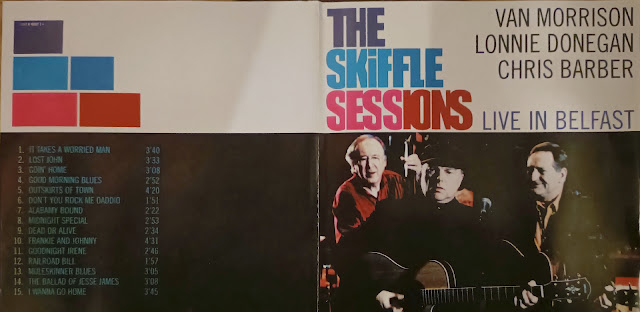
Like any grammar school essay, this review will start with a Wikipedia definition "Skiffle is a genre of folk music with influences from American folk music, blues, country, bluegrass, and jazz, generally performed with a mixture of manufactured and homemade or improvised instruments". It became immensely popular in the UK during the late 50's, to be subsequently forgotten; but not before leaving an important legacy in its wake: the success of skiffle convinced British youths that one doesn't have to be black to play jazz and blues, or a hillbilly to play country; if a Scotsman like Lonnie Donegan can do it, they thought, so can we. So they went on and bought themselves their first guitar - or made themselves one from scratch, using a cigar box and some wires. Thus, in 1956 Liverpool, John Lennon started a skiffle group called The Quarrymen; pretty soon Paul McCartney and George Harrison joined in. The skiffle craze passed the Irish sea, infecting Rory Gallagher and Van Morrison who also proceeded to form bands playing in this idiom. Individual Rolling Stones started their career playing with Alexis Korner, who was Chris Barber's guitarist at the time. Barber introduced trad jazz to the UK; his idea to include folk and blues songs into his repertoire is what gave birth to British Skiffle music. Donegan, a former member of Barber's band, struck out on his own, and had a huge hit in 1955 with a sped-up version of traditional folk blues "Rock Island Line". For a few short years, he was the biggest star of British radio, to be subsequently completely forgotten - by everyone, it seems, except Van Morrison, who organised his reunion with Chris Barber's band for this concert and CD. It's obviously a work of love, a most warm and convivial affair. Barber plays bass and trombone, while Donegan and Morrison share the lead vocal duties; if the latter is the better singer, the former's voice carries more authenticity to the project. Dr. John adds his New Orleans-style piano on two songs, "Good Morning Blues" and "Goin' Home". The presence of an American could be construed as an anomaly in an album that offers homage to a British phenomenon, but, seeing as it all began as an attempt to bring the music of New Orleans to Britain, one can see it as the closing of a circle: an American jazzman paying tribute to Brits paying tribute to American jazz and folk. The material leans heavier on jazz and blues than folk and country, somewhat inverting the analogy of original skiffle. The choice of overtly familiar material (traditionals, songs by Woody Guthrie, Leadbelly, Jimmie Rodgers etc.) is the weakest feature of this collection; one can immediately recall a better-known (or better performed) version of each tune here. I was surprised to hear them close the CD with "I Wanna Go Home", which I knew as The Beach Boys' "Sloop John B" from Pet Sounds. Little did I know that it's a traditional Bahamian tune which has been recorded by various folk singers over the years - Donegan's own version predated The Beach Boys' by 5 years. According to the liner notes, the concert is unrehearsed, which sounds unbelievable considering the perfect coordination between the musicians. I guess the lack of rehearsal time accounts for the fact that they chose these famous songs that everybody was already very familiar with. Ultimately, there's not much here that's novel or particularly interesting; just a fun, good-natured, exercise in nostalgia by the progenitors of British blues and rock - which is enough for me. It certainly was nice to see Donegan rise from decades of obscurity; this (his last ever) recording, together with a honorary MBE by the Queen in the same year, served as belated recognition of his important contribution to British music before his sudden death from a heart attack in 2002.
**** for It Takes A Worried Man, Goin' Home, Good Morning Blues, Outskirts Of Town, Goodnight Irene, I Wanna Go Home
*** forLost John, Don't You Rock Me Daddio, Midnight Special, Dead Or Alive, Frankie & Johnny, Railroad Bill, Muleskinner's Blues, The Ballad Of Jesse James
Would you believe me if I told you that a guitarless duo (Lee Michaels on vocals and keyboard and a guy called Frosty on drums) can sound like Led Zeppelin? Not influenced by them, as they were slightly ahead of them timewise, but sound as powerful, soulful and (well, almost as) heavy as them? It's crazy that Lee Michaels is so little known - I had heard of him, but wasn't really familiar with his music when I spotted this used LP in the bargains section of my local record shop; the cover was a bit worse for wear visually, and the low-res photo didn't help, but it's what's in the grooves that matters. Lee was a young guy from LA who had passed through a few local groups, and even played with Hendrix for a while, but found out he'd rather play solo or with the help of a single drummer, eventually settling on Frosty. The two of them entered the recording studio at 5 p.m., June 2, 1969. They apparently came out before the midnight of the same day, having recorded -more or less live- a whole album. The result of having only two instruments is that both of them are very much upfront, and really loud. If you like the sound of the Hammond B3 (as I do) you'll love how huge it sounds here. Apart from being a great organist, Lee was also one of the great blue-eyed soul vocalists - think Stevie Winwood, Steve Marriott, Joe Cocker etc. The drummer is also fantastic, reminding me a lot of Zeppelin's John Bonham. Side One is a continuous medley; the focus here is on the playing, not the songs. "Tell Me How Do You Feel" and "Don't Want No Woman" have some powerful singing and drumming, as well as very loud amplified organ; "My Friends" (reprised from Lee's debut LP) is more soulful. These three short songs (less than 6'00'' total) segue into each other, and may be viewed as one track. This is followed by an 8-minute drumming tour de force. I think very few people actually enjoy these long solos, irrespectively of the drummer's skill; I, for one, enjoyed Frosty's playing more when he was banging along with the previous songs than during his solo. I was kind of relieved when the organ and vocals came back for "Think I'll Go Back" a more melodic blues soul number. Side Two features four "regular" size tracks, opening with a great cover of T Bone Walker's classic blues "Stormy Monday". The last three are markedly lighter than what preceded them, with the heavy, churchy, Hammond sound mostly replaced by jazzy piano. "Who Could Want More" sounds like late period Traffic, "Want My Baby" is a sort-of-ballad, and "Heighty Hi" a feelgood country-tinged tune with a catchy singalong chorus and pro-drug lyrics. It was released as a single, and narrowly missed the Top-100 - the LP did a bit better rising up to #53. It may sound a bit outdated today, but I'd certainly recommend it to fans of blues and classic rock. I was certainly impressed by the duo's playing as well as the sound quality: each of the two instruments sounds clear as a bell. Lee Michaels had a few more minor hits in the years that followed, never becoming a household name. To compete with rock guitarists, he was into the habit of amplifying the organ sound to the max, which is probably what cost him his hearing. He retired from music early, entering a completely different field: he's the founder of the very successful Killer Shrimp restaurants chain in California. After reviewing his LP, I hope to taste and review his food - If everything goes well, I'll be in his neighborhood in April 2024.
**** for Tell Me How Do You Feel/Don't Want No Woman/My Friends, Stormy Monday, Who Could Want More, Heighty Hi
*** for Frosty's, Think I'll Go Back, Want My Baby
You would think that by now the dilemma CD or vinyl wouldn't exist any more. People may choose to stream albums directly, but when it comes to buying them in physical form, vinyl is a sure-fire winner. But it's not always that simple. Take this album: its price on new vinyl is triple that of the CD, you must be either rich or a huge fan to spend all that cash on it. Used LPs are always an option, and that was my choice in the end: I found it on a discogs seller together with some other stuff I wanted, and ordered it. Condition was VG+ for the record, VG for the sleeve, which as you can see is rather faded. Indeed the record doesn't have scratches or anything, but... some tracks here are, by design, mastered very quietly. When you get to those, you have to turn the volume way up, and inevitably the noise which isn't normally audible starts to overpower the music. And this doesn't only happen with used records. Some new vinyls also suffer from low background noise, probably due to bad manufacturing; record companies charge a lot of money for their 180gr. vinyl reissues, but weight does not guarantee sound quality. Whereas a well-remastered CD usually sounds fantastic; you can turn up the volume all you want during the quiet parts and all you'll hear is music. This is the reason I still go for CD when it comes to albums with slow, atmospheric, music. It's just that I had never heard this one in its entirety. I was only familiar with the more upbeat songs: "The Bear", "Walking On Sunset", "Somebody's Acting like A Child" etc.
British blues legend John Mayall is cursed to forever being remembered not so much for his own talent as a singer, songwriter and musician, but as the man who "discovered" some of the greatest names in British rock: by the time he had made this album, his former guitarists already included Eric Clapton and future Fleetwood Mac frontman Peter Green (Mick Fleetwood and John Mac Vie were also members of Mayall's backing band, The Bluesbreakers). His latest discovery was teen guitar prodigy Mick Taylor, who would also soon leave him, to join The Rolling Stones. As it happened, Taylor was the only one of the Bluesbreakers' latest incarnation who stuck around for the recording of this album, nominally a solo John Mayall LP. Compared to its predecessor Bare Wires, this is a more stripped-down affair (no horns, no side-long song suites, no jazz experimentation), but there's still a progressive element about it: it's a concept album inspired by Mayall's 3 week vacation to the hippy paradise of Laurel Canyon, just above Hollywood. Fittingly, it starts with the sound of jet engines and the words "Ten hours in a plane/England left behind/Back here in L.A/Wonder what I'll find". Taylor delivers an epic but way too short solo, signaling he's already at the same league with the likes of Clapton and Hendrix. This segues into straight blues "Walking On Sunset" about his first impressions of Los Angeles: The clubs (Whisky A Go Go in particular), the famous Sunset Boulevard, the friendly people, the pretty girls... Judging from his lyrics, the girls seem to be the highlight of Mayall's vacation: all these half-dressed teen groupies hanging around in all the musicians' houses he visited seem to have made a huge impression on the 35-year old English bluesman. Some are mentioned by name: "Miss James" with its groovy Hammond is dedicated to Catherine James: 18 years old and a single mother at the time, she was already a legend only surpassed by Miss Pamela, leader of the groupie collective GTO's, then almost 20 and the oldest of the bunch. She, and the rest of her team, get a nod in blues rocker "2401", named after the address that housed the GTO's as well as Frank Zappa, his band, and his baby daughter Moon Unit. Mayall sings the praises of their hospitalty, as well as that of Canned Heat's on blues boogie "The Bear" which is named after the Heat's hirsute singer Bob "The Bear" Hite. "Laurel Canyon Home" is a slow piano piece about how much at home he felt there; indeed he would soon leave England and move to Laurel Canyon, where he stayed for a decade. "Ready To Ride" is a lusty blues, "Medicine Man" one of those very quiet passages I mentioned before: just ghostly percussion and forlorn harmonica. "First Time Alone" is another quiet piece. Peter Green's mournful guitar on the background is barely audible; more of it would have benefited the song greatly. "Long Gone Midnight" is straight blues, "Somebody's Acting like A Child" the most upbeat song here, with an almost funky beat and nice guitar, organ and harp - the only song here that could belong to one of The Bluesbreakers' earlier albums with Clapton or Green. The album closes with "Fly Tomorrow", a 9-minute prog blues opus featuring masterful guitar by Taylor, still only 19 and a few months away from his debut with The Rolling Stones at Hyde Park before half a million spectators. Mayall would follow this LP with the wholly acoustic and drummer-less Turning Point. I have that one on vinyl, too, and I must say that, although that's also an understated and quiet album, it's mastered on a higher volume so that the low background noise never drowns the music like it can sometimes happens with the quieter songs here. Blues From Laurel Canyon is a strong album that needs to be listened in its entirety: the song order takes you on a journey together with Mayall as the songs all merge into each other, and he shares with you his travel experiences and his enthousiasm for the beauty of the Laurel Canyon surroundings and friendly manners of its hippie tribes.
**** for Walking on Sunset, 2401, Somebody's Acting Like a Child, The Bear, Fly Tomorrow
*** for Vacation, Laurel Canyon Home, Ready to Ride, Medicine Man, Miss James, First Time Alone, Long Gone Midnight