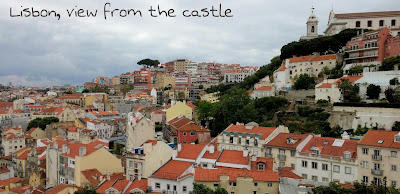
I spent a few days in Lisbon lately and, like always, visited as many record shops as I could. Walking around in Lisbon is somewhat different than what I got used to in the Low Countries, too many hills to make this a pleasant experience (especially when it's hot and damp) despite the evident beauty of the city and the exotic tiled house facades. Yet I'd rather walk under any circumstances than use the tourist buses and trams - for me the only way to experience a city is on foot. At nights the city center is teeming with people enjoying themselves, restaurants and bars full with locals and tourists alike. Glad to see that 5 years of troika austerity haven't ruined the people's appetite for partying. The neighborhood I stayed in (Bairro Alto) is a very touristic one, and filled with bars and live fado joints, Fado being of course Portugal's biggest musical export - a 100-year old emotional and mournful musical idiom that used to be the music of the underworld, the sailors and prostitutes around Lisbon's harbor. Like Argentinian tango, it slowly crossed over and became internationally reknowned to the point of being synonymous to Portuguese music. Which, while I honestly love this kind of music, is just wrong. My visit here made me realise that Portuguese must sometimes look at fado as we Greeks look at syrtaki and Zorba - though, of course, fados do have deep roots in Portuguese tradition while syrtaki is pseudo-folklore for the tourists. In any case all stereotypes tell lies, so one should approach fados as one of many components making up a nation's cultural identity rather than the key to its soul. But the international success of the fados and Lisbon's touristic development constantly pose us the question of whether we are witnessing the real thing or a recreation playing to the tourists' stereotypes of what the original would look and sound like. When I'm in Greece I can instantly tell the real thing from imitations, but here it's much more difficult. For starters, I'd advise visitors to avoid the joints around Bairro Alto. Maybe 20 years ago they were still authentic but today they cater only to the tourists. "Povo" at the city's pink street, a nightlife hot spot, offers good food and fados with no extra charge: you only pay for the -reasonably priced- food and drinks. Also, being in the city's old red light district, you feel you haven't strayed too far from the genre's seedy beginnings: there's still a strip-joint opposite, and the bar next door is painted with erotic graffiti and has a small sex shop inside. Trendy it all may be, but still nowhere as gentrified as, say, London's Soho. If you do end up in Povo, try the octopus salad, steak sandwich, bacalhau a braz, or pica-pau: all traditional and yummy. And the pasteis de bacalhau (codfish muffins) of course: The absolute must-try Portuguese snack.

Back to our subject and the city's record shops, the single most important advise is
check the opening hours. Unlike everywhere else in the world, they don't keep normal shop hours. Some open at 11:00, others at 12:30, 14:00 or 17:00. Some open and close at different times every day of the week and may work for 4, 5 or 6 days per week - I'll try and give some info on opening times, but that won't do much good as they change from one day to the next. Time limitations and irregular opening times meant I didn't get through my list. For example
Vinil Experience (Rua do Loreto 61, 1st Floor) was only 400m from the apartment I stayed, but I couldn't catch it open. Too bad, since it's supposedly a good place for garage/psych/prog (mostly used vinyl and CD) and these are my favorite genres.
Thank God, then, for
Groovie Records (
Rua de São Paulo 252) a stylish record store with a big selection of garage and psych vinyl, some used but mostly quality reissues. UPDATE: New address is Rua Angelina Vidal, 80A.
Pretérito Perfeito (Rua Sampaio Bruno 39) is another shop with folk, psych and prog but it's off the beaten path and open only on Wed-to-Fri, 15:30-19:00. Now, when I was in Lisbon I saw posters advertising the Communist Party's campaign for a 35-hour working week
(as if!) but these cats have gone
way beyond and instigated the
11-hour week. Good for
you, guys! (UPDATE: This shop is now permanently closed). Near the Bairro Alto, on Rua da Misericórdia no.14 you can find Espaço Chiado, a luxe shopping/cultural center in a state of disarray. Most shops inside were vacated or closed (could it be a sign of the financial crisis? If yes, it was the only one I saw. It seems the Portuguese made it through relatively unscathed, compared to Greeks at least). Here are 3 record stores:
Carpet and Snares on the mezzanine is specialized in dance music, while on the same floor you can find the (vinyl shop)
Sound Club. Most (used) LP's cost €15-20 but there are also some offers for €2,5-10. CD's are on their other shop on the 1st Floor. UPDATE: Another record store in Espaço Chiado is
Peek-A-Boo, also with funky/dance stuff. Not far from there, on the nice but uphill pedestrian street Calçada do Duque, you can find
Discolecção at no. 53.
A great source for used vinyl of all kinds, mostly priced between €10-20. Too often I'm exasperated when I'm in a vinyl place going through LP after LP of Tom Jones, Demis Roussos or Madonna. You can
recycle vinyl, you know. Just give it an
honorable death and make way for the good stuff! Like what they have
here. When I visited,
July was playing on the turntable. Respect! A bit further down on no.17 you'll find
Magic Bus, probably the smallest record shop I've ever seen yet definitely worth a visit. CD's cost €5-10 (used) or €7-15 (new) and LP's usually €10-20 (rare ones €30-50). If the ever-changing opening hours of Lisbon record stores drive you crazy, there's always
fnac on Baixa/Chiado (Rua Do Carmo 2) open from 10 a.m. to 10 p.m. It's got the usual books, DVDs and technology stuff, but also a good selection of (new) CD's and some LP's. As always with these chain stores you can have variety, listening stations and special offers. I came away with some Fado and Portuguese prog and indie CD's for €5-€7,90. On a pedestrian street round the corner (Escadinhas do Sto. Espírito da Pedreira 3) there's
Louie Louie a big LP/CD shop with a variety in pop, fados and Brazilian music. Lots of CD's for €5-10, LP's typically €10-15 (special offers €2,5 and new vinyls €20+). Both this and fnac have a bigger selection of fados than Discoteca
Amália, a shrine to Amália Rodrigues which is mentioned in many tourist guides but whose inventory of fado, classical and pop seems
not to have been renewed since the diva's death in the 90's. CD's cost an average €15, while the store also sells cassette tapes - either they're
super hip or, more likely, a few decades behind.
Descending Rua Das Flores on my way to Povo, I stumbled into
Clockwork. Apparently primarily a tattoo studio, it also offers "Urban Culture" items, including punk clothing and CD's. Spotted lots of tattoo'd and pierced alternative guys and gals in the region, too. The last of the shops I visited was
Carbono (R.Telhal 6B, close to the Avenida metro station and Av. da Liberdade). It's the biggest and best of the ones I've seen in Lisbon, with a huge selection of used records and CD's of all kinds in unbeatable prices. I left with 15 or so CD's, some of which were rare and out-of-print and others just plainly too cheap to pass on. Lots and lots of CD's for €2,5, a big metal section €5, and the rest €5-10. I didn't have space for vinyl in my suitcase so I didn't take a good look at the LP's but the average prices were €10 (used) and €20 (new). Also some offers between €1-5. I especially liked their wall of matching record covers (originals and tributes), so I'm posting a photo of that, here. Also on the upside, for once, it's a shop with regular hours (11:00-19:00). Not far from there (Rua Cecílio de Sousa 76) you can find
Twice records. It looks like a regular house with a green door and was closed when I visited (supposedly open 17:00-20:30, a 20-hour working week for them). A record shop I was looking for but must have passed right by was
Flur near Santa Apollonia (Avenida Infante D. Henrique, Armazém B4 Cais da Pedra) by the dockside. Supposedly the right place for indie/alternative music. Then, there's
Crew Hassan (Rua Andrade 8A, indie and reggae), punk-metal joint
Glam-O-Rama on Rua Viriato 12, and
TNT (Tό n' Ticha) on Rua de Campolide 54 C (Hard Rock). Didn't have time to check these out but, according to internet sources, they're worth a visit.
I didn't get as far as Benfica (kind of far from the city center), but apparently it houses one of the biggest 2nd hand CD and vinyl stores in the city (
Mau Génio, Estrada de Benfica 731A/Shopping Center Nevada) - not to mention the stadium of the same-named football
team who won the championship last Sunday, prompting a night of celebration all around the city. Hope this little walk around Lisbon's record shops will be useful to the city's visitors. Just remember that info and prices are current as of May 2016 and don't forget to check opening hours on either googlemaps or
lisbonrecordshops, an indispensable guide not just to the city's record shops but foremost to live music happenings. Of which there doesn't seem to be a shortage: at least 5 concerts every day, including (in a space of two weeks) AC/DC, Peter Murphy, Queen, Bruce Springsteen and Adele.
Not bad!

 Back to our subject and the city's record shops, the single most important advise is check the opening hours. Unlike everywhere else in the world, they don't keep normal shop hours. Some open at 11:00, others at 12:30, 14:00 or 17:00. Some open and close at different times every day of the week and may work for 4, 5 or 6 days per week - I'll try and give some info on opening times, but that won't do much good as they change from one day to the next. Time limitations and irregular opening times meant I didn't get through my list. For example Vinil Experience (Rua do Loreto 61, 1st Floor) was only 400m from the apartment I stayed, but I couldn't catch it open. Too bad, since it's supposedly a good place for garage/psych/prog (mostly used vinyl and CD) and these are my favorite genres.


