Showing posts with label Latin. Show all posts

Wednesday, 3 June 2026

Mutantes "Live - Barbican Theatre, London, 2006" 2007****

Another band I never expected to see live, I discovered Os Mutantes around the turn of the millennium, when Luaka Bop released a compilation of their 1960s material. It received rave reviews, and after hearing it myself I couldn’t help but agree: this eclectic, whimsical and experimental yet often poppy mix sounded as exciting and unique as anything from the era. The band disbanded in the early 1970s, having achieved little recognition outside their native Brazil until the Luaka Bop compilation introduced them to a new international audience. A few years later their albums were reissued on CD — and eventually vinyl as well — while a partially reunited lineup celebrated the band’s 40th anniversary with a major London concert, documented on the CD/DVD release reviewed here. The following years brought sporadic new albums and live appearances by a version of the band led by original guitarist Sergio Dias. They rarely venture into Europe, so last year’s Amsterdam performance — their first Dutch show since 2016 — felt unmissable. They no longer wear outlandish costumes onstage, and, at 75, Sergio Dias isn't in great shape physically, singing and playing seated for most of the show, but his guitar work remained superb, with echoes of Hendrix and Santana throughout. The band alternated between proggy psychedelia and pure pop (e.g. "Baby"). The harmonies were as strong as ever, while Esméria Bulgari handled the lead vocals admirably. Rita Lee, of course, who left the band in 1972 and died in 2023 remains irreplaceable. The other great absentee was Sergio’s brother, Arnaldo Baptista: he has often struggled with mental health issues linked to his past excessive LSD use, and took his leave from the band, long ago.

He nevertheless can be heard on this live CD, alongside Dias, original drummer Dinho Leme, and guest singer Zélia Duncan. Esméria Bulgari was also present on this occasion, albeit only as a backing singer. As I mentioned earlier, Os Mutantes have always been a very peculiar band, drawing on everything from Beatlesy pop and bossa nova to ballads and psychedelic rock, all filtered through a lens of whimsy and anarchic humor not unlike that of the Bonzo Dog Band—while sounding nothing like them in practice. Such eclecticism often left them difficult to categorize. For many years they were mentioned—if at all—only as part of the Tropicália movement, which also included more celebrated Brazilian artists like Caetano Veloso, Gilberto Gil, Gal Costa, and Tom Zé. This was too restrictive, since all of those artists were closer to Brazilian musical traditions, whereas Os Mutantes explored a much wider range of styles. This live CD manages to encapsulate most of them, making it one of the best entry points into the band's music. The performances are uniformly strong, while the arrangements benefit from a fuller band and generally sound more polished than the original versions. Some listeners may miss the rough edges of the originals, but I believe very little is lost in the process. Opener "Don Quixote" is an impressive psychedelic mess, incorporating everything from an orchestral fanfare to the band's signature harmonies and Dias' electric-guitar outbursts. This is followed by "Virginia", a charming Beatlesque ballad. The pace then picks up with a pair of upbeat Latin rockers: "Cantor de Mambo"—reminiscent of Santana and featuring some first-rate electric guitar in this live rendition—and "El Justicero". Hilariously, Tony Blair and "Jorge" Bush are portrayed as Old West gunslingers in the song's intro. The mood changes once again with the exotic, chilled-out bossa nova of "Baby" and "I'm Sorry Baby", both sung in English. Later, "Dia 36" and "Ave Lucifer" drift by as stoned psychedelic ballads awash in vocal distortion and spaced-out effects, while "Fuga No. 11" and "Balada do Louco" evoke a dreamlike meeting point between Gilberto Gil and John Lennon. The acoustic "Le premier bonheur du jour" adds a Rennaissence flavor, while "I Feel a Little Spaced Out" (original Portuguese title was "Ando Meio Desligado") perfectly embodies the sound of The Summer of Love: Imagine throwing The Zombies, Jefferson Airplane, early Pink Floyd, and the soundtrack to Hair! into a blender and ending up with something surprisingly coherent. As the concert nears its end, Os Mutantes showcase their riotous carnivalesque side on "A Minha Menina" and "Bat Macumba" before bowing out with an ecstatic English-language rendition of "Panis et Circenses" that once again recalls The Beatles circa Sgt. Pepper. The above track listing corresponds to my own (UK) version of the album, which combines a single CD and DVD video. There is also a US double-CD edition that adds five songs but omits the visual content. Those tracks are reinstated on my DVD, which also includes a short documentary, video clips from the concert and rehearsals, and a photo gallery. The DVD offers both stereo and surround-sound audio options, as well as subtitles for the lyrics. To be honest, neither the video quality nor the surround mix is particularly impressive, which means I find myself returning to the CD far more often than the DVD. Now, I know that many fans may find Rita Lee's absence difficult to overlook, English translation of the lyrics somewhat incongruous, and the band's live sound a little too down-to-earth for their liking. For myself, I believe that Live In Barbican, 2006 successfully captures the eclecticism, humor, musicianship, and sense of adventure that made Os Mutantes so special in the first place. For newcomers, it serves as an ideal introduction; for existing fans, it's a rewarding celebration of this unique band. Having finally seen the band in concert, I can confirm that, sixty years on, the magic is still there.

***** for Cantor de Mambo, Baby, I Feel a Little Spaced Out

**** for Virginia, El justiciero, I'm Sorry Baby,  Dia 36, Fuga Nº II, Ave Lucifer, Balada do Louco, A Minha Menina, Bat Macumba, Panis et Circenses

*** for Don Quixote, Le Premier Bonheur du Jour

Friday, 27 June 2025

Santana "Sentient" 1987-2024(rec) 2025 (comp)***

Photos: Santana Live at Ziggo Dome, Amsterdam. Tuesday 24 June, 2024
We recently went to Ziggo Dome for a Santana concert. It was the second time I saw the band live - the previous one was waaay back in 1991 at Leoforos Alexandras Stadium in Athens. I was mesmerized by Carlos' guitar, and still think of it as the best guitar playing I've ever witnessed live - and I've seen a lot of concerts starring a lot of famous guitarists. At the time I had recorded the concert on my walkman, and -despite the awful sound quality- every listen would reinforce that conviction. That cassette went wherever cassettes go when you're not paying them attention, but there's a better recording of that concert out there on youtube so you can judge for yourself. This time around, Carlos' playing was a little less impressive, but what do you expect? the man is 77 years old - it's difficult to grasp that he was only 43 back then, quite younger than what I am now, but it felt like I was seeing a legendary beast from a bygone age; Woodstock was like the Jurassic period to me, but I was less removed from it then than I now am from that warm Athens night when I first saw Santana live. And if Carlos' fingers are a tad less nimble than they used to be, Tuesday's concert didn't make for an inferior experience. First of all, this time Santana have a lot more hit songs than they did then; especially the ones from multi-Grammy Award winner Supernatural (1999), they played 5 off that one on the Ziggo Dome concert. Secondly, it's a terrific band: David Mathews was impressive on keyboards throughout, bassist Benny Rietveld played a masterful solo, the vocalists, percussionists, and the rest of the band were also great. But my girlfriend and I were most impressed by wife Cindy Blackman Santana on drums. So, at the end of the show, we went to the merchandise stall and got both Santana's latest vinyl and Cindy's new(ish) CD (to be presented next week)

First of all, "Sentient" may be Santana's newest LP, but it mostly contains older, semi-forgotten, recordings and collaborations, going back as many as long as three decades. Which one can guess by taking a look on the collaborators: Miles Davis (R.I.P.)? Michael Jackson (R.I.P.)? Actually, Miles was already dead when "Get On" was included on Paolo Rustichelli's Mystic Man (1996) which means tha Carlos and the Italian keyboardist were playing along to Davis' trumpet samples. Not bad, though. It's a chillout tune with a semi-electronic Latin beat and a small funky vocal sample. So far that sounds like something you might listen at a Balearic beach bar in the 90's - but the superb playing by the musicians elevates it tremendously. The LP contains another track from the same CD, "Vers Le Soleil". No Miles here - just Carlos and Paolo, relaxed vocals and dramatic synthesized strings. Both are "Sentient versions", meaning they've been reworked for inclusion here. I wouldn't know how much, but the new versions are great, especially Carlos' guitar which is just magical. Another reworked version is "Please Don't Take Your Love" featuring Smokey Robinson, originally recorded for the soul legend's comeback LP Time Flies When You're Having Fun (2009). Smokey's ageless vocal combines with Carlos' classy blues licks to create one of the highlights here. Opener "Let the Guitar Play" was released last year as a Record Store Day single, and features veteran rapper Darryl McDaniels (of Run-DMC) on vocal. I don't know why all those old rockers think they're modernizing their sound by adding unrelated rap segments; to be honest, I find it intrusive and would have prefered the track as an instrumental. "Whatever Happens" off Michael Jackson's last album Invincible (2001) features some nice acoustic guitar and intricate production. It wouldn't have sounded out of place on Supernatural. A second MJ composition "Stranger In Moscow" is included here in a, previously unissued, instrumental version recorded live in 2007 at a small club, backed by renowned drummer Narada Michael Walden and his band. Santana's guitar literally sings, as it copies the tone of MJ's vocal on the original ballad. A great gift for the diehard fan who may already own all the other, rare but previously released, pieces. Another previously unreleased track is "Coherence", credited to Santana and wife/drummer Cindy Blackman. It's an adventurous jazz fusion piece featuring great musical interplay between the couple. The vinyl version of Sentient closes with a masterful instrumental called "Blues For Salvador" from the eponymous 1987 album - I guess its inclusion is justified by the fact that it comes from a "solo" Carlos Santana LP, and thus new in the official Santana-the-band discography. As you may have already guessed, this is a hodgepogde of different styles, even more so than Santana's (in)famous string of commercial "collaboration" albums of the early 00's. It's nevertheless nice to bring all those scattered tunes together, and Carlos' playing is inspired throughout irregardless of song style. Not essential for the casual listener, but good for diehard fans who want to collect everything from their favorite artist, as wll as those who, like me, wanted a souvenir of the Oneness tour (although I believe the band didn't play any of these tunes live). The album cover you see here is exclusive to the European market - basically, it swaps the international edition's front and back covers. The CD version of the album contains extra tracks: two more Rustichelli collaborations called "Rastafario" and "Fool Moon", as well as "I'll Be Waiting", a soul ballad from Moonflower.

**** for Please Don't Take Your Love, Get On, Blues For Salvador

*** for Let The Guitar Play, Stranger In Moscow, Whatever Happens, Vers Le Soleil, Coherence

Sunday, 6 August 2023

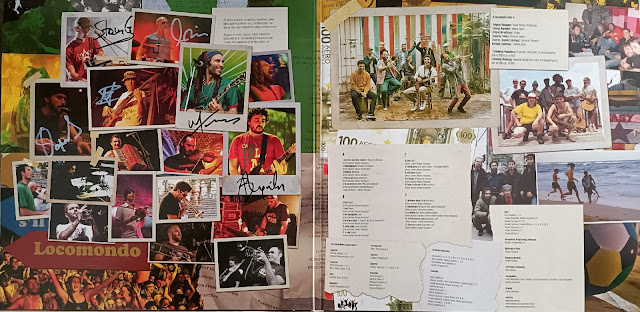
Locomondo "20" 2004-2023(rec) 2023(comp)****


About a month ago, I attended Locomondo's 20 year celebration concert in Athens. It was really more like a huge party - I've followed this band since early in their career (the first time was at a small Exarcheia bar on New Years Day in 2005) and always had a great time at their concert. This time, I had my young nieces with me; it was really nice to be together for their first rock concert, and they could hardly have had a better initiation.
This Limited Edition vinyl compilation was sold during the concert at a stand in Gazi, the former factory and current "cultural space" in the center of Athens where it all took place. It's called "20" (guess why), but for some reason contains 21 songs covering the whole length of their career. For someone like me, who already had most of their CDs, it was a great opportunity to not only own some of their best songs on vinyl, but also to get some of their popular hits that, for some reason, were never available in physical form before. I'll start my review with exactly these tracks, previously available only on streaming platforms: "80's" (rec.2017) is a tribute to this decade which is certain to appeal to those who, like me, lived through it as kids and teenagers. Singer Markos Koumaris speed-sings/raps about almost everything that constituted the 80's experience for us: music, TV shows, fashion, snacks, important sports events etc. There's some era-appropriate disco influence here, while "Goal" (2010), another nostalgic look at childhood, is typical fast-paced ska, and the latest single included here ("Filtragram", 2023) is closer to dancehall reggae. Of the other two tracks getting their first physical issue here, "Se Eida" (2014) has a reggae beat, while "La Mulatta" (feat. Tonino Carotone, 2017) is a Latin dance piece (sung in Spanish) augmented with a Greek demotic break and rembetiko-inspired baglama solo. For those not familiar with these terms, demotic is traditional Greek village music, while rembetiko is an urban style with oriental influences that appeared in the late 19th/early 20th Century. The Greek baglama is a sort of miniature bouzouki; it became popular when rembetiko was outlawed in the 30's, because the rembetes were able to smuggle it under their coats on the way to their clubs. Locomondo are one of few Greek rockers infusing their songs with traditional influences; it started with their reggae cover of classic rembetiko "Fragkosyriani" (2005) and became a permanent fixture of their program. Similar songs here include "Karapiperim" (2008) and island demotic "Το Plataniotiko Nero", here from their 2009 Live! album. This is reflected in the instrumentation which contains unusual instruments for a rock/reggae band, like the violin and the accordion. Another style they sometimes employ is that of a folk-ish ballad, which can be heard on "O Glaros" (2005), "Gelas Pio Dynata"(2007) and "Heria San Ki Auta" (Live, 2009). The rest of the songs here are in the band's signature style, a mix of ska, latin, and reggae, featuring mostly -but not exclusively- Greek lyrics. They're all fine, but I'll mention specifically the only song from their debut here "Trendy Litsa" (2004) and their first big hit, the everpopular "Den Kanei Kryo Stin Ellada (It's Never Cold In Greece)" (2005), as well as underground hit "Pro". The latter started off as a rough studio demo which slipped out on the internet and became viral in no time; it's written in first person about a guy who spends all his time smoking dope and playing Pro (-evolution soccer) on Playstation. The band, who have a conservative streak in them, didn't dare put it in any of their records, but it was their most-requested song, and became a staple of their live shows. Here we get a live version from 2009's Live! CD. It's done the way they play it in every show, starting off with a snippet of an 80's Greek pop hit meant to coax the audience into participation, and ending with the disclaimer "this is a description, not an incitement". In between, there's a hilarious rant about the joys of slacking and smoking marijuana, set to an infectious reggae beat. Now I know that the Greek language doesn't easily lend itself to this kind of music, and that by not understanding the words you miss a portion of the fun, but you should try Locomondo nevertheless; their music is perfect to put you in a good mood. It goes without saying you should go see them if they come your way; you're guaranteed to have a great time. And, of course, get your hands on this record if you can - not only it's the best primer for your introduction to this band; it's going to disappear from the market and become a collectors' item pretty soon.
***** for Den Kanei Kryo Stin Ellada (It's Never Cold In Greece, 2005), Fragkosyriani (2005), Odysseia (Odyssey, 2013), Ta Koritsia Ksenyhtane/ Pro (Girls Stay Up All Night/Pro, Live! 2009), 80's (2017)
**** for Magiko Hali (Magic Carpet, Live! 2009), Goal (2010), Den Prolavaino (I Can't Make It On Time, Live 2011?), Gamilio Party (Wedding Party, 2008), Sister Shine (Live! 2009), Trendy Litsa (2004), O Glaros (The Seagull, 2005), Me Wanna Dance (2007), Karapiperim (2008), La Mulatta (feat. Tonino Carotone, 2017)
*** for Se Eida (I Saw You, 2014), Star (2019), Filtragram (2023), Gelas Pio Dynata (You Laugh Louder, 2007), Heria San Ki Auta (Hands Like These, 2009), Το Plataniotiko Nero (Water Of The Sycamore, Live! 2009)

Saturday, 29 July 2023

Os Mutantes "A Divina Comédia Ou Ando Meio Desligado" 1970*****

A couple of weeks ago I presented a compilation of Rita Lee containing hits of the 1975-83 period. I'm afraid it was a poor testament to the lady's talent, so I've returned with a better one, Os Mutantes' third LP A Divina Comédia Ou Ando Meio Desligado (The Divine Comedy or I Am a Bit Disconnected).
People talk of Os Mutantes as being "the Brazilian Beatles" which is misleading; firstly, because they never achieved that kind of success; and secondly, because The Beatles started off as a simple rock'n'roll, then pop, group, and only started writing more complex compositions during later stages of their career. Os Mutantes, on the other hand, were sui generis right from the start. The trio of Arnaldo Baptista (vocals, keyboards and bass), Sérgio Dias (vocals, guitars) and Rita Lee (vocals etc.) started off in '66 São Paulo as a sort of garage band with very little "proper" rock music knowledge. They must have been influenced by The Beatles and early Pink Floyd but also by French chanson, acoustic folk, jazz, and bossa nova. Together with a bunch of kindred spirits from the Bahia region (Caetano Veloso, Gilberto Gil, Gal Costa, Tom Zé) they formed the Tropicália movement, mixing Brazilian traditions with Anglo-centric pop, psychedelia and the avant-garde. Os Mutantes' use of electric instruments, as well as their whimsy, dadaistic humor, and studio experimentation brought them closer to Sgt. Peppers-period Beatles than anybody else in the movement. In this, their third LP, the Latin element in the music has subsided further, which may have to do with the absence of collaborators Gil and Veloso due to their incarceration and subsequent exile by the military regime. Starting with the cover, which is a black-and-white live photo inspired by a 19th Century engraving for Dante's Divine Comedy, there's a sinister tone here that didn't exist in their previous work. The back cover pictures the trio together in bed, a scandalous insinuation that isn't improved by the nonchalant pose of the guy with the cane and black leather overcoat standing above them. Is he a kinky voyeur, or maybe something worse? Could he be Satan, and the photo an allegory on sin and hell? It doesn't help that the lyrics are in Portuguese, but there seems to be a dark undertone to the whole album - e.g. in the lyrics and psychedelic effects of the otherwise charming acid folk ballad "Ave, Lúcifer", or the car crash sounds following the nostalgic doo wop of "Hey Boy". Each song is in a different style, but they defy simple categorization as there's a million things happening in the same time: a Hendrix-y guitar solo here, Carousel music there, psychedelic effects everywhere. Opener "Ando Meio Desligado ("I Am a Bit Disconnected" but usually translated as "I Feel A Little Spaced Out") seems to be a drug reference. It starts off very pleasantly, reminding me of The Zombies "Time Of The Season". The piece is dominated by Rita's seductive vocals backed by groovy organ and fuzzed-out bass, ending in a mini-freakout of guitar noise and screams. Then there's "Quem Tem Medo de Brincar de Amor" with sweet Mamas and Papas harmonies, soul beat, nice organ, and psychedelic effects alternating with carousel music - like I said before, a million things happening all at once, which is how the whole LP plays out. "Ave, Lúcifer" reminded me of certain Pink Floyd ballads circa 1968-71, while "Desculpe, Babe" is a melodic old-timey ballad, followed by the incredible "Meu Refrigerador Não Funciona" - a heavy electric blues in Anglo-Portuguese that sees Rita Lee give Janis Joplin a run for her money. She never did it before or since, who could have guessed she had it in her? And all that just because her refrigerator doesn't work? Os Mutantes' zany sense of humor at work once again! On the very next song, 50's pastiche "Hey Boy", Rita goes from screaming banshee to playing the ingénue female. "Preciso Urgentemente Encontrar um Amigo" is introduced with a burp, and features heavy guitar and organ interplay à la Atomic Rooster but that's offset by the melodic vocal harmonies. "Chão de Estrelas" is another schizophrenic entry, introducing itself with Spanish folk to continue with ragtime jazz, sounds of aerial combat, and circus music. "Jogo de Calçada" is more conventional West Coast-style psychedelic rock, and "Haleluia" a rockified religious hymn sung with sincere-sounding elation. Album closer "Oh! Muhler Infiel" features wild drumming and bombastic guitars as well as a serene middle section with piano and wordless singing. That's 11 songs, each one different from the other, and each one containing enough ideas to make a whole album. It's amazing that a psychedelic masterpiece like that remained for decades undiscovered to the Western world - well, the Northern world to be precise, Brazil is pretty much to the West geographically! It wasn't until 1999 that David Byrne compiled a compilation of Mutantes songs for his label Luaka Bop, which proved hugely influential. I believe that this, once "lost", LP can now take its rightful place among such 60's milestones as Sgt. Peppers, Velvet Underground & Nico, and Are You Experienced. It's that good!

***** for Ando Meio Desligado,  Ave Lúcifer, Desculpe Babe, Meu Refrigerador Não Funciona

**** for Quem Tem Medo de Brincar de Amor, Hey Boy, Preciso Urgentemente Encontrar um Amigo, Chão de Estrelas, Jogo de Calçada

*** for Haleluia, Oh! Mulher Infiel

Sunday, 16 July 2023

Rita Lee & Roberto "Rita Hits" 1975-1983(rec) 1984(comp)**

After publishing my latest post on Gal Costa, it dawned on me that we lost in the space of a few months arguably the greatest ladies of Brazilian popular song: Gal Costa in November, Rita Lee in May, and Astrud Gilberto in June. I thought it'd be a good idea to dedicate the rest of the month to them; after all this is exactly the appropriate kind of music for a hot summer like this one. 

To be honest, this doesn't represent any of my favorite Rita Lee moments; those would be during her time with Os Mutantes (1966-72). I remember being disappointed when I first listened to this CD, thinking it was just mainstream pop and not that interesting at all. So I put it away for many years, but then I thought it'd be interesting to hear it again with fresh ears so I took it out for another spin. What I didn't remember about it is that it's not a proper best-of covering this particular period in her career (1975-1983). Rather, it is a medley of hits taken from albums of that time, either solo or under the name of Rita Lee and Roberto (De Carvalho, her husband). As expected, the DJ chose the most upbeat songs, with a preference for disco, latin pop, and rock and roll. Suffice it to say that the late 70's and early 80's saw Rita Lee leave her past as an acid folk and psychedelic rock singer behind to embrace the commercial sound du jour - but then again, didn't most of her contemporaries all over the world do the same? As a result, while her earlier music with Os Mutantes remains interesting, these songs sound quite outdated albeit still pleasant as commercial pop of that period goes. The thing is that, even if one feels nostalgic for that era, I honestly can't think of any use for a collection of truncated versions such as this. I do remember that when I was a kid there were some mix LPs like Stars On 45 or Jive Bunny & The Master Mixers that people would play at parties; the DJ would put on a vinyl and let the whole side play on (something like 15 songs in 22 minutes) while he went to the loo or for a drink or to chat up some girl. I guess this compilation may have had a similar function at some time. But this isn't 1984 any more, so I can't think of any reason to recommend it. Somewhere there must be a regular Rita Lee compilation with entire songs. Or, better yet, get anything by Os Mutantes. Seeing as we only get excerpts here (most of them less than 90 seconds each) it's no use grading individual songs. Therefore I'll just mention the tracks and the albums they were taken from. These are, in chronological order, the following:

Esse Tal De Roque Enrow (Fruto Proibido, 1975) / Arrombou A Festa (Refestança by Rita Lee & Gilberto Gil, 1977) / Jardins Da Babilônia, Miss Brasil 2000 (Babilônia, 1978) / Corre-Corre,  Papai Me Empresta O Carro, Mania De Você, Doce Vampiro (Rita Lee, 1979) / Bem-Me-Quer, Orra Meu! , Baila Comigo (Rita Lee, 1980) / Saúde, Atlântida, Mutante (Saúde by Rita Lee E Roberto, 1981) / Flagra, Barata Tonta, Só De Você (Rita Lee - Roberto De Carvalho, 1982) / On The Rocks, Desculpe O Auê (Bombom, 1983) / Caso Sério, Lança Perfume (Baila Conmigo by Rita Lee Y Roberto, 1983)

Sunday, 9 July 2023

Gal Costa "Índia" 1973*****


20-something years ago, I discovered Tropicália through a Luaka Bop compilation of songs by Os Mutantes. It was something of a revelation, since I've always been a fan of psychedelic 60's music but had never imagined a possible hybrid of psychedelia, jazz, folk, and exotic Latin rhythms. In the course of the years I collected some tropicalia-related CD's and LP's, and this is one of my favorites. Gal Costa had been one of the movement's figureheads and made some experimental LP's in that vein, but by 1973 she had left that mostly behind. It still is a very inventive album, combining jazz, folk, pop, bossa nova, and psychedelia - just softer and more mainstream than the challenging psychedelic LP's that preceded it. Which didn't stop it from getting in trouble with the Brazilian dictators who had previously imprisoned tropicalia leaders Gilberto Gil and Caetano Veloso. This time the sensors took exception with the album cover: it presents a close up of Gal's bikini front, while on the back the singer is pictured half naked, wearing only a grass skirt and jewelry made from beads and feathers. IMO it wasn't the nakedness that offended them but the use of indigenous dress (after all, to the military regime, the Amazonian tribes were savages, rather than true Brazilians) and Gal's pose, which was insolent rather than seductive. The cover was then replaced with a simple blue one, until recent reissues like this reproduced the original in all its exotic glory. Musically, the album impresses from the beginning: the eponymous first track features gorgeous orchestral arrangements and nostalgic vocals which remind me of Portugese fados as much as they do of bossa nova. This is followed by "Milho Verde" a traditional Portugese folk song combining Afro Latin percussion with layers of vocals reminiscent of medieval European music - an innovative arrangement by Gilberto Gill who also plays guitar throughout this record. "Volta" is a melancholic early 20th Century composition with sparse piano backing, while side 2 opens with "Relance" a song with Argentinean bandoneon and a funky beat, and one of two contributions made by Caetano Veloso to this album. "Pontos De Luz"'s funky bass and horns riffs offer another detour from the so-called MPB (Brazilian Mainstream Pop) style dominating the rest of the LP, which closes with a great version of Tom Jobim's much-covered bossa nova classic "Desafinado". A perfect listening for warm summer nights, combining soft exotic vibes with those weird Tropicália touches. Gal Costa would go on to ever greater mainstream pop success to become a national idol while remaining a constant irritant to the country's extreme right; she alienated many of her compatriots with her ceaseless denunciation of former president Jair Bolsonaro, and lived just long enough to see him get ousted from office, as she died last November at the age of 77.
***** for Índia, Desafinado 
**** for Milho Verde, Presente Cotidiano, Volta, Relance, Da Maior Importância, Passarinho, Pontos De Luz

Thursday, 27 April 2023

Trinity "El Cumbanchero b/w Wild Cat" 1973***

So, I took another LP out to place on my turntable, and lo and behold a 7' single fell out the supposedly empty sleeve. I hadn't noticed its existence when I bought that used record from my neighborhood record store, a few weeks ago. And it's not one of those cases where the album comes with a bonus 7', either. The previous owner must have lost the original sleeve and just stuck the single inside another record. Curious to hear what I got, I placed it on the turntable mat, lowered my stylus, and... imagine my surprise to hear a couple simulating sex while a band played a frenzied percussion-led latin funk rhythm on the background. That was apparently Side Two, called "Wild Cat". I turned it then over for Side One, which is another upbeat Latin instrumental; a cover of Rafael Hernández' Latin/dance classic "El Cumbanchero" with various electric guitar effects. The single came out on 1973 on the Dutch Pink Elephant label, which released a lot of Beat/R&B singles - most notably by Shocking Blue of "Venus" fame. It's attributed to Trinity, a possibly non-existent group with no other releases in its name. The only other credits are for Jürgen Koppers (engineer) and Peter Joosten (producer). Very danceable little single, I can imagine it being rather popular with DJ's at the Amsterdam nightclubs of the time. And -now that I think of it- unearthed just in time to celebrate its 50-year anniversary. What a nice coincidence! Enjoy!

Wednesday, 8 March 2023

Orquestra Plateria "Orquestra Plateria" 1979***

Quiz: How many Catalan flags can you see on the album's front cover? 
Third visit to Barcelona, another Catalan record in my collection: The first time I got a prog CD by a band called Música Dispersa, second one it was a folk rock album by Sisa, and last time a Latin dance LP by a band called Orquestra Plateria. How is it that three so diverse records may feature the same guy, Jaume Sisa? In any case, I'm not sure he plays here, as many of the band members used pseudonyms; this was supposed to be a break from their dayjobs. It was initially conceived as a one-time thing, a bunch of guys getting together to play retro music they liked, just for the fun of it. Instead it went on for 40 years, although singer Manel Joseph was the sole permanent member. This was their 2nd eponymous LP, and the one that turned them into a national success. Indeed one gets the impression that the musicians are having fun and that feeling of enjoyment is infectious. I must say that opener "Amparito Roca" (a brass-heavy pasodoble) was a bit too old fashioned for my taste, but I personally greatly enjoyed the slightly latinized Catalan-language rock covers (Elvis' "All Shook Up" as "Estic Xocat", The Rolling Stones' "19th Nervous Breakdown" as "Neuratènia"). That said, Orquestra Plateria's true specialty is salsa: "Pedro Navaja" (A Rubén Blades cover) is a highlight of the album, followed by other dance numbers with a strong Cuban influence: "Te casas o no te casas", "El sabio", Perez Prado's "Mambo núm.8". "Roda maxixe chiriquitu" is a folkier piece with a carnival vibe, while the album closes with an unexpected choice: an instrumental from Nino Rota's music for Fellini's 8½. One of the soundtrack's most upbeat pieces, it conjures images of clowns parading in a circus stage, and it's my least favorite track here. I suppose the band must have had fun playing it live, so they included it in their record. On the whole, this is an above-average, slightly old-fashioned, Latin dance LP; it may not rock your world but you won't be able to resist moving to its infectious salsa beat.

**** for Estic xocat
*** for Amparito Roca, Te casas o no te casas, El sabio, Roda maxixe chiriquitu, Neuratènia, Pedro Navaja, Mambo núm. 8
** for Fellini 8 y medio

Thursday, 18 August 2022

Los Bitchos "Let the Festivities Begin!" 2022***

I know that for many of you the summer is almost over, but my summer has just begun... and I have declared this CD to be the official soundtrack. It's fresh, and fun, and - OK, a bit repetitive, but did I mention it's fun? With a title like Let the Festivities Begin!, the band has made their intentions clear from the start, and  all I can say is "mission accomplished". Talking about the band, this is comprised by four young ladies from all around the world: guitarist Serra Petale comes from Australia, keyboardist Agustina Ruiz from Uruguay, bassist Josefine Jonsson from Sweden, and finally drummer Nic Crawshaw is a local (English) girl. So, three different continents and an island that's unsure as to where it belongs. We shouldn't also forget to mention the 5th -honorary- Bitcho, producer/co-writer Alex Kapranos of Franz Ferdinand fame. He's the one who "discovered" the band and ushered them into the studio in order to record what he heard as soon as possible. The album was ready to hit the stores by January 2020 - and then the pandemic hit, so with no chances of promoting the CD with live shows, its circulation kept getting postponed until the first half of 2022. Then, in the summer of the same year, I chanced upon it during a visit to England, and brought it home. The moment I heard the first song, I got a clear idea of what I was in for: "The Link Is About to Die" is not just a strong opener, but also a perfect introduction to the band: this combination of surf guitars, 60's psychedelia, funk, and Latin rhythms (with the occasional oriental flourishes) is what Festivities... is all about. The group have described their sound as "a retro-futuristic blend of Peruvian chica, Argentine cumbia, Turkish psych, and surf guitars" - so precise that they are robbing music critics of the chance to come up with a description of their own. The album is completely instrumental; if I'm not mistaken that's a novelty for girl bands, but the four Bitchos are profficient enough musicians to pull it off. The guitar is, as usual, the prevailing instrument: Serra Petale is now my favorite female guitarist not named after a Batman supervillain. But the synths add a different dimension, introducing an electronic/disco influence, the bassist ups the funk, and drummer proves quite agile in handling crafty tempo changes. These changes being among Los Bitchos signature moves: they make a 4-minute song like "Las Panteras" sound like a mini prog epic comprised of many smaller pieces expertly stitched together. "FFS" ([not] coincidentally the name of a supergroup comprised of Alex Kapranos and The Sparks' Mael brothers) ups the oriental touches with a Greek bouzouki intro - courtesy, I believe, of half-Greek Kapranos. "Try the Circle!" marries oriental guitar licks with a backtrack out of cheesy 70's crime TV shows. "Tropico" sports a comparatively hypnotic reggae beat, but the overall mood is upbeat, celebratory, and more than a little silly. All in all, this may not be a great album, but it sure is a fun one - which obviously has been the point all along. If you haven't succumbed to the ease of streaming playlists, and still play CD's at parties, you're going to need this one! 

**** for The Link Is About to Die, Pista (Fresh Start), FFS, Las Panteras, Change of Heart

*** for I Enjoy It, Tropico, Good to Go!, Tripping at a Party, Try the Circle!, Lindsay Goes to Mykonos

Tuesday, 11 August 2020

Various Artists "Cuban Classics 3 ¡Diablo Al Infierno!" 1974-1992(rec) 1992(comp)***

Luaka Bop is the brainchild of Talking Heads frontman David Byrne. Together with Peter Gabriel's Real World label, these two companies are largely responsible for the growing "World Music" popularity in the 90's. Nowadays every record shop has a "world music" section, and Cuban music in particular has become very popular since the release of the Buena Vista Social Club record and documentary in 1996. But back when this compilation was released, Cuban music was mostly known to the West through the influence of the Cuban diaspora on the salsa scene of Miami and New York. Anyone not trying to defect from Cuba was a suspected communist, so how can their music be any good? - tellingly, the previous installment in the series was titled Dancing With The Enemy. The compilers try to rise above such prejudice and set politics aside, after offering some token anti-communist remarks to appease their American audience e.g. writing about this being a "time of tremendous suffering" for Cubans when somehow they produce some of the most joyous music in the world. Or, while talking about the Metallica-influenced band Zeus, they inform us that being in a Metal band in Cuba isn't easy. At that point one thinks of persecution, jail etc. - but they just mean that Metal musicians aren't salaried employees of the state and have to practice after they come home from their dayjobs. So how does the rest of the CD fare, being as it is the work of salaried employees of a Communist totalitarian state? Quite well, actually. A lot of the music here is influenced by the Santería tradition, a local mix of West African animism and Roman Catholicism with deep roots in Cuba. While the regime officially takes a negative stance against religion in general, they have been tolerant of the Santería folklore as a component of the Cuban national identity, so the Afro-American traditions were rekindled rather than suppressed - the opposite of what happened in countries where the Catholic church remained in power. So NG La Banda's "Que Viva Chango!" (a cover of Celina González's classic hit) is dedicated to the African (Yoruba) God of lightning and thunder, and Lazaro Ros' "Ikiri Ada" starts with an incantation to Ogun, the God of Iron and patron of hunters and blacksmiths. Both these songs (indeed most of the tracks on this album) are classic Afro-Cuban dance tunes, but there's a reason this compilation is subtitled "New Directions In Cuban Music", it's not all salsa-like dance grooves. For example, "Congo Yambumba" (a devotional song from the Congolese Palo Monte tradition rather than the dominant Yoruba one) is sung a capella by a group of youngsters called Grupo Vocal Sampling. Síntesis (a veteran band that started as prog rockers and have always been on the musical vanguard) play traditional African ritual songs with a modern manner: "Asoyin" features synths, electric guitars and an electronic beat instead of the "sacred" batá drums. Other styles that diverge from the Latin dance direction are the speed metal of the aforementioned Zeus, reggae of Los Blues, and the balladry of Carlos Varela (here with a live recording of satirical protest folk "Guillermo Tell"). Saving the best for last, we get a couple of bonafide hits: the Latin funk "El Baile del Buey Cansao" by Cuban superstars Los Van Van, and "Bacalao con Pan", a 1974 hit for Irakere, successfully bridging Afro-Cuban jazz and popular dance music. Irakere members like the pianist Chucho Valdés, saxophonist Paquito D'Rivera, and trumpeter Arturo Sandoval (who later relocated to the U.S) have subsequently followed illustrious and award-studded careers as jazz soloists and band leaders. As a whole, the CD makes for pleasant listening until the last (metal) song kicks in. Nothing wrong with the song itself, it just feels totally out of place and kind of destroys the mood. As an overview of modern Cuban music, this album fulfilled a need at its time but now sounds too traditionalist and outdated. It'd be nice if someone put out a more current and varied compilation out there.
**** for Bacalao con Pan (Irakere), El Baile del Buey Cansao (Los Van Van), Tu No Sabes de Amor (Pío Leyva), Ikiri Ada (Lazaro Ros & Mezcla), Que Viva Chango! (N.G. La Banda)
*** for Asoyin (Síntesis), Rompe Saraguey (Los Blues), Congo Yambumba (Grupo Vocal Sampling), No Me Carezcas (Dan Den), Homenaje (Pablo Milanés), Guillermo Tell (Carlos Varela), ¡Diablo Al Infierno! (Zeus)

Wednesday, 3 June 2020

Massada "Pukul Tifa" 1979***

I've been finding these cheap Massada albums at the second hand stores here in Holland for quite some time. If all their album covers looked like this I never would have given them a chance, but the album art of their debut Astaganaga was pretty enough for me to take it to Sounds Records' listening station and give it a spin. I was certainly pleasantly surprised by the results: I expected some kind of cheesy 70's disco, but here was one of the best Latin Rock LP's I had ever heard, and I had never read about it in any of my English music reference books or magazines. It appears the band never really broke out of the Netherlands: although the liner notes of this (their second) album boast of the debut's international success, this seems to have been restricted to Belgium, Suriname, and the Dutch Antilles - all Dutch-speaking territories. The band members were mostly South Moluccan in origin, and they initially played under the name of Eagles at various Dutch-Moluccan feasts. For those who aren't familiar with that nation, they are the Polynesian natives of the erstwhile "spice islands" - former Dutch colonies which now form a part of (or are occupied by, depending on who tells the story) Indonesia. Many thousands of them had left their islands and settled in The Netherlands after the withdrawal of The Dutch and their liberation/occupation by the Indonesian army. Anyway, when the (American) Eagles started getting known in The Netherlands, their Dutch namesakes changed their name to Massada, an ancient citadel in Israel. They released their debut LP in '78, and followed it up with Pukul Tifa ("Beats the Drum" in Malay) a year later. As the title suggests, there is a strong rhythmical element, with various percussive instruments (congas, timbales, bongos etc) dominating the band's sound. That said, "Impulse of Rhythm" which opens the LP is a subtle low melody getting slowly reinforced with flute and smooth guitar. As it gets louder, it segues into a Latin Jazz number called "There's No Time to Return". This exhibits all the quality of Santana in their heyday. Great work from the 9-piece band, especially the percussionists and lead guitarist Chris Latul (sitting at the middle looking like Genghis Khan). "Fathers Within One Father" also features some strong musicianship (sax and, again, guitar) but is marred by the sub-disco beat and synths. Side two opens with the atmospheric instrumental "Arubai" whose gentle percussion and laid-back guitars conjure images of an exotic beach. It's followed by a short Afro-Latin drum interlude called "Tjakalélé!" and lead single "Unknown Destination", a pleasant dance number. The disco beat, cheesy synths, and smooth vocals sound completely outdated, but there's an airiness to the musicians' playing that transcends that description. Halfway through, the song is hijacked by a loud electric bass giving it a meatier, funkier, sound. The album closes with "Air Mata Tumpa" ("Tears are Flowing"), a ballad with choral vocals which (I daresay, even though I'm not familiar with the region's music) sounds at last more Polynesian than Latin. I enjoyed the album a lot, mostly because it doesn't just stick to the Latin dance rhythms but also contains some nuanced and understated jazz playing. Well worth discovering if you come across a copy. Same goes for their previous LP Astaganaga (to be presented in a later post) which is arguably superior.
**** for There's No Time to Return, Arumbai 
*** for Impulse of Rhythm, Fathers Within One Father, Tjakalélé!, Unknown Destination,Air Mata Tumpa

Monday, 30 March 2020

Orchestra Baobab "Pirates Choice: The Legendary 1982 Session" 1989(released)*****

I listened to this album when it first came out even though -like most people in the late 80's- I wasn't hip to "world music". It didn't exist as a genre yet - hell it doesn't exist as a genre now, it's just as a label for everything that's not anglo pop. Anyway, it helps to at least have hip friends even if you're not, and my best friend (later a music journalist) taped it for me. I was blown away right from the start by the relaxed dance groove, mellow sax and -above all- by Barthelemy Attisso's fluid guitar arpeggios. Not having another frame of reference at the time, I thought of him as the African J.J. Cale. I think that was just because of the laid-back groove though, since I don't discern any country or blues influences, the music is purely a mix of African and Cuban elements. Orchestra Baobab came together in 1970 as the house band of Dakar's exclusive Baobab club, and have different ethnic backgrounds: Attisso comes from Togo, drummer Mountaga Koité and sax player Issa Cissokho are (East Senegalese and Malian, respectively) Mandinka hereditary griots. Of the singers, Ndiounga Dieng belongs to the main Senegalese ethnic group Wolof, while Rudy Gomis and Balla Sidibe (the latter also plays timbales) come from Casamance, a region near the Guinea Bissau border with a strong Portuguese influence. They were very popular in the mid-70's and in high demand as entertainers, although by the time of this recording their Cuban rhythms were starting to fall out of favor with Dakar's club crowd who preferred the funkier style of younger bands like (Youssou N'Dour's) Étoile de Dakar. These recordings come from a 1982 studio session, recorded live without overdubs, and were originally circulated in cassette and limited LP form. By the time they were discovered by World Circuit and re-released under the title "Pirates Choice" the band had disbanded. It took the second re-release (in 2001, when the "world music" fad had caught on for good) for the band to return to active duty, make more records and tour the world. I saw them soon after in Athens (on a double bill with Salif Keita) and they were still amazing. The CD starts with a couple of laid-back rumbas ("Utru Horas" and "Coumba") sung by Rudy Gomis in creole Portuguese and French, respectively. The next two tracks ("Ledi Ndieme M'bodj", "Werente Serigne") are sung by Dieng in Wolof, and are more upbeat. "Ray Mbele" features yet another lead singer in Medoune Diallo and sounds unmistakably Cuban - except for the language, of course. The original album closer was the slow, almost wistful, "Soldadi", apparently based on a traditional Casamance tune. This CD edition adds alternate versions of "Utru Horas" and "Coumba", while the 2001 re-release (with a different cover) added a whole CD with 6 more songs recorded during the same sessions. That latest edition is still in print and easy to find, not exactly a "buried treasure" even though it was awarded that status by Mojo Magazine. Well, "buried" or not, a musical treasure it certainly is. Highly recommended, whether you like African, Jazz, or Latin music - or even if you're an out-and-out rock fan as I was when I first heard it.
***** for Utru Horas, Coumba, Werente Serigne, Ray Mbele
**** for Ledi Ndieme M'bodjm, Soldadi, Utru Horas (Alternate Take), Coumba (Alternate Take)

Saturday, 7 March 2020

Barrabas "Barrabás Power / Abraxa" (1972-1994) 1995(comp)**

I remember Barrabas from the Crucifixion... sorry, I started this sentence to say "I remember Barrabas from the Monastiraki flea market" but I couldn't resist the pun. I always saw their LP's there at the disco section, and naturally ignored them. In Spain you can find them at the 60's/70's rock -sometimes even in prog and psychedelia- section, which would have caught my attention. As it is, I only got round to them after watching an episode of the flawed but occasionally great HBO series Vinyl. I heard "Wild Safari" playing over the closing scene and credits (see below) and rushed to Shazam it. So I found out that Barrabas were not at all what I expected from the band whose records sat between Boney M and Raffaella Carrà at the record stores, rather like a smoking hot Latin funk that belonged to the same family with War and Santana. Later I found out they also sang "On The Road Again" which I was familiar with from 80's discotheques. Chancing upon this CD in a used books/records store in Granada (Spain) I noticed it contained both songs and grabbed it. 
As compilations go it's something of a strange one: first of all, on the cover it seems as if the name of the band is Barrabás Power and the album's Abraxas. In some databases it's registered like that. In others, like discogs, the band is registered as Barrabas and the album as Power/Abraxas, which causes some confusion with a 1973 album from the same band called simply Power. Then, there's the issue of whether these are original recordings or re-recordings. The liner notes mention that this is a compilation of their greatest hits from the 70's and 80's with the addition of two "new" songs. On the other hand the album's production is credited to a Jose M. Mall, which implies they are all come from the same sessions. Also, the fact that only 9 previously released tracks are chosen from a 9-album discography doesn't make sense for a compilation. Re-recordings, right? But then, you'd expect more homogeneity in the sound. I really don't know. I'll treat it as a compilation and review it chronologically like I usually do with them. So: from 1972's eponymous debut we get "Wild Safari" and "Woman", both Latin funk numbers with a lot of percussion and jazz rock guitars reminiscent of Santana. From 1973's Power we get "Mr. Money" in similar style, while "Hi-Jack" from 1974's ¡Soltad A Barrabas! is already more disco-sounding with smoother vocals and keyboards including a cool jazzy break in the middle. The band's next 3 albums are inexplicably omitted to go straight to 1981's Piel De Barrabas. The disco transformation continues with "On The Road Again" and "Hard Line For A Dreamer" but, despite some new wave-y synths on the latter, there's still some Latin rock and old-school funk in there. "The Lion (Don't Kill The Lion)" and "(Be My) Rebel" from next years' Bestial have a pretty standard 80's production. Both are disco, though the latter features some rockier guitar riffs and solos. Their last album, 1983's Forbidden, is represented by the forgettable and borderline silly dance number "Saint Valentine". The two "new" songs are actually very mid-80's sounding, which makes me think they're outtakes rather than 90's recordings. They are rather sympathetic, if inessential: "Caribe" is a slow number with Latin rhythm, and "It's Better Late Than Never" has some horns (or synths mimicking the sound of horns) that remind me of the commercial white pseudo-soul of the time a la Robert Palmer. I guess this compilation is O.K. for someone like me who just wanted to have a couple of the band's most famous hits, there's only one or two songs that I regularly skip when I listen to it. But it's too short for a band that recorded 9 LP's and it probably includes re-recordings, so I can't in all honesty recommend it.
***** for Wild Safari
**** for On The Road Again
*** for Woman, Hi-Jack, Mr. Money, Hard Line For A Dreamer, The Lion (Don't Kill The Lion), (Be My) Rebel, Caribe, It's Better Late Than Never
** for Saint Valentine

Sunday, 16 February 2020

Devendra Banhart "Ma" 2019****

I recently saw Devendra play in Rotterdam's Annabel stage. In some respects he was quite different from the youth I remembered seeing at the AN Club in Athens, 15 years ago: the salt-and-pepper beard, the way he acted as the leader of his band instead of "just one of the guys". In other ways, he was the same: his openness and sweetly awkward demeanor, for example. An air of Peter Pan-ness and unworldliness that I guess only artists can afford. He mostly played songs from his last 3 albums (the ones I didn't own, though I fixed that deficiency on the spot). My girlfriend remarked that he was "more pop" this time while I was thinking "jazzier". I guess we were both right and that the songs, like the man, have evolved while retaining something singular.
Case in point, his latest album "Ma". Its luscious laid-back sound and judicious arrangements are certainly more mainstream than the psychedelic lo-fi folk of his early records. Where the Latin touches once seemed idiosyncratic, now they seem to be integrated in an easy listening approach. "Love Song" for example has that lounge feel, while "Ami"s mellow sax is pure 70's yacht rock. Thankfully the arrangements are always tasteful and clever, never overtly sentimental, while the laid-back guitar sound throughout the album is also quite enjoyable. It opens with him asking in his trembly Donovan/Bolan-esque voice "Is This Nice? Do You Like it?" as if he's really eager to please. Not what you expect from an "indie" artist, but it's true that the quirkiness of the music here never gets in the way of its listenability, making it one of his most accessible albums. "Kantori Ongaku" for example manages to mingle Latin and Japanese influences to produce a pleasantly light and breezy tune. Incredibly the album is at once pretty consistent in mood but also very varied in style: "Memorial" is reminiscent of Leonard Cohen, "Carolina" of Gilberto Gil, and "Abre las Manos" of Manu Chao. The latter expresses his concern and support for the people of his native Venezuela in the difficult times they are facing, always from a human perspective and without politicizing. "Now All Gone" is strange, featuring a slow trip-hop rhythm with a chorus reminiscent of Indian tribal chanting. "Taking a Page" has some trippy Asian parts, and "October 12" is another hushed bossanova ballad. "My Boyfriend's in the Band" is the closest he gets to his late '00's California rock style, while "The Lost Coast" is a hazy atmospheric piece. Closing ballad "Will I See You Tonight?" pairs him with 60's folk chanteuse Vashti Bunyan for a result that reminds me of certain Tindersticks duets from the 90's. Just like the music, the cover artwork (surely by Devendra himself as usual) makes a break with the past, replacing the intricate penwork of his previous albums (which I quite liked) with a striking and somewhat primitive oil painting of flowers. As for the album title, I've read two different explanations: one maintains that the album is a celebration of motherhood and the nurturing spirit, the other one suggests that it comes from the Japanese word "Ma" (間) which translates as "negative space", "pause" or "the space between two structural parts". I'm inclined to go with the latter explanation, seeing as there is a strong Japanese air in the record (among the most obvious: "Kantori Ongaku" is a tribute to Yellow Magic Orchestra leader Haruomi Hosono and features a Japanese chorus). More probably the singer knew of both meanings and chose a term that is open for interpretation. Final thought: seeing as Devendra's manchild voice is a bit too cute anyway, wrapping it in a cloud of warm woodwinds and strings risks sounding too polished, as in missing an edge. Which this album doesn't always avoid, but that's not too important when it contains some of the most charming music I've heard this year. Even if you're a snubby intelectual who likes edgier stuff, you can't deny it makes for delicious ear candy.
**** for Is This Nice?, Kantori Ongaku, Ami, Memorial, Carolina, Love Song, Abre las Manos, My Boyfriend's in the Band, Will I See You Tonight?
*** for Now All Gone, Taking a Page, October 12
** for The Lost Coast

Sunday, 13 October 2019

Hot Pants "Loco Mosquito" 1986 (2000 reissue)****

Previous month's UNCUT magazine had a whole page's review and whole back cover ad to promote the reissue of Manu Chao's Clandestino. Which wouldn't be that strange if they weren't presenting it as if it was an unknown new album or a "buried treasure" case. Yes, seriously! Clandestino, the world-wide hit that 20 years ago was inescapable (at least in Europe): you couldn't spend a whole day without hearing it, unless you lived in a cabin without radio up in the mountains. Moby's Play was a distant second. What were the Brits listening to at that time? Robbie Williams, The Spice Girls, and Oasis, what else? So while the world is wondering "where the hell is Manu Chao?" (the man hasn't made a record for more than a decade) the Brits are wondering "who the hell is Mano Chao?" And that's now! Imagine how cut off they will be after Brexit!
Not that there aren't discoveries to be made in Europe about Chao's musical past. Familiar as everybody is with his solo hits, and past as the bona fide leader of Mano Negra, how many of us have heard his albums with Los Carayos or Hot Pants? Well I have, and will present them in this blog. Apparently The Hot Pants were Chao's first group circa 1980-81, and settled in this name and composition (Manu guitar/vocals, his cousin Santi drums, Pascal guitar & Jean-Marc bass) in '84. A first single named "So many nites" was released in '85, followed by this LP in '86. The music is a mixture of rockabilly, punk, ska and latin. They have their own distinct style, but one can recognize them as Mano Negra's progenitors, especially in the 3 Latin songs: The Gypsy-Kings-Go-Punk Chunguitos cover "Ay Que Dolor", original garage-salsa "Ya Llego" and "Rosamaria" - the latter is a cover, but sounds nothing like the original and exactly like Mano Negra would sound later. Then you have a few classic rock tunes reminiscent of the early raw Rolling Stones ("Come On", Chuck Berry cover "Ma Dear"), garage funk "Junky Beat", psychobilly "Gipsy", "Ball And Chain", and "Chicken Chat". Opener "African Witch" somewhat reminds me Elvis Costello in his rocking-est, while there are also some unexpected echoes of swing ("Crawdaddy") and Dixieland ("Lazy Pal"). 
It would have been nice if this 2000 reissue (just in time to profit from Clandestino's almost-worldwide success) included the aforementioned single or the original version of "Mala Vida" which was later re-recorded by Mano Negra and remained a live staple throughout Chao's career. As it is, one has to search for the original 7' single and Romances 85 compilation to get these. But we do get a nice, previously unreleased, rocker called "Can't Let It Down". Soon after the album's release, Manu and Santi would leave Hot Pants to form Mano Negra with Manu's brother, Tonio, a band in which they expanded on the Latin-tinged songs of the album by mixing their beloved Clash with their Spanish heritage - although born and bred in France, they all descended from Spanish activists on the run from Franco's dictatorship. At the same time, Manu and Tonio also joined other French alternative music heroes in the supergroup Los Carayos. More about them later.
**** for Ay Que Dolor, Ball And Chain, Rosa Maria , Gipsy, Come On, Ya Llego, Junky Beat, Can't Let It Down
*** for African Witch, Chicken Chat, Craw-Daddy, Lazy Pal, Ma Dear