Showing posts with label Instrumental. Show all posts

Monday, 23 February 2026

James Brown "directs and dances with The James Brown Band THE POPCORN" 1969***

So, this is a "James Brown LP" from 1969. I believe that it's the only one in my collection where the main artist is only credited with "directing and dancing". Indeed, Brown's vocal talents aren't on display here; this is an all-instrumental album featuring his band. The liner notes on the back cover praise the singer's skill as an instrumentalist, but whether he plays anything here is unclear. It's widely assumed that he plays at least some organ; what we do know is that he directs, and dances with, the band. Now, if you haven't seen James Brown directing the band you might think he doesn't do much. Nevertheless, while the band improvise on certain melodies and rhythms like jazz players often do, the length, tempo, order of solos etc is all driven by the singer, who uses certain moves to communicate with the musicians. Very few could pull it off, but the Jamed Brown band had been drilled by the singer to perfection. Unfortunately, his being such a hard drillmaster, combined with his bossiness and parsimony drove the band to quit on him soon after they recorded this LP. 
James Brown directs the band (from Universal Pictures movie Get On Up, 2014)
 
The band quit on James Brown (from Universal Pictures movie Get On Up, 2014)
Undaunted, Brown he a bunch of younger guys who formed the basis for his next band, The J.B.'s. When some of the veterans heard here rejoined, The J.B.'s became one of the world's tightest bands, responsible for some of the funkiest music ever heard on this planet. Fred Wesley (trombone) and Maceo Parker (sax) were among those who returned to the fore, but not saxophonist Pee Wee Ellis who co-wrote and arranged this LP as well as many 60's hits by James Brown. Neither did Clyde Stubblefield whose funky drum breaks are a sample treasure trove for hip hop artists up to this day. These two are the true stars of the album, next to guitarist Jimmy Nolen; Nolen's may not be a household name, but he was voted at No. 12  by both Mojo and Rolling Stone in their respective 100 greatest guitarists of all time lists. He invented (I'm quoting wikipedia here) "a style of picking known as "chicken scratch," in which the guitar strings are pressed lightly against the fingerboard and then quickly released just enough to get a muted "scratching" sound that is produced by rapid rhythmic strumming of the opposite hand near the bridge". I wouldn't be able to describe it that well myself, but I can add that it's a highly distinctive style, and that he's given ample time to display it on this album. Opener "The Popcorn" is a short piece that showcases everyone at their best: funky drum breaks, great horns, that chicken scratch guitar, even -buried deep in the mix- some pretty groovy organ, which wikipedia attributes to Pee Wee Ellis. "The Middle, "Soul Pride"  and "The Chicken" are also among the more danceable tracks; On the first, I'm most impressed by the drums and bass, on the second by the guitar, and on the latter, the saxophone. The rest of the LP is also very enjoyable jazz funk, with the horns at the forefront - a very solid album overall, with no weak tracks. Sometimes one forgets how good these guys backing JB were, his hyperenergetic vocal performance stealing the show from the backing musicians. So it's good that, among his countless albums, he released a number of instrumental LPs - of which this is probably the best. I'd say it's a pity that this was the original band's last - but then, the JBs who followed them were at least just as good. Say what you will for James Brown, but you can't deny that he had an unmistakeable nose for talent!
**** for The Popcorn, In the Middle Pt. 1 & 2, Soul Pride Pts. 1 & 2, The Chicken
*** for Why Am I Treated So Bad, A New Shift, Sudsy, The Chase

Wednesday, 24 May 2023

Jean-Luc Ponty "Upon the Wings of Music" 1975***

It's unusual for me to present two violin-based jazz rock fusion LPs in succession - it's not like I have a lot of those in my collection - but here it is: French violinist Jean-Luc Ponty's 1975 solo LP Upon the Wings of Music (UTWOM) was the first of an exceptionally successful string of albums for the Atlantic label; at the time he was mostly known as a member of Mahavishnu Orchestra and as a star collaborator, both for experimental combo's like Frank Zappa's Mothers of Invention and pop stars like Elton John. I must admit I'm not usually a fan of instrumental music, but I find UTWOM to be very listenable thanks to the great musicianship involved: Ponty, of course, on classical and electric violin as well as synthesizers, but the rest of the band too - especially keyboardist Patrice Rushen and drummer Ndugu. As is often the case with jazz, compositions (all Ponty originals) are of secondary importance compared to performance, but anyway the ones that stand out for me are crammed on Side 1: it opens with the title track, featuring insistent drumming and funky bass. The synthesizers are quite upfront here, and there are some lovely keyboard arpeggios, but it's the violin solos that steal the show here. Follower "Question With No Answer" is a more mellow composition, as is "Now I Know". If the first track is closer to electronic music, second one to classical, and the third closer to the blues, to me the highlight is track number 4, the one closer to prog rock. "Polyfolk Dance" has by far the most memorable riffs as well as some tasty electric guitar and insanely fast violin passages. Side 2 is quite listenable, but - with the exception of closer "Fight For Life" - it offers less thrills. "Echoes Of The Future" is an interesting experiment: consisting solely of multiple violin overdubs, you'd expect it to sound like an orchestra but often you think you're hearing a percussive instrument or synthesizer. Generally the violin may be the dominant instrument in this album, but lovers of classical or folk strings won't find much to like here, as it's often distorted and laden with electronic effects. If, on the other hand, you're into jazz, funk, fusion, prog, and early electronic music, (or -ideally- a combination thereof), this LP should be right up your alley.
**** for Upon The Wings Of Music, Question With No Answer, Polyfolk Dance, Fight For Life 

*** for Now I Know, Waving Memories, Bowing Bowing

** for Echoes Of The Future

Monday, 12 December 2022

Deuter "Cicada" 1982***


OK, so this isn't the kind of album one usually finds in my collection: alphabetically it sits between Greek punk rockers Deus X Machina and German industrial punks Deutsch Amerikanische Freundschaft, both of whom are the antithesis of Deuter's introspective melodies. I brought it back from the neighborhood record shop, because it was in the bargain bin and I remembered coming across the composer's name in the progarchives website. That was somewhat misleading, as this album isn't even remotely connected to progressive rock - which is not to say that it's without its charms. Having bought it in the pre-Christmas period, I found it puts me into holiday mood, especially the serene but joyful opener "From Here To Here" and the slightly sprightlier "From Here To Here (reprise)". The composer though seems to have other religious interests: German-born Georg Deuter moved as a young man to India, changing his first name to Chaitanya Hari after a Hindustani saint, and living in an ashram, which is the local equivalent of a monastery. Nevertheless his music doesn't sound like other Indian albums in my collection (I have some Ravi Shankar, a little Bollywood etc). It sounds more like the kind of meditation CD's one hears play as a musical background at yoga/reiki centers, albeit with better musicianship than most. Kudos for that to Deuter, who plays all the instruments himself. The most prominent sound here is that of the flute, backed by discrete synthesizers, gentle acoustic guitar, a little sitar, bells, etc. Deuter's synths also imitate birdsong, most notably on the title track, while some other nature sounds (splashing waves, rustling leaves) may or may not be sampled. It's warm and soothing music, a bit too sweet and placid for my taste to tell the truth. My interest is sometimes piqued when the synthesizers come to the fore, as in the longer tracks "Light" and "Alchemy" which remind me of Vangelis similarly blending electronic music with acoustic instruments and oriental themes in his China LP. Other than that, it slips into the background, which is I guess the intended function of ambient music. Another notable piece is the bucolic "Haiku", if only for featuring the only guest musician, Deva Renu on harp. All in all, this may well be a prominent work in the field of spiritual/new age music. I would probably recommend it to someone looking for some nice background music for relaxation and meditation, but it's definitely not my cup of tea. 

**** for From Here To Here, Light, From Here To Here (Reprise)

*** for Sun On My Face, Sky Beyond Clouds, Haiku, Alchemy

** for Cicada, Between Two Breaths

Thursday, 18 August 2022

Los Bitchos "Let the Festivities Begin!" 2022***

I know that for many of you the summer is almost over, but my summer has just begun... and I have declared this CD to be the official soundtrack. It's fresh, and fun, and - OK, a bit repetitive, but did I mention it's fun? With a title like Let the Festivities Begin!, the band has made their intentions clear from the start, and  all I can say is "mission accomplished". Talking about the band, this is comprised by four young ladies from all around the world: guitarist Serra Petale comes from Australia, keyboardist Agustina Ruiz from Uruguay, bassist Josefine Jonsson from Sweden, and finally drummer Nic Crawshaw is a local (English) girl. So, three different continents and an island that's unsure as to where it belongs. We shouldn't also forget to mention the 5th -honorary- Bitcho, producer/co-writer Alex Kapranos of Franz Ferdinand fame. He's the one who "discovered" the band and ushered them into the studio in order to record what he heard as soon as possible. The album was ready to hit the stores by January 2020 - and then the pandemic hit, so with no chances of promoting the CD with live shows, its circulation kept getting postponed until the first half of 2022. Then, in the summer of the same year, I chanced upon it during a visit to England, and brought it home. The moment I heard the first song, I got a clear idea of what I was in for: "The Link Is About to Die" is not just a strong opener, but also a perfect introduction to the band: this combination of surf guitars, 60's psychedelia, funk, and Latin rhythms (with the occasional oriental flourishes) is what Festivities... is all about. The group have described their sound as "a retro-futuristic blend of Peruvian chica, Argentine cumbia, Turkish psych, and surf guitars" - so precise that they are robbing music critics of the chance to come up with a description of their own. The album is completely instrumental; if I'm not mistaken that's a novelty for girl bands, but the four Bitchos are profficient enough musicians to pull it off. The guitar is, as usual, the prevailing instrument: Serra Petale is now my favorite female guitarist not named after a Batman supervillain. But the synths add a different dimension, introducing an electronic/disco influence, the bassist ups the funk, and drummer proves quite agile in handling crafty tempo changes. These changes being among Los Bitchos signature moves: they make a 4-minute song like "Las Panteras" sound like a mini prog epic comprised of many smaller pieces expertly stitched together. "FFS" ([not] coincidentally the name of a supergroup comprised of Alex Kapranos and The Sparks' Mael brothers) ups the oriental touches with a Greek bouzouki intro - courtesy, I believe, of half-Greek Kapranos. "Try the Circle!" marries oriental guitar licks with a backtrack out of cheesy 70's crime TV shows. "Tropico" sports a comparatively hypnotic reggae beat, but the overall mood is upbeat, celebratory, and more than a little silly. All in all, this may not be a great album, but it sure is a fun one - which obviously has been the point all along. If you haven't succumbed to the ease of streaming playlists, and still play CD's at parties, you're going to need this one! 

**** for The Link Is About to Die, Pista (Fresh Start), FFS, Las Panteras, Change of Heart

*** for I Enjoy It, Tropico, Good to Go!, Tripping at a Party, Try the Circle!, Lindsay Goes to Mykonos

Wednesday, 25 May 2022

Vangelis "China 中國" 1979****

A few days ago, Greek music lost one of its most famous and beloved composers, Vangelis Papathanasiou - internationally known by first name only. He's mostly celebrated for his Oscar-winning soundtrack work, and as one of the progenitors of New Age, but he started his career in '63 playing organ and writing songs for Forminx, one of the most popular Greek pop bands of the 60's and inventors of the yanka dance craze - at least as everyone in Greece is (still) concerned. In reality Forminx's "Jeronimo Yanka" was based on a Finnish traditional tune called Jenka, but who bothered to check? Similarly, "Rain And Tears" -Vangelis' first big hit with his second, more famous, band Aphrodite's Child- was based on a piece by 17th century composer Johann Pachelbel. What of it? It's not about where your inspiration comes from, it's what you do with it that matters! Aphrodites Child were based in Paris, France, since its members were fleeing the oppressive Greek junta but couldn't get a visa for the UK which was their original target. After releasing seminal prog album 666, they broke up, with singer Demis Roussos enjoying a successfull MOR career and Vangelis delving further into progressive/electronic music. By my count, China was his 7th solo album in as many years, and was inspired by the history, tradition, and music of the Far East. The composer had never visited China, and neither does he explore its culture, tradition, and philosophy in depth. Instead, like so many European orientalists before him, he borrows some elements of its traditional art and derives inspiration from its landscapes to create an Oriental-flavored Western work of art. This doesn't detract a single iota from the album's worth. It's not meant as an introduction to Chinese music but as another exploration of the synthesizer's ability to create enticing soundscapes. This time it's not all electronic though. Vangelis accompanies himself on piano, as well as Chinese flutes, gong, and various plucked instruments, with the only external additions being the playful violin (more Balkan than Chinese-sounding) of "The Plum Blossom" and the narration of an 8th Century Taoist poem on the tranquil "The Little Fete". Despite the overall relaxed feel, the album starts off with a bit of elemental noise gradually settling into a melodic synthesizer piece with recurring electronic tones "Chung Kuo". The evocative piano of "The Long March" is followed by the more upbeat and electronic "The Dragon" with its percussive flourishes."The Tao of Love" is a beautiful oriental melody played on some kind of plucked instrument. "Yin & Yang" also starts with a lovely plucked melody, but this is undermined halfway through by a menacing electronic sound in the background that reminds me of Pink Floyd's "One Of These Days". Thankfully, Vangelis doesn't threaten to cut us into little pieces like Floyd did, and the song ends more or less like it started. "Himalaya" is a long atmospheric synthesizer piece that reminds me of Tangerine Dream whose Klaus Schulze, another wizard of the synthesizer, we also lost very recently. It evokes snowy mountain peaks, and comes to its conclusion with the cinematic "The Summit". All in all an immersive and relaxing experience, it is similar to ambient music but actually has the opposite effect: instead of negating other influences to help you clear your mind, Vangelis fills it with images and sensations taking you on a mental trip to an idealized, completely imaginary, China. If you enjoyed his music for films like "Chariots Of Fire" and "Blade Runner" you should love this, too. If, on the other hand, you're not already a fan of instrumental/synthesizer music, don't expect to be converted after listening to China.
**** for The Long March, The Plum Blossom, The Tao of Love, The Little Fete, Yin & Yang
*** for Chung Kuo, The Dragon, Himalaya, Summit

Tuesday, 28 August 2018

Miles Davis "Ultimate Miles" 1945-2007(orig.) 2017(comp)****

I'm sure (or at least I hope, for your sake) that most of you will recognize the scantily dressed lady on the left. Her true name is unknown, but she's known as Venus De Milo. She was abducted by a Frenchman who put her on display at The Louvre, but her original home was the Greek island of Milos where I am right now, writing the introduction to today's post. She has served as a muse to many a pop musician, including Prince and Television, both of which wrote songs with the same name. Jazz saxophonist Gerry Mulligan (then a member of Miles Davis' band) also wrote an instrumental composition called "Venus De Milo" which was included in their masterpiece Birth Of The Cool. Further below you'll find a youtube clip of it, which I hope you'll enjoy. I certainly do enjoy Milos' beautiful beaches and tasty cuisine. I am nevertheless not neglecting my blogging duties and will keep posting during my island vacation. Until next time...

I'm not a huge jazz fan, in fact jazz only accounts for about 5% my rather sizeable collection. Not because I don't like it that much, I often go to jazz clubs and love listening to live jazz. But every time I play instrumental music at home it sort of blends in the background. By the time the CD is finished I remember very little about what I've just heard. Which means I'm not the one to enlighten you when it comes to someone like Miles Davis. Countless people have delved deep in his massive (100+ albums, including live recordings) and incredibly varied discography. Certainly for a genre that can seem samey to the ear of a beginner, few records can sound as different as, say, Kind Of Blue and Bitches Brew. I've always been meaning to buy Davis' "essential" albums to close the relevant holes in my collection but I end up buying overlapping compilations instead. The most exhaustive of them is this 5 CD collection, drawing from all the stages of his career. With such rich source material and ample running time, a cursory look made me think I was looking at the "Utimate Miles" collection indeed. Instead -let me spoil the end of the review for you- the compilers miss the mark. I really just wanted the highlights of Miles' illustrious career. Instead I'd say roughly a third of what's here is essential listening while the rest seems to have been selected randomly. Which doesn't make it a bad album. On the contrary, these CD's have a nice flow, and you get a broad overview of Miles' different styles and periods. But it's nevertheless a missed chance to assemble all of his essential recordings in one place. I guess eschewing the obvious in favour of the relatively unfamiliar is instinctive when the compiler is a true fan. The 5 CD's are more or less chronologically arranged, although not in any order. Instead we begin at the end: 
CD1 (1980-1992) contains songs from his last acknowledged masterpiece Tutu (1986) and covers of contemporary pop hits by Cindy Lauper ("Time after time") and Michael Jackson ("Human nature"). The general direction here is laid-back funk jazz though "Jean-Pierre" sports some fiery electric guitar solos courtesy of Mike Stern. A nice discovery for me was "Mystery" from his last album, the hip hop-influenced Doo Bop released shortly after his death. Two more posthumus selections continue in the same direction with hip hop remixes of classics: "In a silent way" is remixed by dj cam and "Freedom jazz dance" features vocals by rapper Nas.
***** for Time after time
**** for Tutu, Human nature, Fat time, Mystery

*** for Jean-pierre, Back seat betty, Perfect way, White, U 'n' i, Freaky deaky, In a silent way remix, Freedom jazz dance ft. nas

CD2 (1956-1961) is a non-stop parade of classics, especially ballads. Albums anthologized here include Miles Ahead, Milestones, Kind Of Blue, Round Midnight and Gerswin's Porgy And Bess. On some of them Miles is accompanied by John Coltrane (tenor), Cannonball Adderley (alto)  and Bill Evans (piano) - each a jazz giant in his own right. Others feature a bigger band under the supervision of Gil Evans. Every track here is pure magic.
***** for So what, Stella by starlight, Summertime, Round midnight, Blue in green, Someday my prince will come, Bye bye blackbird
**** for New rhumba, Sweet sue just you, It ain't necessarily so, Blues for pablo
*** for Sid's ahead

CD3 (1962-1969) sees Miles making the move from modal jazz to jazz rock. Many important albums are anthologized but the selections seem random: we get "The pan piper" and "Will o'the wisp" from the classical/Spanish folk-inspired Sketches Of Spain, presumably because they are the shortest tracks, a few pretty ballads, the bossanova-tinted "Aos pes da cruz" and "Corcovado", and an excerpt from "In a silent way". But some of his best music of that era is conspicuous by its absence.
***** for I fall in love too easily, Will o'the wisp
**** for Aos pes da cruz, Baby won't you please come home, The pan piper, Corcovado, Circle, In a silent way
*** for Mood, Pinocchio, Vonetta, Fall, Frelon brun
CD4 (1945-1958) contains his oldest recordings. The vibe is atmospheric and romantic, what we sometimes call "nocturnal jazz". Bebop opener "Now's the time" a Charlie Parker tune with Miles and Dizzy Gillespie guesting. We get two songs from his iconic Birth Of Cool album ("Venus de milo", "Moon dreams"), the heartbreaking ballads "It never entered my mind" and "My funny valentine", solo-laden "Walkin'", vibraphone-heavy "Bags' groove" and "Generique" from the soundtrack of French film noir Ascenseur pour l'Échafaud. Doesn't get any cooler than that sight and sound combination. "Blue Room" meanwhile sounds like it's mastered off a scratchy old 78. Musicians guesting here include such luminaries as John Coltrane, Sonny Rollins, Max Roach, Thelonious Monk and Art Blakey. Jazz fan or not, it's impossible not to like this particular CD.
***** for Now's the time, Dear old stockholm, Venus de milo, It never entered my mind, Walkin', My funny valentine, Bags' groove, Generique
**** for Tasty pudding , Moon dreams, Green haze, Four, In your own sweet way
*** for Blue room
CD5 (1969-1976) deals with his most experimental period, during which he gave birth to so-called Jazz rock. He's often accompanied by that subgenre's dream team including John McLaughlin (guitar), Chick Corea, Joe Zawinul and Herbie Hancock (keyboards), and Wayne Shorter (sax). Unfortunately two of the selections from his iconic album of the period Bitches Brew ("Miles runs the voodoo down" and "Spanish key") are featured in severely truncated form. Another truncated jazz rock opus is "Prelude pt.2" from the live Agharta while we also get two songs from the influencial street-wise funk of On The Corner ("Take 4" and "Black satin"). I was very pleased to discover a few gems from relatively obscure albums: "Water babies" from the same-titled album, "Duran" from Directions and the straight blues "Red china blues" from Get Up With It, surprisingly introduced with some downhome harmonica.
***** for Red china blues, Miles runs the voodoo down, Prelude pt.2
**** for John mclaughlin, Black satin, Spanish key, Water babies, Duran
*** for On the corner take 4, Honky tonk, Sanctuary (live), Willie nelson/the theme (live)

All in all, this may not be the "ultimate" collection it might have been but it does contain a whole lot of great jazz. But while it certainly works well as an introduction to the various sides of this mercurial artist, I'd suggest newcomers to try the more concise Essential Miles Davis. More about that in a future post.

Sunday, 28 January 2018

Brian Eno "Ambient 1 Music for Airports" 1978****


This is probably Eno's most celebrated album, yet I avoided it for years and only came around to buying it after finishing with his conventional, song-based, 70's  discography. I'm not a fan of instrumental music, still less of new age and ambient styles. But I thought I'd make an exception since this is widely considered the first (and, by some, the best) ever ambient album - in any case the first that was expressly created as a mood piece. Eno's purpose was to create music that, although interesting, would pass unnoticed while "inducing calm and space to think”. This is its saving grace as well as what separates Eno's ambient albums from shopping mall muzak, which steers away from thoughtfulness towards shopping-friendly mild euphoria. As you may have guessed atmospheric is the keyword here, tranquil instrumental music with no obvious hooks such as you might find in classical or jazz. Resonant melodies played by synths, pianos and human voices (I know I said it's an instrumental album, but the wordless vocals are strictly used as a musical instrument) are intertwined but, because the music is so sparse, the result isn't discordant or busy sounding. Rather like the calming sensation of lightly falling raindrops, birdsong and a running brook, if I may get poetic for once, the elements are neither harmonising nor conflicting. The first track "1/1" is the longest: 17,5 minutes of lovely piano snippets (composed and played by Soft Machine's Robert Wyatt) repeated endlessly over an atmospheric synth background. If you're listening intently, it'll bore you to death. Which makes it the perfect opener for this album: after 5 minutes or so, either the music has melted into the background and dug itself into your subconscious or you feel the need to yank the record out and put something more meaty. On "2/1" the piano is replaced by "angelic" female vocals inducing a choral spiritual/meditative feel. "1/2", opening what originally used to be the LP's side 2, blends the sparse piano and vocals of  the previous two tracks to great effect. Probably the prettiest piece on the record. While still being extremely calm and hypnotic, "2/2" is a fuller piece than what preceded it, almost like a conventional jazz/modern classical composition. The synths emulate a wind instrument playing an actual melody next to the usual wave-like sound. Apparently the record fulfilled its stated purpose for a time, serving as background music at New York's LaGuardia airport -until commuters started complaining that it was too "depressing". For myself, I couldn't disagree more. I find it a gorgeous piece of music that never fails to set the mood right when used in the correct occasion.
***** for 2/1
**** for 1/2, 2/2
*** for 1/1

Friday, 18 August 2017

Huevos Rancheros "Dig In!" 1995***

Huevos Rancheros were a Canadian surf trio (1990-2000) which, according to wikipedia, "was (in its early days) sometimes described as a cross between Led Zeppelin and The Ventures". Well, maybe in the early days there was a bit a of Zeppelin in the mix, but by the time of their third album "Dig In" the guitar wasn't bluesy or heavy at all. And, like most instrumental surf music, this is mostly about guitar. The Ventures comparisons now yes, I understand: just listen to "Secret Recipe" or the mid-tempo "Where's The Bathroom" and "Girl From N.A.N.A.I.M.O." The album's highlight and lead single is undoubtedly the instrumental version of Frankie Laine's "Jezebel" with dazzling guitarwork reminiscent of Dick Dale and enough Mexican/Western flavour to justify the band's name. Some Western twang creeps up here and there "American Sunset", the grungy "64 Slices Of American Cheese", and rockabilly-ish "Go West Young Bee". There's a welcome 60s garage flavour in the farfisa organ of "Go West Young Bee " and Yarbirds-like intro of "Who's Your New Girlfriend?", 50's rockabilly in "Rockin' Lafayette" and the unnamed hidden track, wild psychobilly in "Rockin' In The Henhouse" and "Gump Worsley's Lament", while "Whiteout In Wyoming" and "Evacuation" add a bit of spy-movie mystery to the mix. Like the dish that gave the band its name, it's all about tasty ingredients combined well. Huevos Rancheros do have the necessary touch, but surf music is a rather limited genre, so despite their best efforts it still sounds a bit samey to my ears.
**** for American Sunset, Who's Your New Girlfriend?
*** for Secret Recipe, Whiteout In Wyoming, Rockin' In The Henhouse, Where's The Bathroom (In Spanish), 64 Slices Of American Cheese, Gump Worsley's Lament, Evacuation, Rockin' Lafayette, Go West Young Bee 
** for Girl From N.A.N.A.I.M.O.

P.S. I started this blog picking random albums from my collection to review, but nowadays I'm either reviewing my latest acquisitions or stuff I feel like writing about. The inspiration for picking this particular CD was my girlfriend's delicious huevos rancheros. Here's the recipe for those who'd like to try it out: First make the refried beans. You'll need 250gr. black beans, 2 onions, 2 garlic cloves, oil, a bay leaf, salt and pepper. Soak the beans overnight, boil with a bay leaf and some salt and pepper, and drain them. Keep 1 cup of the water. Heat a pan, add 1 spoon of oil and the onion and garlic finely choped. Add the beans and water from the boiled beans. Keep stirring until the beans burst open, then squash everything with a fork. If you're in a hurry you can also use canned refried beans, but I can't guarantee it'll taste the same. Warm the tortillas on the pan and leave them in a bowl to get a cup-like shape. Then make the sauce: grind one tomato and boil it with a garlic clove, one jalapeno pepper, salt/pepper/sweet paprika powder and a couple spoonfuls of tomato paste for 3-4 minutes. Put it through the blender for a smoother texture. Warm some oil on the pan and fry the eggs. When the white is done, turn it over for 10-15 seconds so that the yolk will be cooked but just a little wet inside. Use the tortilla as the base, add 2 tablespoons of refried beans, the fried egg, salt and pepper and tomato sauce on top. Serve with coriander. Yummy!

Friday, 23 December 2016

The Brian Setzer Orchestra "Wolfgang's Big Night Out" 2007🎄🎄🎄


If there's one rocker whose name is forever linked to Christmas, that would be Brian Setzer. The former singer/guitarist of the greatest rockabilly revival group The Straycats branched out into swing during the mid-90's with his big band The Brian Setzer Orchestra. They released a number of Christmas CD's, but I won't be presenting one of those today: this one has a different, yet quite Christmas-y in its own way concept: playful swing versions of some of the most famous classics, starting with Beethoven's 5th Symphony, retitled "Take the 5th" - as in "I refuse to incriminate myself, so I'll take the 5th". Talk about starting off with a bang, doesn't get any better than this! The horns and drums sound the loudest but, as always with the B.S.O., there's some quite flashy guitar playing as well - just to showus that Ritchie Blackmore isn't the only rock guitarist to play Beethoven! It's followed by "One More Night With You" (actually Grieg's "Hall of the Mountain King"), one of only two tunes with vocals, which he sings with the help of a female chorus - Classical music done in Rat Pack Vegas-style, and very successful to boot! The girls return on "Honey Man" (a.k.a. Rimsky-Korsakov’s "Flight of the Bumblebee"), urging him to play "Faster!Faster!" - and he does, you can mentally see his guitar throwing sparks! Khachaturian's "Sabre Dance" is another fast tune that allows him to display his speed, while the other Beethoven track "Fur Elise" is given a more romantic Django-like gypsy swing flavour. The worst piece of classical music ever (Mendelssohn's wedding march) is spruced up and mingled with Wagner's "Lohengrin" to make it a bit less cliché. The title is, once more, a comical play of words: "Here Comes The Broad" (as in "here comes the bride"). Setzer continues his irreverent stance, giving Tchaikovsky's "1812 Overture" a mambo introduction and renaming "The Blue Danube" into "Some River in Europe". He intersects small musical phrases stolen from all over (from the French national hymn to "Smoke On The Water") and enjoys playing with the songs' titles. And, since Christmas is never far away with Setzer, he closes the album with the old English carol "God Rest Ye Merry Gentlemen" done up in 60's spy-movie fashion and employing a heavier Hendrix-like style on guitar. A fun album that got Setzer one more Grammy nomination, this time in a most unexpected category as Best Classical Crossover Album - and rightly so, as he managed to transform ages-old overtly familiar melodies with playful and imaginative orchestrations, danceable rhythm, swinging drumming and his nimble guitar work. The album cover illustrates that idea by having the band posing as serious pouting composers on the one photo and partying rockers on the other - except for the guy (2nd on the left) looking like J.S. Bach, he just pouts twice! I'm pretty sure it's because Setzer forgot him. Get over it, Johan Sebastian! It's Christmas, live a little! Dance, drink, have some fun🍸 for Chrissakes!
**** for Take The 5th (Beethoven's 5th symphony), One More Night With You (Grieg's "In the Hall of the Mountain King), Honey Man (Rimsky-Korsakov’s "Flight of the Bumblebee"), For Lisa (Beethoven's "Für Elise")
*** for Wolfgang's Big Night Out (Mozart's "Eine kleine Nachtmusik"), Yes We Can Can (Offenbach's can-can "Orpheus in the Underworld"), Swingin' Willie (Rossini's "William Tell Overture"), Sabre Dance (Khachaturian's "Sabre Dance"), 1812 Overdrive (Tchaikovsky's "1812 Overture"), Take A Break Guys ("God Rest Ye Merry, Gentlemen")
** for Here Comes The Broad (Wagner's "Lohengrin"/Mendelssohn's "A Midsummer Night's Dream"), Some River In Europe (Strauss's "The Blue Danube")

Best wishes for Christmas and the New Year to you all!

Wednesday, 7 December 2016

George Martin "In My Life" 1998**

Often referred to (by, among others, Paul McCartney) as the fifth Beatle, Sir George Martin has scored music for the theatre and cinema, and has produced and arranged many records. Despite that, he'll always be remembered mostly for producing (almost) all our beloved Beatles albums - the exception being "Let It Be". His contributions (the string quartet on "Eleanor Rigby", piano solo in "In My Life") were on the spot and helped raise some already great songs to the level of masterpiece. So it's no surprise that he returns to the Beatles songbook here. What is puzzling is his oddball choice of collaborators, ranging from talented musicians (Jeff Beck), less talented musicians (Celine Dion), talented non-musicians (Robin Williams) and non-talented non-musicians (sorry Goldie Hawn!). He tries to give new twists to the familiar tunes and is only intermittently successful. Opener "Come Together" by actor Robin Williams & jazz singer Bobby McFerrin is pleasant enough, if redundant. On the contrary, re-imagining "A Hard Day's Night" as sensual late-night jazz with Hawn imitating Marilyn Monroe is a bold and interesting move. Jeff Beck on electric guitar delivers a masterful instrumental jazz-rock version of "A Day In The Life", ditto for acoustic guitarist John Williams on a beautifully orchestrated version of "Here Comes The Sun". Virtuoso violinist Vanessa Mae gives her own classical interpretation of "Because", aided by a choir. Celine Dion turns everything into pop mush and "Here There & Everywhere" is no exception. The orchestration is reminiscent of James Bond movies, of which Martin has scored a couple. Phil Collins delivers a medley from "Abbey Road". The comedians try to inhabit the characters in the songs as if they were movie roles: Billy Connolly impersonates a circus ringmaster on "...Mr. Kite", while Jim Carey tries different voices as he obviously doesn't have an idea who "The Walrus" is supposed to be. It's said he was inspired by a character from "Alice Through the Looking-Glass" but I guess only John Lennon knows for sure, and he isn't around to explain. Martin also reprises here his instrumental music from the "Yellow Submarine" soundtrack, which has to be the less-played side of any Beatles record. For those who don't own the LP, side A contained the songs and Side B the orchestral movie score. Nobody ever turned it around to listen to Martin's composition, so he must have thought it was worth another chance and included it here. Another Martin instrumental is "Friends And Lovers" a beautiful orchestral piece that segues into the centrepiece of the album "In My Life". It features Sean Connery reciting the words of the song, backed by a sad piano and strings. I'm sure it was supposed to be a sensitive and affecting epilogue, but I found it fairly ridiculous. The album was designed to be Martin's final statement, at the age of 72. As it turns out, he lived enough to celebrate his 90th birthday and only passed away earlier this year. It was one of the shocking deaths of 2016, only instead of "I can't believe that Bowie (or Prince) is dead" it was "I can't believe George Martin was still alive". No disrespect meant - the man left a tremendous legacy behind. Any time you want to celebrate it, play The Beatles' Rubber Soul or Revolver. Not this CD.
*** for Come Together (Robin Williams & Bobby McFerrin), A Hard Day's Night (Goldie Hawn), A Day In The Life (Jeff Beck), Because (Vanessa Mae), Here Comes The Sun (John Williams), Golden Slumbers/Carry That Weight/The End (Phil Collins), Friends And Lovers (George Martin)
** for Here There & Everywhere (Celine Dion), I Am The Walrus (Jim Carey), Being For The Benefit Of Mr. Kite (Billy Connolly), The Pepperland Suite/March Of The Meanies/Sea Of Monsters (George Martin), In My Life (Sean Connery)

Monday, 10 October 2016

Flairck "Variaties op een Dame" 1978***


Virtually unknown outside of The Netherlands, Flairck must have been quite popular here in their prime - I'm judging by the amount of old LP's on sale in record fairs and in antique/ charity shops, the everpresent in Holland kringloopwinkels. The band's music is usually categorised as prog, though there's not even a hint of rock about it. It's all instrumental and played on acoustic guitars (Erik and Hans Visser), woodwind instruments (Peter Weekers) and violin (Judy Schomper). A fair description could be "chamber music with folk and world music elements". The latter are, for example, evident in the pan pipes of the gentle opener "Aoife". "Voorspel in Sofia"  is a fast number with gypsy swing guitars, classical violins and Jethro Tull-ish flute. "April 3rd" is a sleepy sitar tune, while "Oneven Wals" is a pastoral piece enlivened by the insertion of Celtic reels and jigs. The main attraction is, of course, the same-named "Variaties op een Dame" (Variations on a lady). It is a 21-minute suite with slow and fast passages through classical, folk and ethnic melodies. Without a doubt a display of superior compositional and instrumental skills. The album closes with the forgettable country-ish acoustic guitar of "Dubbelspel". I'm not really a fan of instrumental music but I enjoyed this album. It works great as background music - who knows? maybe it was conceived as a musical backdrop for intimate sensual contacts. The album title and cover are suggestive enough, as for a title like "Foreplay in Sofia", that goes beyond mere suggestion. Well, maybe that's the explanation for both its popularity in the 70's and why the 2nd hand stores are now all full of it: 40 years later, those former lovers have less use for it, so off it goes to the thrift store. Get it and let their loss be your gain - because all joking aside, it is a very good record!
**** for Aoife, Voorspel in Sofia, Variaties op een Dame 
*** for April 3rd, Oneven Wals, Dubbelspel 

Tuesday, 8 September 2015

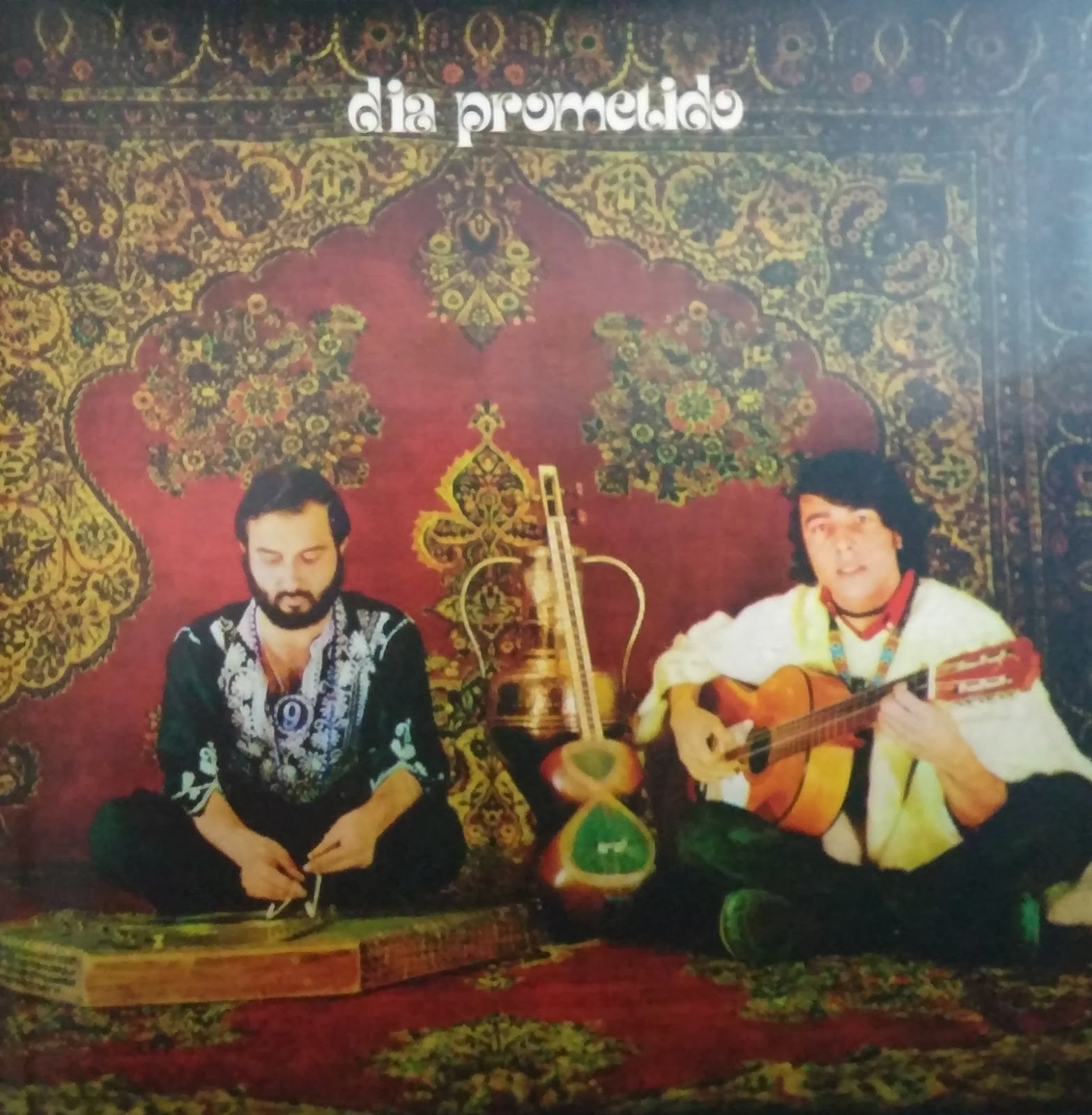
Dia Prometido "Dia Prometido" 1971**

I found this at the "psychedelic rock" session, although it's neither rock nor psychedelia. The mislabeling has caused me to be a little negative in my rating, I'm afraid. Based on the liner notes, I was expecting something akin to Orient Express or Kaleidoscope (US). Instead what you get here is similar to the Lord Sitar album from the 60's: easy listening and pop hits performed with traditional instruments. That album (to be presented, sometime) is usually dismissed as psych-sploitation riding the wagon of the Beatles' infatuation with the sitar and India in general. Here the sitar is replaced by what the liner notes identify as a psalter and which Greeks and Asians will recognize as santur(i). It is indeed descended from an ancient Greek instrument sometimes called psaltery or canon - whence the modern Greek name for one of its variations, canonaki. Various versions of the instrument are also to be found in Turkish, Arabian, Persian and Indian traditional music. Western variations include the zither, dulcimer and autoharp and were popular with British acid-folk groups of the time. These are nevertheless strummed with the hand and sound quite different from the santur, whose strings are struck with a couple of wooden mini-hammers. For all purposes, this is probably the first use of santur outside Middle Eastern or Greek folk music. The player is an Iranian with the very un-Persian name of Guillermo Polo. He is joined by a Chilean guitarist and Spanish rhythm section while the album was recorded in Spain and simultaneously released in Spain and Iran. It's one of very few Iranian pop albums I'm aware of, although neither "pop" nor "Iranian" is an accurate description. It starts off with Mozart's "Symphony No 40 In G Minor" and immediately achieves its goal, if that goal is to convince you of the instrument's expressive capabilities outside oriental forms. "The Windmills Of Your Mind" benefits from a sprightly jazz arrangement including organ and flute, but "One Note Samba" isn't quite the harmonious marriage of East & West its makers doubtlessly envisioned. Beatles songs like "Something" and "And I Love Her" sound a bit like elevator music, a feeling I often get when pop/rock hits are given the instrumental treatment (Did I mention that the album is completely instrumental?). Soundtrack themes like "A Time For Us", "Love Story" or "The Umbrellas Of Cherbourg" are much more natural in this setting. "Sounds Of Silence" is the one song where the record approaches psychedelia, thanks to some electric guitar and more pronounced bass and drums. I decided to give the album a 2* rating because it's marketed as psychedelic rock, which it isn't. Neither does it offer an introduction to Persian music and culture, as the compositions are all standards of Western music. As an Easy Listening collection, it has it merits: It's well played and the use of the santur is a novelty worth hearing. Too bad I'm not a fan of Lounge music... 
**** for Symphony No 40 In G Minor, The Windmills Of Your Mind, A Time For Us
*** for Concerto per Una Voce, Love Story, The Umbrellas Of Cherbourg, Sounds Of Silence
** for One Note Samba, Something, Airport Love Theme, And I Love Her, Yesterday When I Was Young

Friday, 31 July 2015

Candy Dulfer "Sax-A-Go-Go" 1993**

When I first came to the Netherlands, I had a conversation with a young lady who told me she played the saxophone. I surprised her by telling her that it's a rare instrument for a woman to play. She believed it to be a rather feminine instrument. I guess that's a testament to Candy Dulfer's success in her native land: that she familiarised everyone with the image of a beautiful young woman playing an instrument previously associated with older black guys, and made it look sexy. Not that black jazz musicians can't be sexy to some people, but for most of us Candy is an infinitely preferable sight. Her father Hans Dulfer is a renowned sax player who began teaching Candy the basics of the instrument at the age of 6. Her debut "Saxuality" in 1990 sold very well and was nominated for the Grammy award. Although still only 20 years old, she soon began performing and recording with giants of the music world such as Van Morrison, Pink Floyd and Prince. This follow up plays up her R&B/Hip Hop influences and is obviously aimed at the pop charts rather than the jazz connoisseurs. The slick production values and use of synths and drum machines may have served their purpose at the time but sound dated today. Candy's playing, on the other hand, is technically faultless - maybe a bit too safe and sometimes almost bland. But it is what it is -no Miles Davis cool genius or John Coltrane passion but a pop approach to jazz as background music to groove to at a club or chill out with a glass of wine. The funky dance numbers include "2 Funky" (obviously), "Sax-a-Go-Go" (featuring rapper Easy Mo Bee), "Bob's Jazz" (classy acid-jazz with nice organ/saxophone interplay) and the Funkadelic-like "Jamming" - all composed with the help of her producer, Ulco Bed. Two classic soul covers showed what she can do given classic material: Average White Band's "Pick Up the Pieces" and Eugene McDaniel's "Compared to What" (the only track with full vocals, a bad idea when you're competing against Roberta Flack's original version). "Mister Marvin" and "Man in the Desert" are two mid-tempo originals while "I Can't Make You Love Me" and "Sunday Afternoon" a couple of smooth ballads. Granted, it's all glossily produced, packaged and sugarcoated to sell to a pop and R&B (rather than jazz) audience, yet under all the gloss and glitter there still lies a jazz musician. And not a bad one, either...
**** for Bob's Jazz, Pick Up the Pieces
*** for 2 Funky, Sax-a-Go-Go, Bob's Jazz, I Can't Make You Love Me, Compared to What
** for Mister Marvin, Man in the Desert, Jamming, Compared to What, Sunday Afternoon

Saturday, 6 June 2015

Les Vice Barons "Steel Blue Moods"1997***

Right now I'm sitting in my small studio apartment in Brussels, listening to Les Vice Barons and drinking ice-cold strong Belgian beer (Delirium Tremens, since you ask - yes, the one with pink elephants on the bottle). The weather outside is very atypical of Brussels and can only be described with the Greek word κουφόβραση, which the always reliable (lol) google translate explains as: humid heat or sultriness. Somehow I think these words can also be applied to the music at hand. Les (or sometimes The) Vice Barons are fellow Bruxellois and are probably also steaming right now, a few blocks from here. The sixties esthetic, gun and femme fatale on the cover are indicative of the music within, instrumentals in thrall to the surf music of Davie Allan and 60's crime thrillers as scored by the likes of John Barry. The album is really good, if you like instrumental surf music. For me, a whole album of it is probably a bit too much. I certainly enjoyed the opener "Surfsploitation", a fast piece with tremolo guitar right out of the Pulp Fiction movie. In retrospect, half the album is variations on the same theme, but I think the first one is the best. "Like Weird" is a mid-tempo spy movie theme with the organ in the forefront while "Shaft In Matongue" combines funky wah wah guitar with surf music sax and guitars. Kudos for originality, boys! "Timebomb" is a classic instrumental and the band nails it. One of my favorite features of this band is their use of the keyboards. Here, like in most of the album, the organist plays the guitarist's sidekick (The Robin to his Batman) but he does a great job at it. "No Way To Behave" is the only vocal track, a country/soul ballad and "9.10" a fast instrumental with oriental and spacey effects."Big Head", "Fuel Injection", "Hangover Special" and "Unabomber" are likewise fast-paced surf instrumentals. Taken one at a time, they're enjoyable but all at once they become rather tiresome. "Werwolf" is a slow surf song and the album closes with John Barry's theme for classic TV series "The Persuaders".
**** for Surfsploitation, Timebomb
*** for Like Weird, Shaft In Matongue, 9.10, Big Head, Hangover Special, The Persuaders
** for No Way To Behave, Fuel Injection, Werwolf, Unabomber