Wednesday, 14 June 2023

Various Artists "Festival Of The South Seas" 1961***

OK, so that's an album I bought purely for the cover. Well, not completely true, I was also curious as to what I would listen, I mean I hadn't heard any music from Fiji or Tahiti before, but mostly for the cover. I have these frames I hang on my wall where I put vinyl covers on display, different ones every month, usually with a theme. So I thought I'd buy this cheap LP (it only cost me €2,5) and frame it alongside some other exotic themed cover e.g. Les Baxter. I was surprised to find it was a collectible item, mostly because it was among other worthless pseudo-world albums from the 60s e.g. anything from mambo to balalaikas. Usually these were supposed to make local traditions palatable to Western audiences rather than portray folk music as it is. But some of this stuff sounds quite authentic to my ears. Apparently this LP was recorded live "in The Town Hall" (not sure of which town, but somewhere in New Zealand) on June 6, 1961 at a concert sponsored by, among others, TAEL (Tasmanian Empire Airways Ltd). Different Polynesian nations are represented. None of the artists was familiar to me, but after some searching I found out that things aren't exactly as represented. Daphne Walker, for example, the one here who sounds most like a professional entertainer, was born and raised in New Zealand, but she's included as a representative of Hawaii. Her three entries ("Sophisticated Hula", "Little Brown Gal", "Ukulele Lady") are among my favorites, English-language 50's swing with a Hawaiian theme and great Hawaiian-style steel guitar. Possibly the guitarist is Bill Sevesi, the other "Hawaiian" act here, but in reality another New Zealander. A steel guitar virtuoso, he adds two great swing instrumentals "Tiger Shark" and "Twelfth Street Rag" - the latter's highlight is a Django-on-ukulele-style solo. As for the Samoan Surf Riders, they are Samoan (although some of them are of German descent), but, again, based in New Zealand. "Malie E" features mostly percussion and choral vocals, while "Minoi" has a country swing flavor - I suspect the guitarist is again Bill Sevesi. Eddie Lund And The Tahiti Nui Club, on the other hand, are real Tahitians. They play on 3 tracks: "Introduction/Orea Dance" and "Drums Of Tahiti" are percussion-dominated, while "Te Manu Pukarua" is a catchy little dance number. Last -but not least, as they say- country represented here is Fiji. The Pacific Teenagers' "Bulu Makau = The Bull Cow Song" is a charming song with female harmonies that sounds to me similar to Hawaiian hula music; very different from the Fujian group doing their "War Chant" with the accompaniment of some castanet or maracas-like percussions. On the whole, I'd say the more Polynesian-sounding tracks were more interesting/authentic sounding, but the Hawaiian ones (even though played by New Zealanders, they sound very similar to real Hawaiian music in my collection) sound more pleasant to my ears. Listening to this LP made me want to travel to Polynesia, which is literally half the world away, and the cost of travelling is prohibitive to me. But never say never... One thing's for sure: if I ever get there, I'll try to pick up some records by local artists, and share my impressions with you. Also: I'm enclosing a spotify link here for those who want to listen to the album, but be aware that the tracklist on spotify is wrong: if you want to know who performs each song, you should read the title of the one directly above it. 

*** for Sophisticated Hula (Daphne Walker), Tiger Shark (Bill Sevesi), Little Brown Gal (Daphne Walker), Bulu Makau=The Bull Cow Song (Pacific Teenagers), Minoi (Samoan Surf Riders), Kaahi (Daphne Walker), Twelfth Street Rag (Bill Sevesi), Te Manu Pukarua (The Tahiti Nui Club), Ukulele Lady (Daphne Walker)

** for Introducing Eddie Lund and Otea Dance, Dance Song (The Tahiti Nui Club), Malie E (Samoan Surf Riders), Drums Of Tahiti (Eddie Lund And The Tahiti Nui Club), War Chant (Fijian choir)

Thursday, 8 June 2023

Roger Waters "Radio K.A.O.S." 1987***

As I read in last week's Guardian, "Police in Germany have launched a criminal investigation into the Pink Floyd co-founder Roger Waters over a Nazi-style uniform he wore at a recent concert in Berlin. According to a police spokesman “An investigation has been opened over the costume displayed at the concerts on 17 and 18 May... The context of the clothing worn is deemed capable of approving, glorifying or justifying the violent and arbitrary rule of the Nazi regime in a manner that violates the dignity of the victims and thereby disrupts public peace”. Berlin police will continue to gather evidence and then hand over their findings to the state prosecutor, who will assess whether Waters’s act can be considered as incitement to hatred". Now doesn't that sound like a bad joke? Waters' work is deeply humanist, pacifist and anti-fascist in nature; could the German police really believe that Waters was actually "glorifying" the Nazis (who, incidentally, his father died fighting against)? Are they really unaware of Pink Floyd's The Wall album and movie? After all, the same work was presented with lots of fanfare and high profile guests in what was formerly no man's land between East and West Germany, only a few months after the fall of the Berlin Wall. In every performance, during the song "In The Flesh", he impersonates onstage (as actor Bob Geldof did in the film) a demented and hateful character, don't they know that? Of course they do! It's just that Waters has always been very vocal in his support for the Palestinian cause, openly condemning the state of Israel for human rights violations and for the occupation of Palestinian lands. So they apply political pressure on other governments to try and shut him up! How very not fascist of them!
Coincidentally, this is the same week I bought a vinyl copy of Waters' 1987 Radio K.A.O.S. LP. It's not a work that's aged well, I must say. Like most of his work, solo or with Pink Floyd, it's a concept album. I'm now going to to do something lazy and paraphrase wikipedia to give you a synopsis of the story: Our hero Billy is a paraplegic youngster with severe motoric and speech disabilities, but his brain is somehow able to receive and manipulate radio waves. His twin brother Benny is a miner who lost his job due to the "market forces". One night, drunken Benny inadvertently kills a passerby by dropping a concrete block from a bridge. He is taken to prison, while Billy is sent to live with his uncle David in California. Using a cordless phone and his radio wave manipulation abilities, Billy learns to access computers and speech synthesisers, and starts having conversations with a DJ on L.A.'s Radio K.A.O.S. Exasperated by the political and social world situation, he eventually hacks into a military satellite, simulating a worldwide nuclear attack while deactivating the military's power to retaliate. The album concludes with a song about how, faced with imminent death, people realize that the struggle for more money and power has led the world astray, and start to give attention to the things that really matter, like their friends, family, and solidarity to fellow humans. The story nowadays is supposedly rather outdated - and I say supposedly, because neither the poverty caused by neoliberal politics nor the nuclear threat is as distant as we would like it to be - certainly not with the NATO vs. Russia hostilities materializing into an actual war in Ukraine. Specific references, such as jabs at Reagan and Thatcher, are nevertheless too grounded in the 80's, and the story is needlessly convoluted. Musical production is likeways very old-fashioned, and clean to the point of sterility in a way that only 80's productions can be. Overproduced too, but that I don't mind, because which Floyd album isn't? The songs are full of female backing vocals, synthesizers, and saxophone solos (by Mel Collins, formerly of King Crimson/Camel). I'm often reminded of Robert Palmer, sans the soul vocals. There's also some very good guitar by Andy Fairweather-Low, albeit discreetly low in the mix. Most of the songs are 4 or 5 minutes long, with the whole thing sounding more like contemporary (for the 80's) pop rock than like Floyd's prog rock heyday. The unity of the project is achieved by the interspersed effects (such as Morse-code) and radio snippets, mostly by Radio K.A.O.S.'s fictional DJ. Upbeat opener "Radio Waves" is the lead single, commercial AOR with a nice guitar solo. Mid-tempo follower "Who Needs Information" is better, sounding somewhat like mid 80's David Bowie. "Me Or Him" is slower and quieter, the use of flute instead of the more bombastic synths giving it an understated feel. "The Powers That Be" reminds me of Floyd's "Dogs"; there's a sense of menace in the guitar riff and urgency and "you better run" chorus, but that's disarmed by the pleasant synths and upbeat horns. Likewise, side 2 opener "Sunset Strip" is as bright as befits a song about L.A.; never mind that the protagonist feels out of place and nostalgic for his UK home. "Home" and "Four Minutes" propel the story forward. As compositions, they are rather generic 80's pop rock whose saving grace is guest vocalist Clare Torry. Sure you know who she is; even if the name may not sound familiar there's no way you don't remember the wordless wailing in "Great Gig In The Sky" on Dark Side Of The Moon. Well, that was Clare! The album closes with a hopeful note on "The Tide Is Turning". It's a melodic ballad with the surprising addition of a male choir. Nice of Waters to add a bit of light to his usually bleak world vision. Now, I'm old enough to remember when this album got out in '87 and how everyone pitted it against his former bandmates' A Momentary Lapse Of Reason to decide who is the true heir to the Pink Floyd legacy. In most aspects, Radio K.A.O.S. seems to take up where Floyd left off with The Final Cut, which in turn was a (weaker) retread of The Wall. Which means there's a direct line linking it to one of Floyd's greatest artistic achievements. But, while Waters' hired band are impeccable professionals, there's something missing: Gilmour's distinctive guitar and vocal, Wright's keyboard magic, and whatever Mason does on drums - sorry Nick, I can't tell the difference between you and any other drummer, but the fault is all mine. On the other hand, A Momentary Lapse Of Reason (to be presented some other time) may lack a unifying theme, but sounds more like classic Floyd by virtue of the musicians involved. The production, incidentally, lets both albums down, being very sterile and rooted in the 80's. I personally think that they're equally good (or bad, as some would have it), and that each represents different aspects of Pink Floyd. The audience voted for Gilmour's version; possibly because it had more radio/MTV exposure, or because of the impressive spectacle of the gigantic stadium tours, or simply because he won the court case and got to keep the band name. Listening to Radio K.A.O.S. now, and production notwithstanding, it obviously doesn't deserve the bad rap it gets by critics and fans. P.S. It just dawned on me that many of you may not realize what the album cover is depicting: it is supposed to be an 80's computer screen; don't you go on thinking of a flat screen either, these were heavy cubic monitors usually displaying a black background with monochromatic green letters/characters. In this case, the green dots and dashes are nothing more than the album's tracklist rendered in Morse code - or so I'm told; next thing you know they might accuse Waters of adorning his record covers with coded anti-semitic propaganda, and no-one but a few ancient sailors/radio operators could tell the difference! 
**** for Who Needs Information,The Tide Is Turning [After Live Aid]  
*** for Radio Waves, Me Or Him, The Powers That Be, Sunset Strip, Home, Four Minutes

Thursday, 1 June 2023

Skafish "Skafish" 1980***

The first time I came across Skafish it was with their live contribution on soundtrack LP URGH! A Music War The Album, which I reviewed for this blog 8 years ago (wow, time flies when you're having fun - and even when you're not!). This is what I wrote about them back then: "Sign of the Cross*** The only band I hadn't heard before. Based on their name I would have guessed they played ska music, but they surprised me with their hardcore punk, almost metal, attack and anti-religious lyrics. They obviously weren't trying to make any friends. Gotta respect them for that!". When I recently found a whole album by them in the bargain bin, I decided to delve further into this band. What did I learn? First off they have indeed no connection to ska music: the band's frontman/singer/songwriter is called Jim Skafish, hence the name. They come from Chicago, and their 1976 stage debut is considered to be the Windy City's introduction to punk. This album, though, is hardly recognizable as punk. If you want to know how they sound, you have to imagine an equal mix of Frank Zappa, The Ramones, Devo, and The Rocky Horror Picture Show. Jim himself was a real character: tall and weird looking, if not outright ugly, often wearing old ladies' clothes, he impersonated all those outcasts he was singing about. This LP doesn't contain "Sign of the Cross"; it starts off with a spoken "introduction" by backing vocalist Barbie Goodrich in the guise of a former cheerleader wasting her life waiting for Mr. Right. "Joan Fan Club" is another high school story, a realistic depiction of the hellish daily life of a girl constantly picked on by bullies. The theatrical, darkly comic, delivery and fast tempo reminds me of certain tracks by the Dead Kennedys. Next up, there's a surprisingly moving ballad called "Maybe One Time". New wavey "Obsessions Of You" features a "big" chorus and multitracked vocals reminiscent of a musical revue number. "We’ll See A Psychiatrist" is a noisy piece with heavy guitar, "Romantic Lessons" an old timey 60's pop ballad, and "Guardian Angel" a semi-ironic Doo Wop pastiche similar to certain Frank Zappa songs. "No Liberation Here" is a heavy grunge-rocker, while the noisy closer "Take It Out On You", Buzzcocks-like "Work Song" and -especially- album highlight "Disgracing The Family Name" are the probably the only numbers that justify the punk rock label; the latter also reminds me of Danny Elfman's contemporary band, Oingo Boingo. This is, in my opinion, a great -albeit very unconventional- album: you have, above all, the theatrical aspect, punky rage, and dark comedy, vocals ranging from operatic to angry rants, you get some nice melodies and catchy choruses punctuated by moments of cacophony exacerbated by heavy guitar and Jerry-Lee-like clanging piano in the least appropriate moments. Now that I think of it, maybe "great" isn't the right word. But "interesting" and "original", most definitely are. According to discogs, the album was recently reissued on CD and LP, though original vinyl copies may be easier to come by.
**** for Joan Fan Club, Maybe One Time, Obsessions Of You, No Liberation Here, Disgracing The Family Name
*** for Romantic Lessons, Work Song, Guardian Angel, Take It Out On You
** for Introduction, We’ll See A Psychiatrist 

Wednesday, 24 May 2023

Jean-Luc Ponty "Upon the Wings of Music" 1975***

It's unusual for me to present two violin-based jazz rock fusion LPs in succession - it's not like I have a lot of those in my collection - but here it is: French violinist Jean-Luc Ponty's 1975 solo LP Upon the Wings of Music (UTWOM) was the first of an exceptionally successful string of albums for the Atlantic label; at the time he was mostly known as a member of Mahavishnu Orchestra and as a star collaborator, both for experimental combo's like Frank Zappa's Mothers of Invention and pop stars like Elton John. I must admit I'm not usually a fan of instrumental music, but I find UTWOM to be very listenable thanks to the great musicianship involved: Ponty, of course, on classical and electric violin as well as synthesizers, but the rest of the band too - especially keyboardist Patrice Rushen and drummer Ndugu. As is often the case with jazz, compositions (all Ponty originals) are of secondary importance compared to performance, but anyway the ones that stand out for me are crammed on Side 1: it opens with the title track, featuring insistent drumming and funky bass. The synthesizers are quite upfront here, and there are some lovely keyboard arpeggios, but it's the violin solos that steal the show here. Follower "Question With No Answer" is a more mellow composition, as is "Now I Know". If the first track is closer to electronic music, second one to classical, and the third closer to the blues, to me the highlight is track number 4, the one closer to prog rock. "Polyfolk Dance" has by far the most memorable riffs as well as some tasty electric guitar and insanely fast violin passages. Side 2 is quite listenable, but - with the exception of closer "Fight For Life" - it offers less thrills. "Echoes Of The Future" is an interesting experiment: consisting solely of multiple violin overdubs, you'd expect it to sound like an orchestra but often you think you're hearing a percussive instrument or synthesizer. Generally the violin may be the dominant instrument in this album, but lovers of classical or folk strings won't find much to like here, as it's often distorted and laden with electronic effects. If, on the other hand, you're into jazz, funk, fusion, prog, and early electronic music, (or -ideally- a combination thereof), this LP should be right up your alley.
**** for Upon The Wings Of Music, Question With No Answer, Polyfolk Dance, Fight For Life 

*** for Now I Know, Waving Memories, Bowing Bowing

** for Echoes Of The Future

Tuesday, 16 May 2023

Wolf "Darryl Way's Wolf" 1973(rec) 1974(comp)****

This is one of those albums I buy on a whim: I had never heard of Wolf before - I mean, of course, the band, not the animal species that fairy tales scare children with. But the album cover caught my eye; also, I took the name of Darryl Way on the cover as a good sign. If it doesn't ring your bell, let me give you a hint: Curved Air, a prog/folk group that produced some great LPs -and even a couple of hits- in the 70s. Classicaly-trained violinist Darryl was the co-founder and prominent instrumentalist of that band until their first split due to "musical differences" in '73. Way immediately formed a new band called Wolf, recording with them 3 albums. This compilation contains selections from the first two, Canis Lupus and Saturation Point (both 1973). Canis Lupus (the scientific name for the common wolf) was the earliest of the two, represented here by 3 tracks."Cadenza", which closes side 1, is a dynamic instrumental featuring spacey moog and classical violin, as well as lengthy guitar and drums solos. "Go Down" opens side 2, and it's a gentle ballad with expressive vocals and classical guitar. The album closes with "McDonald's Lament", a beautiful piece with lyrical violin. The whole vibe is reminiscent of Italian prog, as well as the British Canterbury scene - not coincidentally, bassist/singer Dek Messecar later played in Caravan, while guitarist John Etheridge joined Soft Machine. Last but not least, Ian Mosley had a long and successful career drumming for Marillion. All very accomplished musicians, they are given even more room to shine on the follow-up Saturation Point, which goes further into a jazz rock fusion direction. Album opener "The Ache" is a dynamic instrumental propelled by great drumming and featuring an abundance of fiery violin and guitar solos. "Two Sisters" follows a harder path with hard rocking guitar/violin interplay that reminded me of the guitar/organ dueling between Blackmore and Jon Lord in Deep Purple. "Saturation Point" is more laid back and jazzy, with Mahavishnu-like guitar solos. Lastly, "Toy Symphony" is yet another instrumental with symphonic and jazz elements. Darryl's violin is here also very much in the foreground. All in all, this comp is easily worth 4*, provided -and that is a big must- you care for prog and jazz fusion. Otherwise, you'd be better served listening to Curved Air, where Darryl Way's virtuosity is contained within more conventional song structures, and where the wonderful vocals by Sonja Kristina often steal the show from the instrumentalists.

**** for Two Sisters, Candenza, Go DownSaturation PointMcDonald's Lament

*** for The Ache, Toy Symphony

Wednesday, 10 May 2023

Record Shops of Milan, Venice and Verona.

Usually when I give my report on the record stores of a city I've visited, I dwell a bit on the sites, give some pointers on places to visit, dishes to try, etc. Venice will be an exception. You're probably overly familiar with it from popular culture, yet nothing can prepare you for the actual Venice experience. Even though the streets are teeming with hordes of tourists and every other building serves touristic purposes, and even though the true Venetians have left the old town and the people working the shops are from China, Pakistan, or Egypt - the magic is still there. As far as I know, there are some record shops on the mainland but only one in Venice proper. This is called Living In The Past (Sestiere Dorsoduro, 3474). At first glance, it may look like any old thrift store, but it has a well curated collection of used vinyl - mostly original 60's-70's editions. There are a couple of boxes of rare/expensive LP's, the rest (rock, jazz, Italian, some new wave) cost €15-50. Also some CD's and books, mostly in Italian. The shop owner is quite helpful and looks himself like a vintage 70's rocker.

In fair Verona, where we lay our second scene, I only found one record shop, Dischi Volanti. It's on a nice pedestrian street (Via Fama 7) and it's quite big with a lot of variety (rock, alternative, prog, classical etc). About 1/3 of the shop is dedicated to vinyl (€30+) and the rest to CDs (€15+). This was my first visit to a record store together with my young nieces, and I'm happy to say they absolutely loved it. They were happy to discover the albums by their favorite groups which they only know from streaming services, and took photos of album covers they found impressive. Thankfully we weren't reprimanded for their enthusiasm, so their first visit to a record store remains a good experience. Other than this, I visited the local Feltrinelli bookstore - this is a chain you can find in almost every Italian city. They always have some mainstream CD's and vinyl for sale, though there's few discoveries to be made. 


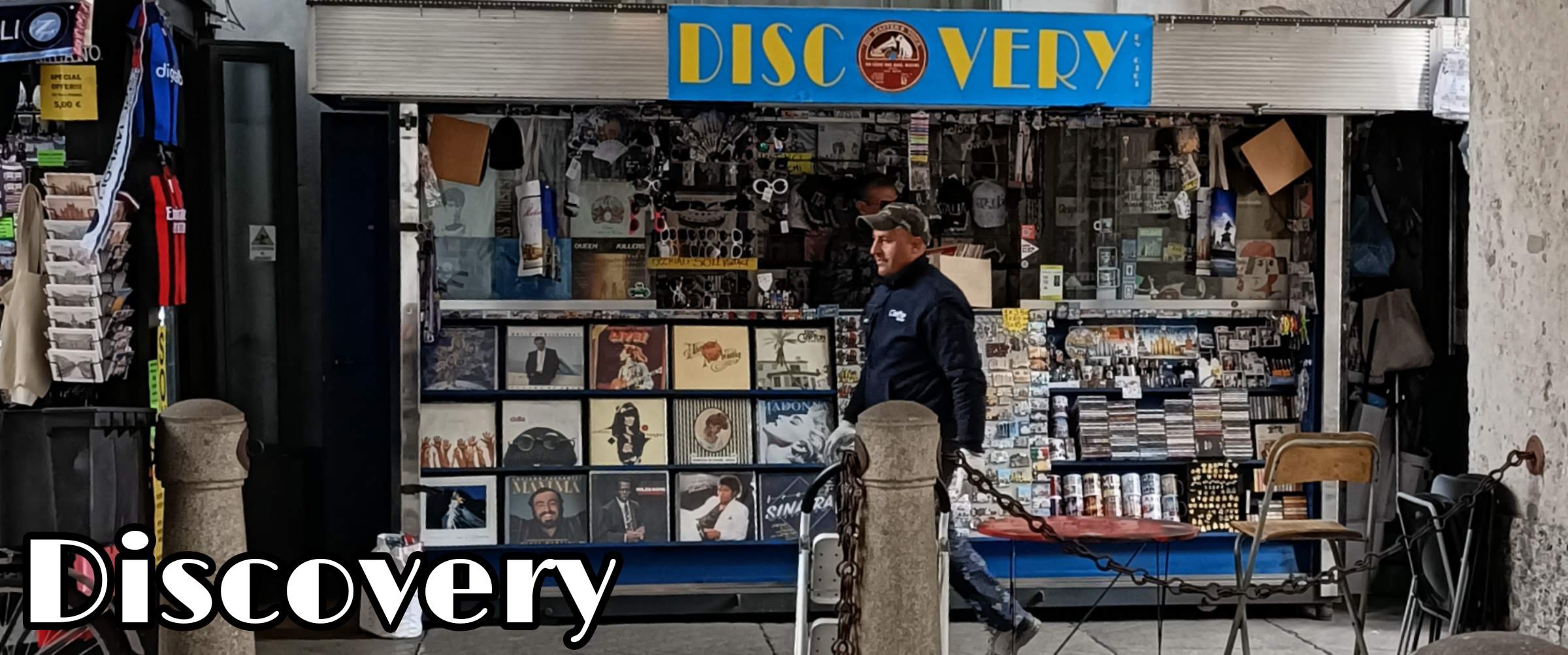
Our third stop in this trip was Milan. As one would expect from the second biggest city in Italy, Milan offers more choices for shopping. Of course, one can find big stores by Gucci, Prada, Louis Vuitton etc. at the Galleria Vittorio Emanuele II but if you're looking for records that's the wrong place. Well, not quite. There's a Feltrinelli, which I didn't visit but should carry the usual stuff. Also on the Piazza del Duomo, near the Cathedral, there's a huge Mondadori bookshop that also sells vinyl (new releases and classic album reissues, €25-40) and CD's (€10-15). Very close (at Passaggio Santa Margherita) you can find Discovery by Gigi, a rather singular kind of record shop which is actually a souvenir street kiosk that also sells random used LPs (overpriced at €25-30) and CDs (€5). Moving on to the real record stores, one would have to start with probably the most famous, Serendeepity (Corso di Porta Ticinese 100) This is quite a large shop, with an emphasis on dance music (electronic/disco/reggae/world) as well as some rock classics (LPs €30+, some offers on 50% discount). The shop also sells other stuff, including music books and fashion items. A few meters upstreet you can find a tiny shop called Green Tunnel. It only packs a few dozen records (electronic, disco etc) and dance culture-related T-shirts and trinkets. At the north of the city (Via Gustavo Fara 4) there's Massive Music Store. Not as massive as one would like, but with a decent enough collection of 2nd hand rock/metal/jazz/Italian LPs (€20-30) and new vinyl (€25-50). Also CDs (€10-20) and 7' singles. I also visited Rosetti Records (Via Cesare da Sesto 24). Not too big, but with a decent variety of LPs (used €5-15, new €25+), CDs, books and DVDs. Rock, Indie, Italian, etc. 

Which brings us to a region you really must visit when in Milan: Naviglio Grande is a long canal whose both banks are lined with cute shops and aperitivo bars. After I checked out the record shops here, I returned with friends and we had dinner at a "bar with kitchen". Living in The Netherlands, one expects that to mean nachos or burgers. Instead, we were served large portions of ossobuco with risotto alla milanese and Cotoletta alla milanese - the latter is rather too similar to a Viennese schnitzel, but the Lombards insist they invented it first. Anyway, there are two record stores here, one on each side of the canal. Il Discomane (Alzaia Naviglio Grande 38) is the larger, and apparently the most historic one, as it's been catering to music lovers at the same address since 1978. Can't say I love the way the records are arranged, but it has a respectable collection: classic rock, folk, jazz, indie, punk etc. Used vinyl costs mostly €8-15, new €30+. There are also cassettes, books, DVD's, and 7' singles, as well as crates of rare/collectible vinyl, starting from €35+. CD's are rather cheap, a lot of them are on offer for €2,5-5, the rest go for €10-15. Cross the bridge to the other bank, and you'll find Dischivolanti (Ripa di Porta Ticinese 47). Almost the same name with the Verona store mentioned earlier, no apparent relation. Lots of good records here (rock/prog/metal/indie etc.), prices vary between €15-30(used LP's), €25+ (new LP's) and €7-8 (CDs). From there, it's a 15-minute walk to Psycho Records (Via Zamenhof 2). Classic Rock, psychedelia, jazz, punk etc. New LP's for €25+, used ones €10-30. Also CD's, mostly €5-10. 
A shop I visited but didn't spend any time in was La Bottega Discantica (Via Nirone 5). You see, this shop deals exclusively in classical music. I like to listen to it sometimes, but it's a vast field I know very little about. Lastly, there's another record store I didn't catch open. For some unknown reason, it opened later, specifically on the day I visited. Backflip Records (Via Salasco 17) is run by a well-known Italian female DJ, and aims to provide a full overview of Black Music a.k.a. "the totality of music created through the black experience, regardless of the category". Supposedly she's very knowledgeable on the subject, and the shop carries some lesser-known gems in this kind of music. Judging from what I saw in this trip, the record shops in Milan can be nice enough to browse; one is bound to find some interesting items, but no real bargains - except possibly in Italo Disco which I'm not familiar with myself, but may be of interest to DJ's.

Monday, 1 May 2023

Metallica "Master of Puppets" 1986*****

I recently (27 April) caught Metallica live in Amsterdam, the opening show of their new M72 Tour. The novelty of the tour is that it consists of "No Repeat Weekend" shows, two in every city, with no setlist duplications, allowing thus the band to dig deeper into their catalogue and present the fans with some less obvious choices. The show didn't get off on a good start: support band The Architects had awful sound, and the introduction of a big round Hot Wheels race track in lieu of a stage wasn't very convincing. Neither did I find their entrance very amusing: First you have to sit through a 5-minute slideshow of photos while the speakers play AC/DC's "It's A Long Way To The Top", then there's another long introduction; an Ennio Morricone instrumental while a scene of The Good The Bad And The Ugly is playing on the screens. Instead of building up tension, they have you going "C'mon already! this is getting boring!" But the show itself was good: a setlist featuring many old favorites (plus 3 tracks from their newest opus), played with confidence and undiminished power. Plus, Hetfield's stage banter has considerably improved since the last time I saw Metallica. Admittedly, that was in 1999 (in another century, really) but I remember being amused and bemused at the time by the fact that he couldn't say a complete sentence without using the "F" word... a couple of times, at least. Having listened to so much Metallica lately (before, after, and -above all- during the abovementioned concert), I naturally chose one of their CDs to present this week. And what better choice than Master Of Puppets? Not only it's an album that unites old and new fans in appreciation (there was a big schism among them circa The Black Album) but the inclusion of the title track in an iconic scene from the Strange Things Netflix series has won the band a brand new generation of fans. No surprise it was the set closer of their first show of the new tour, you can't go out on a higher note! 

Album opener "Battery" starts off deceptively with some soft acoustic guitar, before transforming to typical early Metallica thrash: powerful riffs, growling vocals, savage drums, and shredding guitar. For encyclopedic reasons, let me remind you that Thrash Metal is supposed to be an amalgam of Hardcore Punk (e.g. Discharge, Black Flag) and New Wave of Heavy Metal (e.g. Iron Maiden, Diamond Head). The progenitors of that style are usually collectively called The Big 4: Metallica, Slayer, Megadeth, and Anthrax - yet, with every step they took, Metallica moved away from the genre they helped create. The tempos started getting slower (this is of course very relative, as thrash metal is known primarily for its breakneck speed), compositions more complex, and a sense of melody started emerging from beneath the racket. Instrumental "Orion" is an indication of the band's ambitions: bookended by brutal thrash riffs, this 8,5 minute epic also leaves space in the middle for expressive guitar solos and playful, surprisingly understated, basswork - MoP was destined to be bassist Cliff Burton's swan song: he died soon after in a tour bus accident, aged only 24. "Orion" is also one of 3 tracks in this album that go beyond 8 minutes. The other two are "Disposable Heroes" (because of its speed and anti-military subject matter, and despite its long duration, I think of this as the "punk" song of the album) and "Master of Puppets" itself. What can I say about a classic like that? From the powerful intro, sinister lead vocal and anthemic chorus of "Master! Master!", to its lyrical middle break and strong message about the danger of addictions... this is one of the songs that define the whole genre of Heavy Metal. "Leper Messiah" (a denunciation of ultra-right tele-evangelists) is a slightly less successful dish made with the same recipe, while "Welcome Home (Sanitarium)" is a semi-ballad with an emotive lead vocal that proved that Metallica were adept at more than just thrashing away. "The Thing That Should Not Be" is, for me, the low point of the album: its sub-Sabbathic riffs are too slow, and it's generally not interesting enough as a composition. The album closes with "Damage Inc." a violent sonic attack probably aiming to reassure their underground audience that Metallica may have diversified into more commercial directions, but remain as uncompromising as ever - a balancing act they excel in, even now.

***** for Master of Puppets, Disposable Heroes, Welcome Home (Sanitarium), Orion

**** for Battery, Leper Messiah, Damage Inc. 

*** for The Thing That Should Not Be